You opened a tab to read later. Then another. Then you bookmarked a few, told yourself you'd sort them into folders eventually, and now you have a graveyard of links you can't quite remember and don't trust yourself to find again. Sound familiar? The problem isn't that you save too much — it's that bookmarks give you no context for what you saved or why.
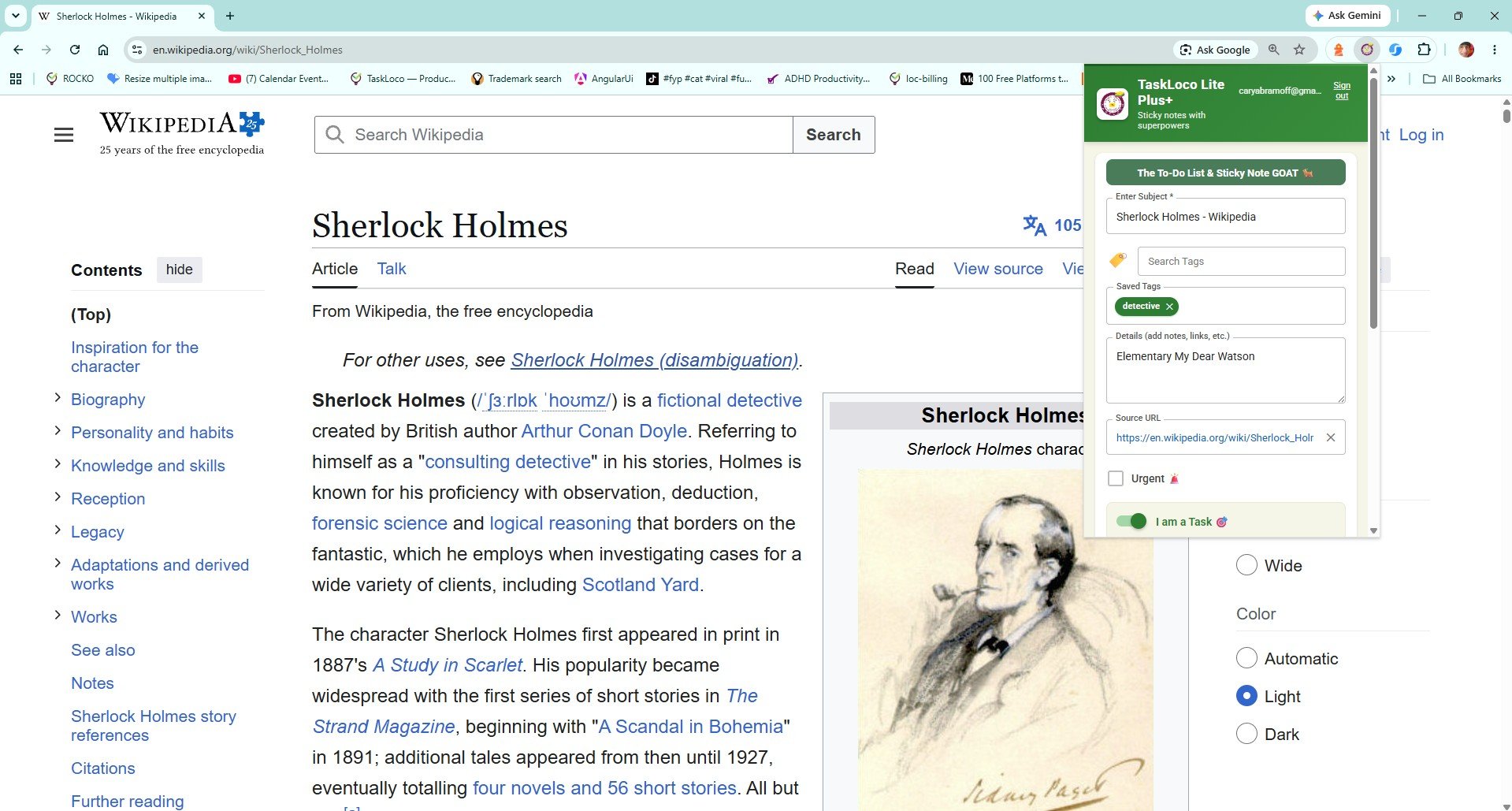
There's a better mechanic: save the page as a visual sticky note the moment you find it, with the title and URL already filled in, sitting on a board you can actually scan. The Sticky Note Web Clipper is a free Chrome extension that does exactly that — one click on the toolbar icon and the page is captured. No folders to name, no copy-pasting, no tab hoarding. This article walks through why bookmarks fall short, what to look for in a real link-saving tool, and why the clipper beats the folder every time.
What to Look for in a Link-Saving Tool
Before picking any tool, it helps to understand what the job actually is. Saving a link is not the goal — being able to use that link later is the goal. Most people reach for bookmarks by default because they're built into the browser, but built-in doesn't mean best-fit. Here are the three criteria that actually matter:
- Capture speed. If saving something takes more than two seconds, you will skip it. The friction of naming a folder, choosing a location, or pasting a URL is enough to make you leave the tab open instead — which is just procrastination with extra steps. A good saving tool should require a single action.
- Retrieval clarity. A link you can't find is a link you didn't save. The saved item needs enough visual or textual context that you recognize it on sight — not just a raw URL in a list. Title, source, maybe a thumbnail or a color tag: anything that lets you scan rather than read every entry.
- Cross-device access. You find things on your laptop. You read them on your phone. If the two don't sync, you're emailing yourself links like it's still the early internet. Whatever tool you use should make saved items available wherever you actually have time to act on them.
These criteria apply whether you're evaluating a browser's native bookmarks, a dedicated web clipper, or any other approach. Keep them in mind as we look at how the options actually stack up.
Why Bookmark Folders Break Down in Real Use
Bookmark folders look like a system. They have hierarchy, names, and structure — which is exactly why people trust them and exactly why they fail. The problem is that the work of maintaining a folder system grows faster than the value it returns.
When you bookmark a page, you make a split-second decision about which folder it belongs in. Is this article about productivity, writing, or tools? You guess, you click, and you move on. A month later, you remember the article but not the folder — so you search, find three folders it might be in, and eventually give up. The content wasn't lost; the context was. Bookmarks store addresses, not meaning.
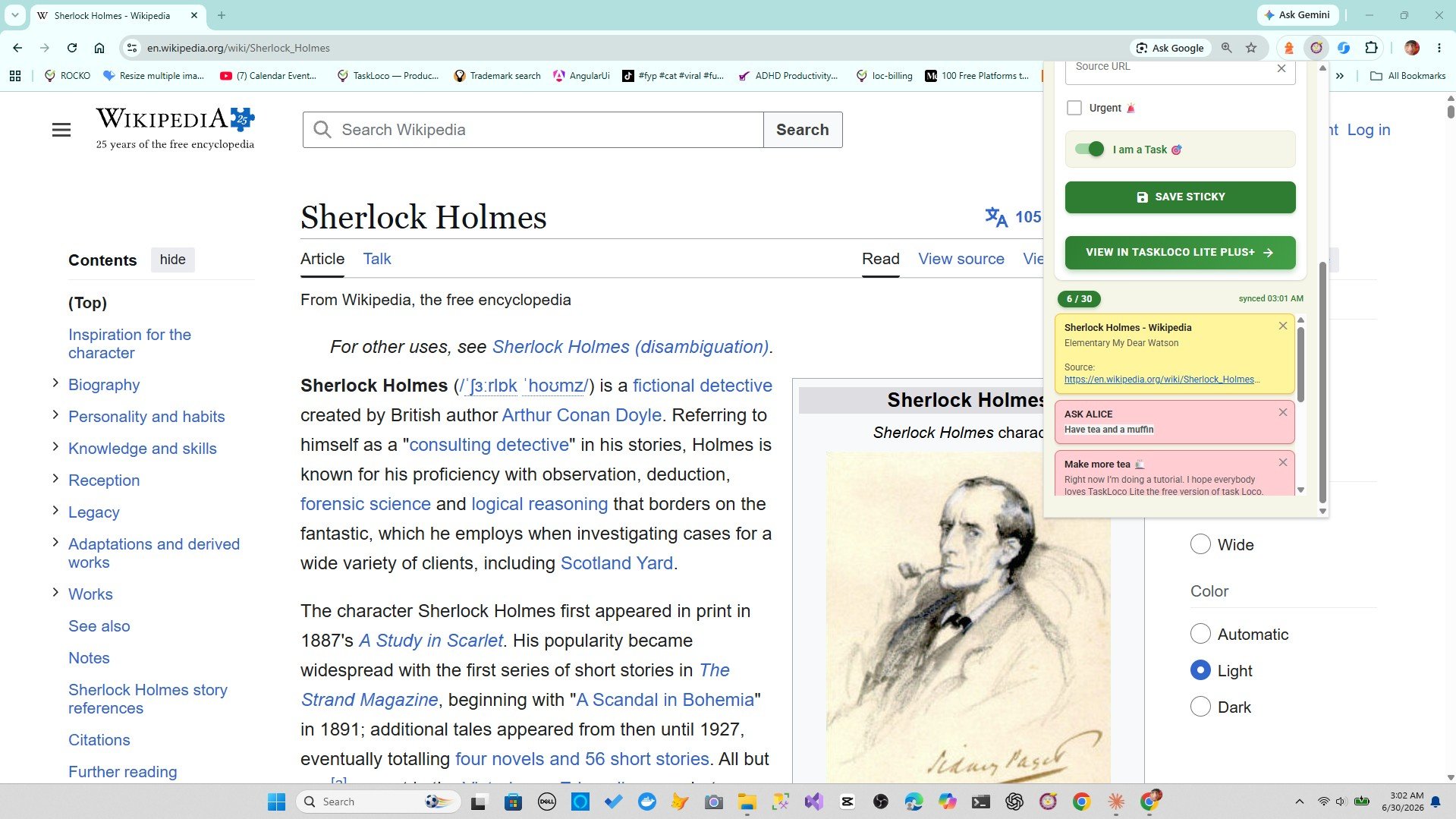
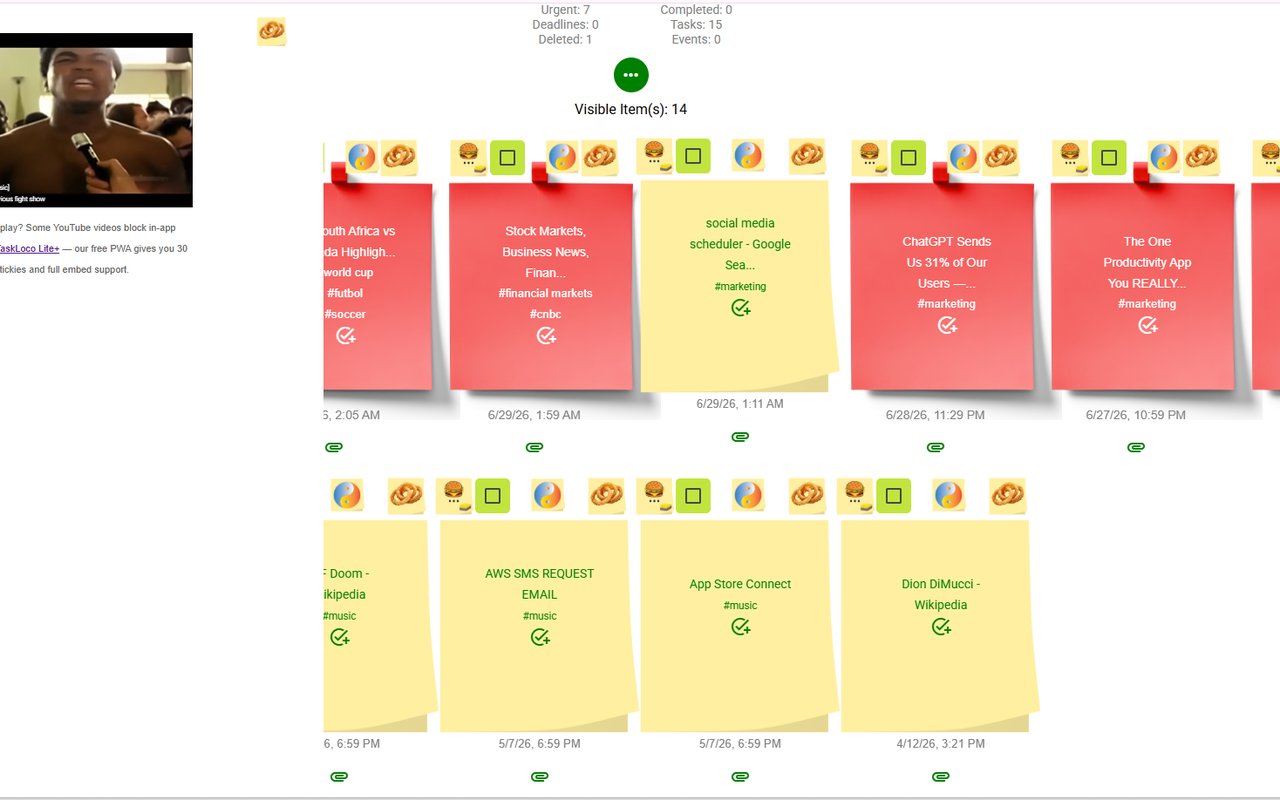
There's also the visual problem. A bookmark list is just text. Fifty links look the same at a glance. There's no way to scan for the article you half-remember without reading every title. Compare that to a wall of color-coded sticky notes where shape, color, and position all carry information — you can find what you're looking for the way you find a sticky note on your monitor, not the way you ctrl-F through a text file.
Neither bookmarks nor open tabs were designed as a read-it-later or research system. They were designed as navigation shortcuts. When people use them as a capture system, the mismatch shows.
How the Sticky Note Web Clipper Works
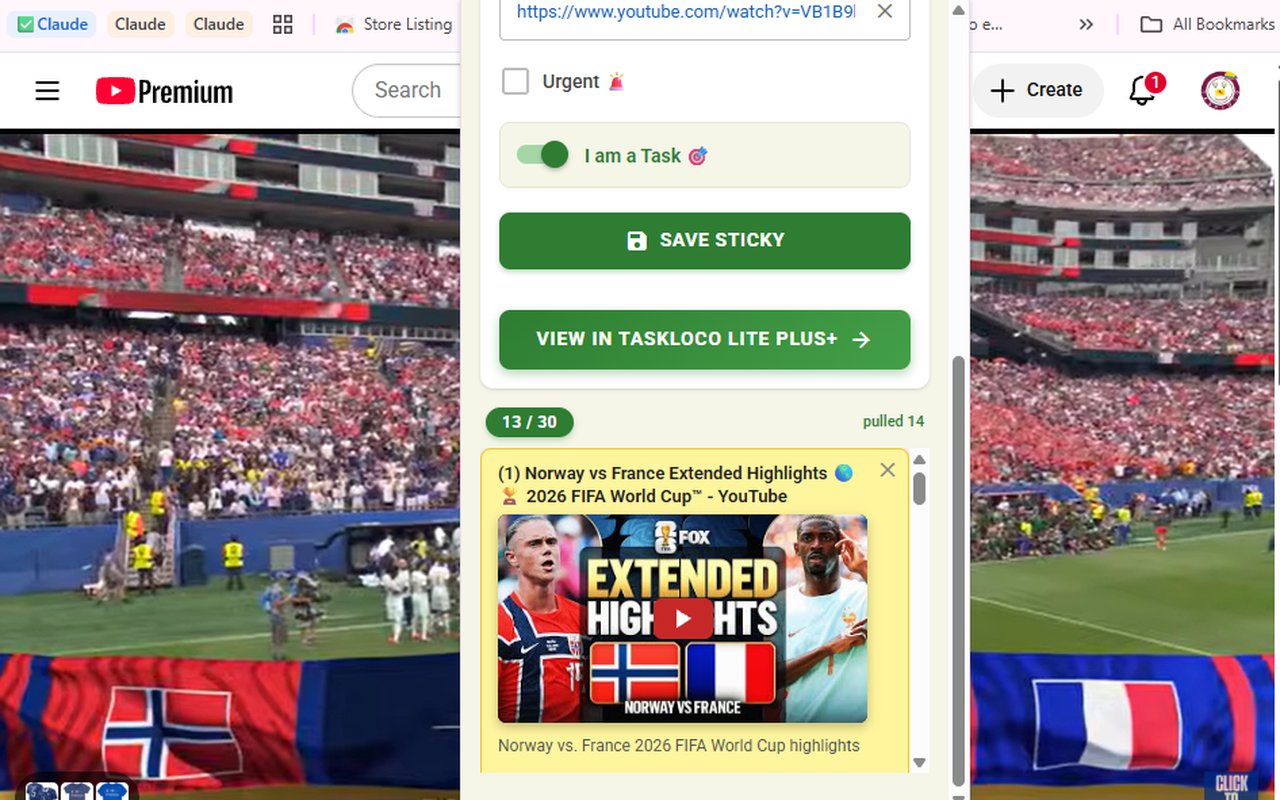
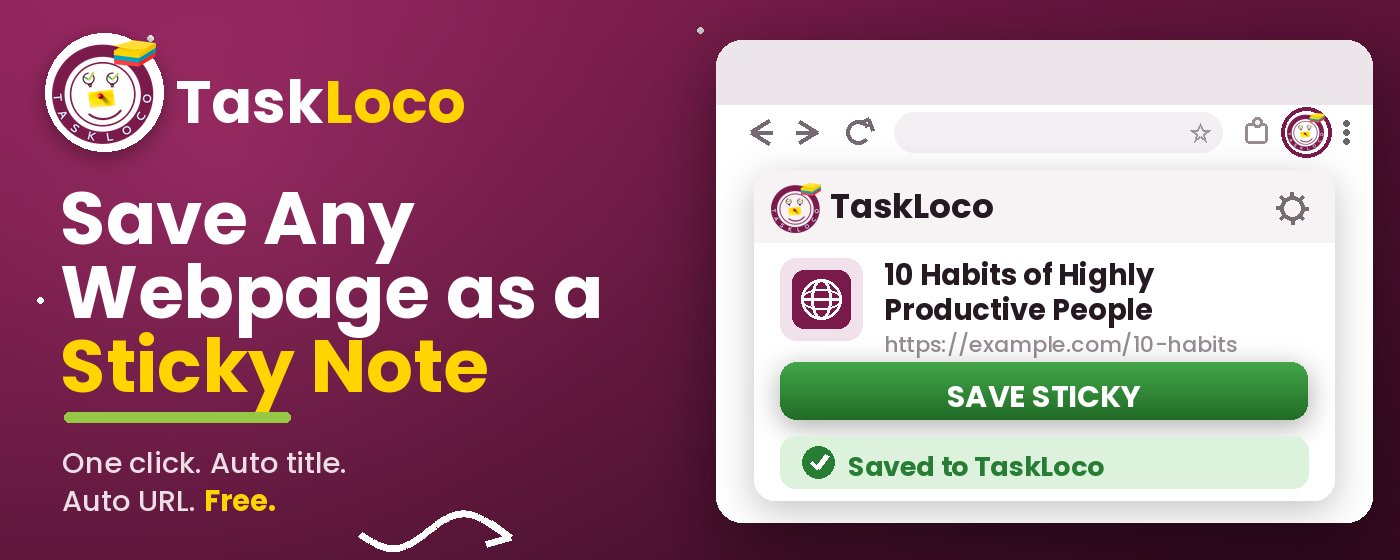
The Sticky Note Web Clipper is a free Chrome extension from TaskLoco. Install it, sign in with Google, and a small toolbar icon appears in your browser. When you find a page worth saving — an article, a YouTube video, a research source, a product page, anything — you click the icon once. That's it. The page title and URL are auto-filled into a sticky note and saved to your TaskLoco wall.
There's no naming step, no folder decision, no copy-paste. The capture is done before you've had time to second-guess it. The note sits on your wall alongside everything else you've saved, and you can add tags, change the note color, or write a quick personal note if you want context — but none of that is required in the moment.
- YouTube videos clip and embed inside the note, so you can play the video directly from your wall without hunting for the tab.
- Tags and search let you find saved items fast — search by title, tag, or keyword across everything you've clipped.
- Syncs everywhere. Your saved notes are available on the TaskLoco web app, iPhone, and Android — whatever you saved on Chrome shows up on your phone.
Sign in is free with Google. The extension is free. There's no setup beyond installing it from the Chrome Web Store and clicking the icon the next time you find something worth keeping.
The Cases Where Bookmarks Still Make Sense
To be fair: bookmarks are not useless. If you have five or ten sites you visit daily — your email, a company dashboard, a news homepage — a bookmark bar is genuinely the fastest way to get there. That's navigation, not capture, and bookmarks were built for navigation.
The clipper is not trying to replace your bookmark bar. It's solving a different problem: what do you do with the interesting page you found while browsing that you want to come back to, but not right now? That's where bookmarks break down and the sticky note format wins. The note carries context, sits visually on your wall, and syncs to your phone — none of which a browser bookmark does by default.
If you only ever save three links a year and never look at them again, the built-in bookmark system is fine. But if you're a regular reader, researcher, student, or just someone who finds a lot of things worth saving — and wants to actually use them later — the one-click clipper is the more honest tool for the job.
How TaskLoco Compares
| Feature | Sticky Note Clipper | Browser Bookmarks |
|---|---|---|
| Capture speed | One click on the toolbar icon — page saved instantly as a sticky note FREE | Click the bookmarks icon, choose or create a folder, confirm — multiple steps |
| Title and URL auto-fill | Both auto-filled at the moment of capture — nothing to type FREE | Title is auto-filled but URL sorting is manual; folder placement requires a decision |
| Visual layout | Notes appear as color-coded sticky notes on a scannable wall FREE | Plain text list — all links look identical at a glance |
| YouTube video saving | YouTube pages clip and embed — video plays directly inside the note FREE | Saves the URL as text only — no embed, no preview |
| Context and personal notes | Add a personal note to any clipped page to record why you saved it FREE | No way to add context — the URL is the only information stored |
| Tags | Tag any note to group and filter saved items across topics FREE | No tags — only folders, which require a naming decision at save time |
| Search across saved items | Search by title, tag, or keyword across all clipped notes FREE | Browser bookmark search exists but only matches titles, not any added context |
| Sync to iPhone | Saved notes sync to the TaskLoco iPhone app automatically FREE | Chrome bookmarks sync to Chrome on mobile, but display is a plain list |
| Sync to Android | Saved notes sync to the TaskLoco Android app automatically FREE | Chrome bookmarks sync to Chrome on Android — plain list only |
| Wall / board view | All saved notes live on a visual wall you can scan and reorganize FREE | No board view — only a nested folder tree or flat list |
| Folder management overhead | No folders required — tags and the wall handle organization naturally FREE | Folders require naming, nesting decisions, and ongoing maintenance |
| Cost | Free — the extension is free and TaskLoco has a free tier FREE | Free — bookmarks are built into Chrome |
| Best use case | Saving articles, research, videos, and links you actually want to revisit FREE | Quick navigation shortcuts to sites you visit daily |
Who Should Use Each
Use the Web Clipper if…
- You find articles, videos, and pages worth saving regularly and want to actually go back to them
- You want saved pages to show up as visual notes — not a plain list of URLs
- You save things on your laptop and want to read or reference them on your phone later
- You're tired of hunting through nested bookmark folders for something you know you saved
- You want to clip YouTube videos and have them embed and play right inside your notes
Use Browser Bookmarks if…
- You only bookmark five or ten sites you navigate to every single day — no more, no less
- You never need to search through what you've saved or add any context to a link
- You don't need saved links on a device other than the one you bookmarked from
The Sticky Note Web Clipper is free. Install it from the Chrome Web Store, sign in with Google, and every page you clip becomes a sticky note you can find later.
Your clipped notes sync to TaskLoco across Chrome, desktop, iPhone, and Android — also free to start. No credit card to begin.
Get the Free Clipper
Sticky Note Web Clipper
- Free Chrome extension
- One-click save — any page, article, or video
- Title & URL auto-filled
- Tags & search
- Free forever
Synced to TaskLoco
- Sign in free with Google
- Your wall on Chrome, desktop, iPhone, Android
- YouTube videos embed & play in notes
- Visual sticky-note wall
- Free to start
Add It to Chrome — Free
One click saves any page, article, or YouTube video as a sticky note. Title and URL auto-filled.
Add to Chrome — FreeSee TaskLoco in Action
Frequently Asked Questions
Is the Sticky Note Web Clipper free?
Yes — the extension is completely free. Install it from the Chrome Web Store, sign in with Google at no cost, and start clipping pages immediately. TaskLoco, where your notes are saved, also has a free tier.
How is this different from just using Chrome bookmarks?
Bookmarks save a URL in a text list. The Sticky Note Web Clipper saves the page as a visual sticky note — title and URL auto-filled — on a scannable wall that syncs to your phone and desktop. You can add tags and personal notes, and YouTube videos embed and play inside the note. It's built for retrieval, not just storage.
Do I need to create an account to use it?
You sign in with Google — one click, no form to fill out. Sign-in is free and takes about ten seconds. After that, every page you clip is saved to your TaskLoco wall and available on your phone and desktop.
Can I save YouTube videos with it?
Yes. When you clip a YouTube page, the video embeds inside the sticky note and plays directly from your TaskLoco wall. You don't need to find the original tab or search YouTube again — the video lives in the note.
Will my saved notes be available on my phone?
Yes. Notes you clip in Chrome sync to the TaskLoco web app and the free TaskLoco apps on iPhone and Android. Whatever you save while browsing on your laptop shows up on your phone automatically.
What kinds of pages can I clip?
Anything with a URL: articles, news stories, research pages, product pages, YouTube videos, blog posts, documentation — if it's a webpage, the clipper saves it. The title and URL are always auto-filled, so there's no manual entry required.
How do I get started?
Add the Sticky Note Web Clipper to Chrome from the Chrome Web Store — it's free. Sign in with Google, then click the toolbar icon the next time you find a page worth saving. The note is created instantly. No setup, no folders to configure, no tutorial required.
Born in Brooklyn. Powered by AWS. Your data stays yours.
TaskLoco is available on iPhone, Android, Chrome, and every web browser.