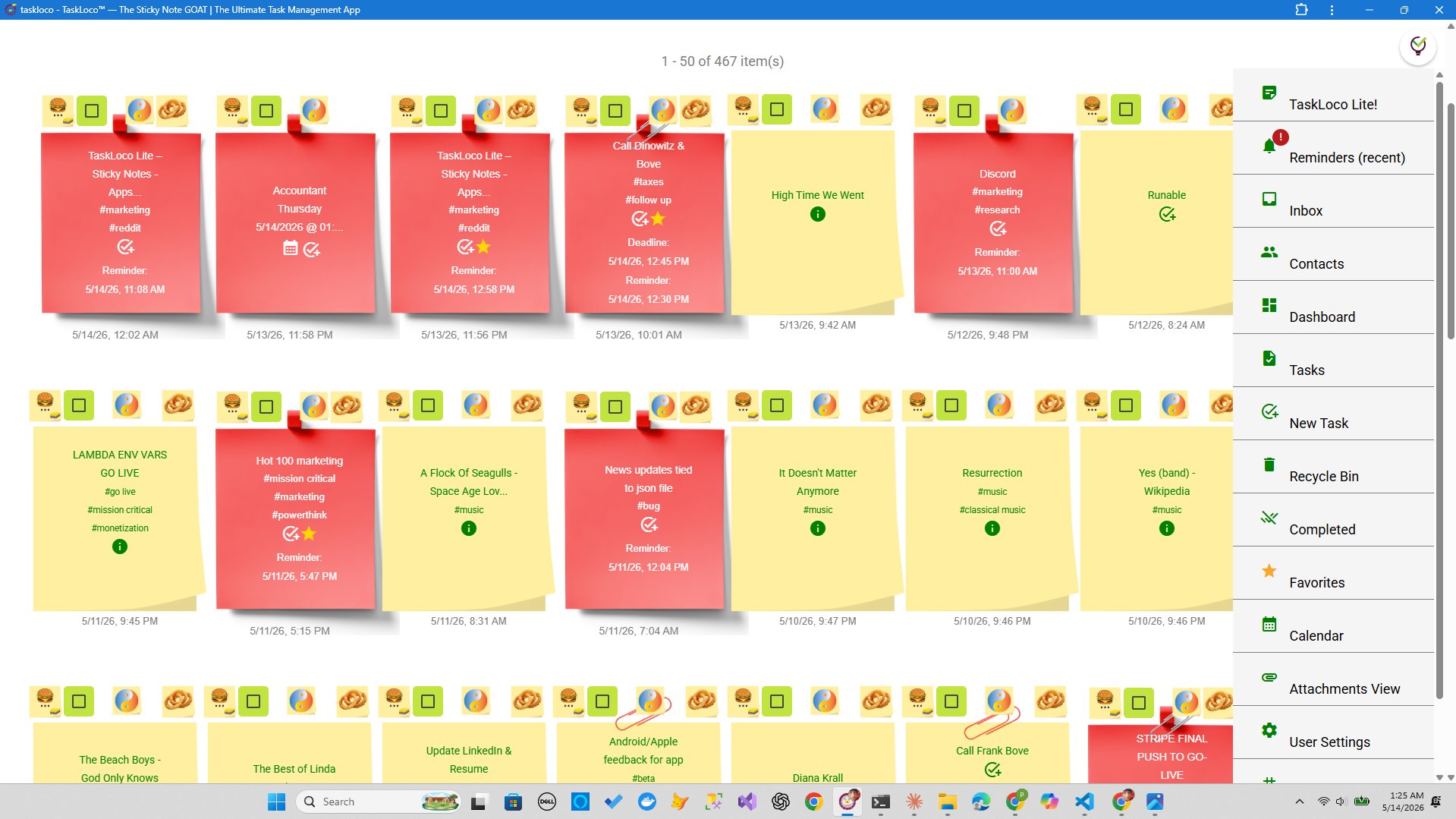
Complex organization systems fail because they require too much maintenance. You download the app, set up elaborate workflows, then abandon everything after two weeks. Sound familiar?
The solution isn't more complexity — it's less. Digital sticky notes work because they mirror how your brain actually processes information: visually, quickly, and without rigid structure. You write what you need to remember, stick it where you'll see it, and move on with your life.
TaskLoco Premium is regularly $9.99/month per person. Right now, charter members can lock in 50% off the regular price — forever. That means $4.99/month per person today. And if our price ever goes up, you still pay half. Always.
Code CHARTER50 auto-applies at checkout. First 500 spots only — once they're gone, this offer is gone permanently. Act fast while spots last.
Every Premium subscription includes unlimited notes, 10GB file storage, reminders, calendar, and team sharing. Each team member requires a separate subscription. 7-day free trial — no charge until day 8. Cancel anytime.
Free Options: TaskLoco vs Traditional Organization Methods
TaskLoco Lite
- Native iPhone & Android app
- Completely anonymous — no sign-in
- Data stays on your device
- Up to 20 notes
- Free forever
TaskLoco Lite Plus+
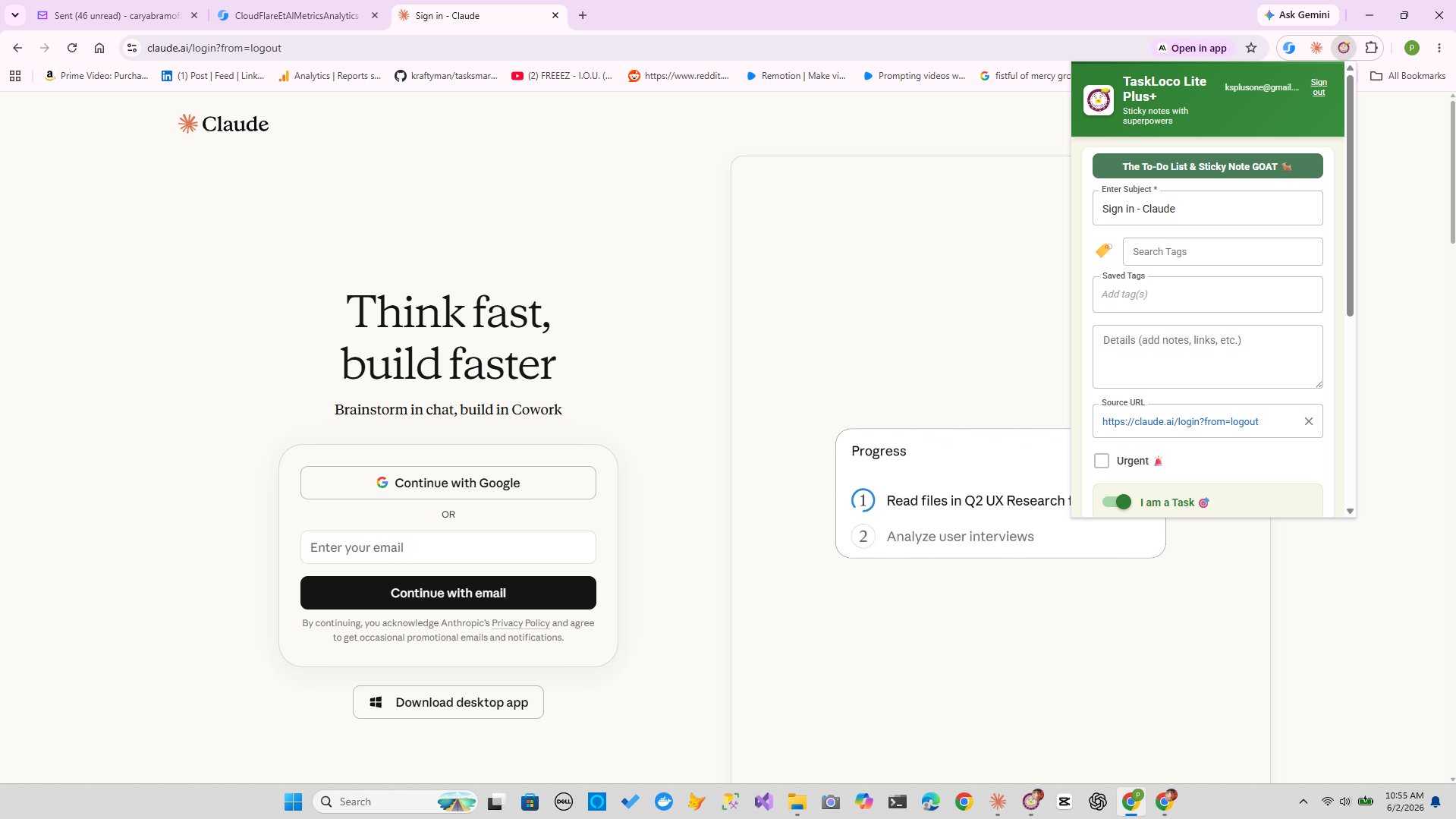
- Web app + Chrome extension
- Sign in with Google
- Wall syncs across all devices
- Up to 30 notes
- Free forever
Start With Brain Dump, Not Categories
Most organization advice tells you to start with categories and folders. This is backwards. Your brain doesn't work in neat folders — it works in associations and visual patterns.
Instead, start with a brain dump. Open a digital sticky note app and write down everything that's bouncing around your head. Work tasks, personal errands, ideas, worries — everything goes on separate notes. Don't organize yet. Just get it all out.
Traditional apps like Notion or Obsidian make you think about structure first. Digital sticky notes let you think first, organize later. The visual layout reveals connections you wouldn't see in a linear list.
Visual Grouping Beats Rigid Categories
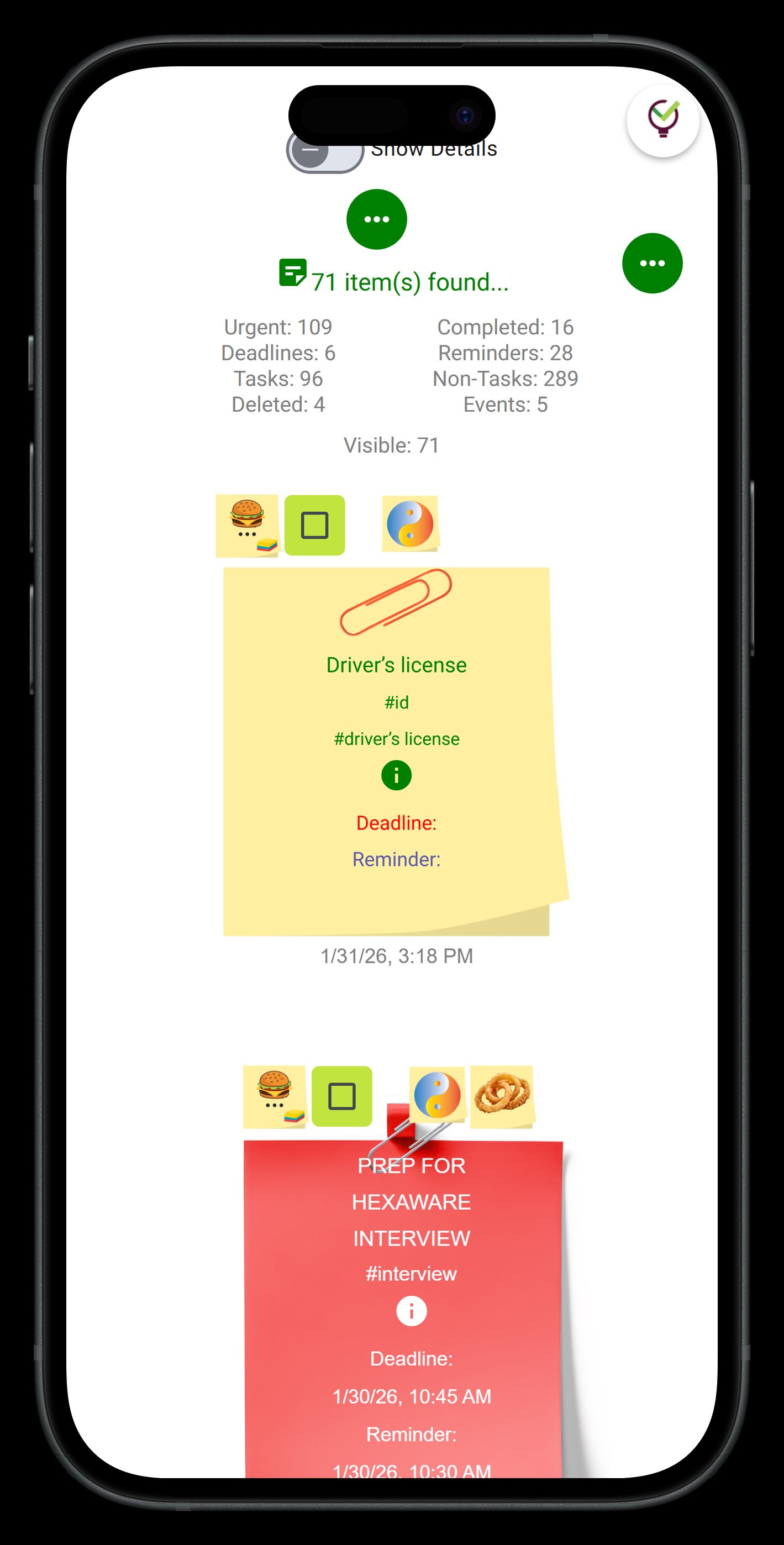
Once your thoughts are visible, organization happens naturally. You'll see notes that cluster together — work stuff gravitates toward work stuff, personal items group with personal items. This is visual grouping, and it's more powerful than predetermined categories.
With physical sticky notes, you'd move related notes closer together on your desk or wall. Digital sticky notes work the same way, but with superpowers: search across everything, set reminders, attach files, sync between devices.
Apps like Asana force you into projects and tasks. Trello locks you into boards and cards. But real life doesn't fit neat categories. Some things are urgent but not important. Others are important but not urgent. Visual grouping handles these nuances automatically.
Add Context Without Overwhelming Structure
The best organization system captures context without creating maintenance overhead. Traditional task managers demand due dates, priority levels, project assignments, and tags. Most of this metadata gets ignored or becomes outdated.
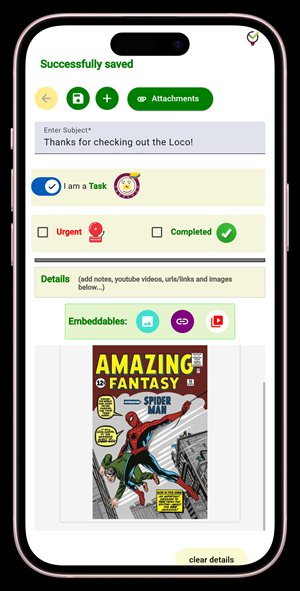
Digital sticky notes handle context differently. Colors indicate urgency intuitively — red feels urgent, yellow feels moderate, green feels low-key. File attachments live directly on the relevant note. Reminders fire when you actually need them, not when some arbitrary due date arrives.
Take meeting notes: instead of creating a project in Asana with subtasks and assignments, you capture everything on one note with relevant files attached. The visual layout shows you the full context at a glance. If action items emerge, they become separate notes that reference back to the meeting note.
Make It Stick With Minimal Friction
Organization systems fail when they require too much effort to maintain. The best system is the one you'll actually use tomorrow, next week, and next month.
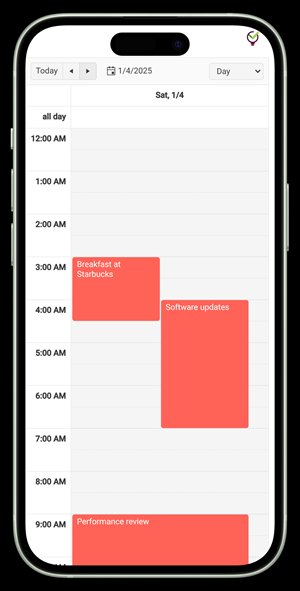
Digital sticky notes minimize friction in three key ways: quick capture, visual scanning, and natural maintenance. You can create a note in seconds, see everything important at a glance, and update only what actually changes.
Compare this to enterprise tools like Monday.com or Smartsheet that require constant updating of status fields, progress percentages, and dependency chains. These work for dedicated project managers but fail for regular people trying to stay organized.
The sticky note approach scales with your needs. Start with simple text notes. Add colors when useful. Set reminders when necessary. Attach files when relevant. But none of these features are required — they're available when you need them.
The Honest Comparison
| Feature | TaskLoco | Traditional Organization Methods |
|---|---|---|
| Learning curve | Minutes — works like physical sticky notes FREE | Hours to weeks for complex productivity systems |
| Visual organization | Natural grouping and spatial arrangement FREE | Linear lists or rigid folder structures |
| Quick capture | One-click note creation, Chrome extension for web clips FREE | Multiple steps, form fields, required metadata |
| Maintenance overhead | Minimal — update only what changes FREE | High — status updates, progress tracking, dependency management |
| Cross-device sync | Automatic sync with Lite Plus+ and Premium | Usually available but may require specific apps |
| File attachments | 10GB included with Premium, up to 1TB available | Physical notes can't attach files |
| Reminders | Built-in with Premium, SMS add-on available | Requires separate calendar or reminder apps |
| Team sharing | Yes — included with Premium. Each team member requires a separate subscription — currently $9.99/month per person, but TaskLoco is offering a Charter Member special: 50% off for life, currently $4.99/month per person for the first 500 subscribers with code CHARTER50. | Limited to physical proximity |
| Search capability | Full-text search across all notes and attachments | No search in physical notes |
| Offline access | TaskLoco Lite works completely offline FREE | Physical notes always work offline |
| Setup complexity | No setup required for Lite, Google sign-in for sync FREE | Complex project structures and workflow setup |
| Cost | Free tiers available, Premium starts at charter pricing FREE | Physical notes are cheap, complex apps are expensive |
| Flexibility | Adapts to any organization style or method FREE | Rigid project templates and required workflows |
| Calendar integration | Built-in calendar view with Premium | Requires separate calendar apps |
| Enterprise features | Basic team sharing, no enterprise SSO | Advanced project management, compliance, reporting |
Who Should Use Each
Use TaskLoco if…
- You want a simple system that actually works long-term
- You prefer visual organization over rigid categories
- You need quick capture without complex setup
- You want to sync notes across devices seamlessly
- You're tired of abandoning complex productivity systems
Use Traditional Organization Methods if…
- You need advanced project management with Gantt charts and dependencies
- You require enterprise compliance and detailed reporting
- You manage large teams with complex workflows
- You prefer detailed metadata and progress tracking
Lock In 50% Off — Forever
7-day free trial. No charge until day 8. CHARTER50 auto-applies at checkout.
🔒 Lock In My Charter SpotSee TaskLoco in Action
Frequently Asked Questions
How much does TaskLoco cost for organization?
$9.99/month per person (currently $4.99/month per person for first 500 charter members with code CHARTER50)
Can I use TaskLoco offline for organization?
Yes. TaskLoco Lite works completely offline with no account required. It stores up to 20 notes locally on your device. For syncing across devices, you need Lite Plus+ (free with Google sign-in) or Premium.
Is the sticky note method really effective for organization?
Yes, because it matches how your brain naturally processes information — visually and spatially. Unlike rigid category systems, sticky notes let you organize thoughts as they naturally group together, making the system more intuitive and sustainable.
How do digital sticky notes compare to physical ones?
Digital sticky notes add superpowers to the familiar format: cross-device sync, file attachments, reminders, search, and team sharing. You get the visual simplicity of physical notes with modern productivity features.
Can I share my organization system with team members?
Yes. TaskLoco Premium includes real-time team sharing with email notifications. Each team member needs their own subscription, but you can share specific notes or entire organizational systems.
What if I need more advanced project management features?
TaskLoco focuses on simple, visual organization. If you need Gantt charts, project dependencies, or enterprise compliance features, consider tools like Asana or Monday.com instead.
How quickly can I get organized with TaskLoco?
You can start organizing immediately. TaskLoco works like physical sticky notes — no learning curve. Do a brain dump of your thoughts, then visually group related items. The system adapts to your thinking style rather than forcing you to learn complex workflows.
Born in Brooklyn. Powered by AWS. Your data stays yours.
TaskLoco is available on iPhone, Android, Chrome, and every web browser.