You open one tab to check a fact, that tab leads to three more, and twenty minutes later you have a browser that looks like a filing cabinet exploded. Sound familiar? Tabs were designed for navigation, not storage — yet most people treat them like a to-do list, a reading queue, and a research library all at once.
The problem isn't that you're saving too much. It's that tabs give you no structure, no labels you wrote yourself, no way to group by topic, and no safety net if Chrome crashes or you accidentally close a window. This article walks through a practical system for taming research across many open tabs — one you can start using today, with or without any extension at all.
Why Tabs Fail as a Research System
Tabs feel productive because they're frictionless to open. But that same frictionlessness is what makes them a terrible organizational tool. Here's what actually goes wrong:
- No context. A tab title like "Overview – Wikipedia" tells you almost nothing about why you opened it or what argument it supports.
- No grouping by meaning. Chrome's tab groups help visually, but they don't capture why sources belong together — only that you put them there.
- Cognitive load. Research shows that holding open loops in working memory drains focus. Every unread tab is a small mental nudge saying "you haven't dealt with me yet."
- Fragility. One crash, one closed window, one forgotten "Restore Session" prompt, and hours of gathered sources disappear.
The fix isn't opening fewer tabs — it's building a habit of capturing and closing. Every source you find should be saved somewhere durable the moment you decide it's worth keeping, and then the tab should be closed. That's the core discipline behind every effective research workflow.
A Practical System for Organizing Research Without Losing Anything
You don't need special software to get started. Here's a method that works with tools you already have, and that scales up as your research grows.
Step 1 — Triage before you hoard. Before opening a new tab, ask: am I going to actually read this or just feel better having it open? If it's genuinely useful, save it immediately. If it's speculative, close it.
Step 2 — Use a capture document. Keep a plain text file, Google Doc, or note open alongside your research. Every time you find a source worth keeping, paste the URL and write one sentence explaining why it matters. This forces you to process each source instead of just accumulating it.
Step 3 — Group by argument, not by topic. Most people organize research by broad subject ("climate," "economics"). Instead, group by the specific point each source supports. This makes writing or acting on the research dramatically faster because your sources are pre-sorted by how you'll use them.
Step 4 — Close tabs after capturing. This is the hardest habit to build, but it's the most important. A saved source you can find again is more useful than an open tab you're afraid to close. Once something is captured in your system, close the tab. Your browser will feel faster and your thinking will too.
Step 5 — Review and prune regularly. At the end of a research session, spend five minutes going through what you saved. Delete anything that didn't hold up on reflection. This keeps your system from becoming another version of the tab problem — just in a different container.
Where Visual Sticky Notes Change the Game
The capture-document method works well, but it has one real weakness: it's linear. A long list of URLs in a Google Doc is better than forty open tabs, but it's still hard to scan at a glance, and it tells you nothing about what a page actually looks like or what kind of source it is.
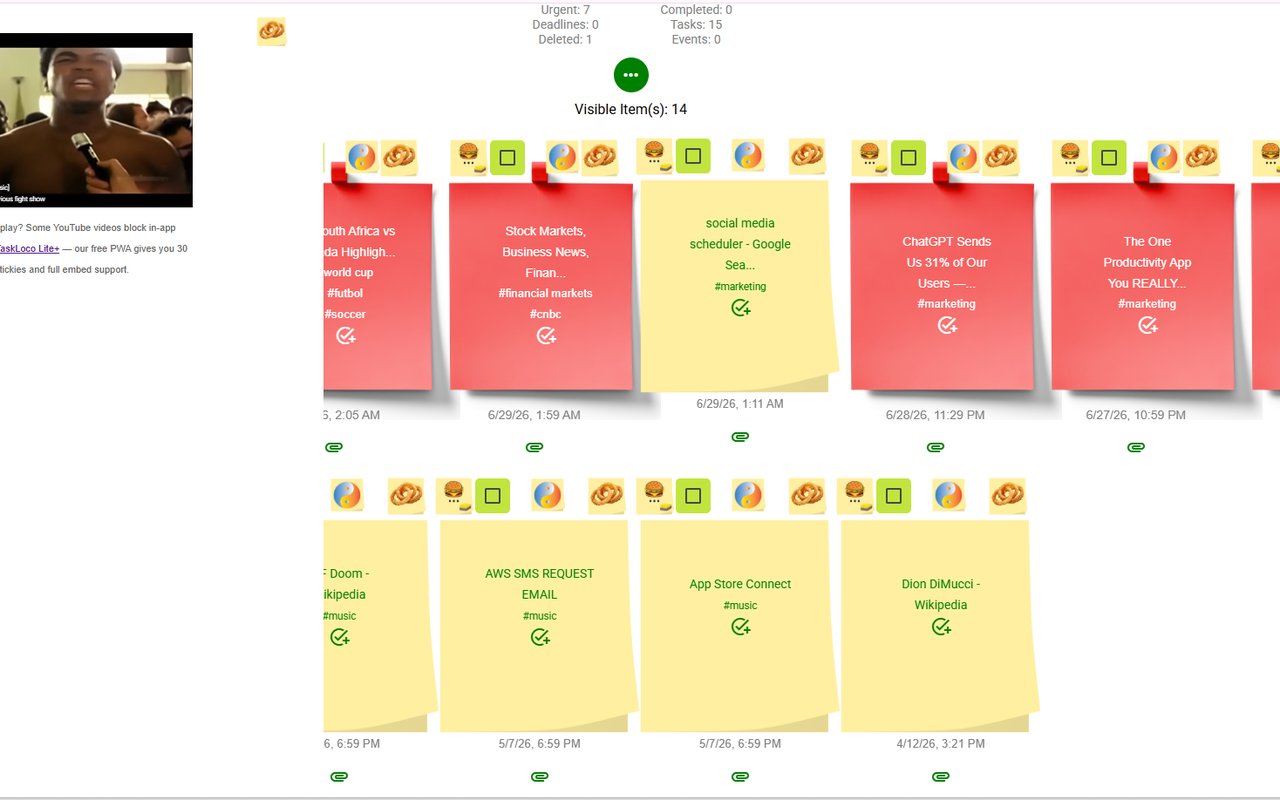
This is where saving pages as visual sticky notes earns its keep. Instead of a list of raw URLs, you get a wall of named, colored cards — each one representing a source, each one clickable back to the original page. You can see your whole research landscape at a glance, group related notes together spatially, and spot gaps or redundancies that a text list hides.
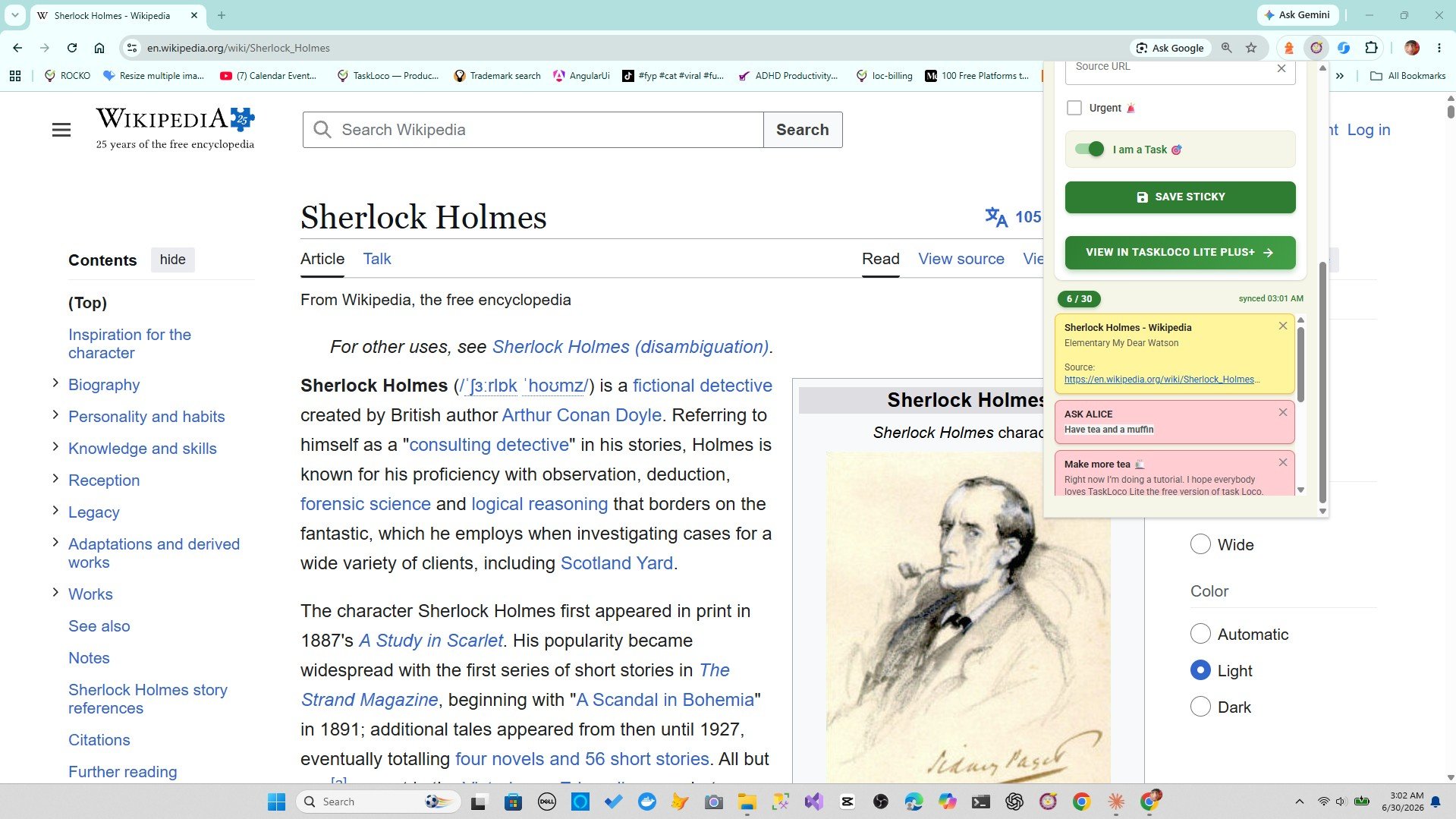
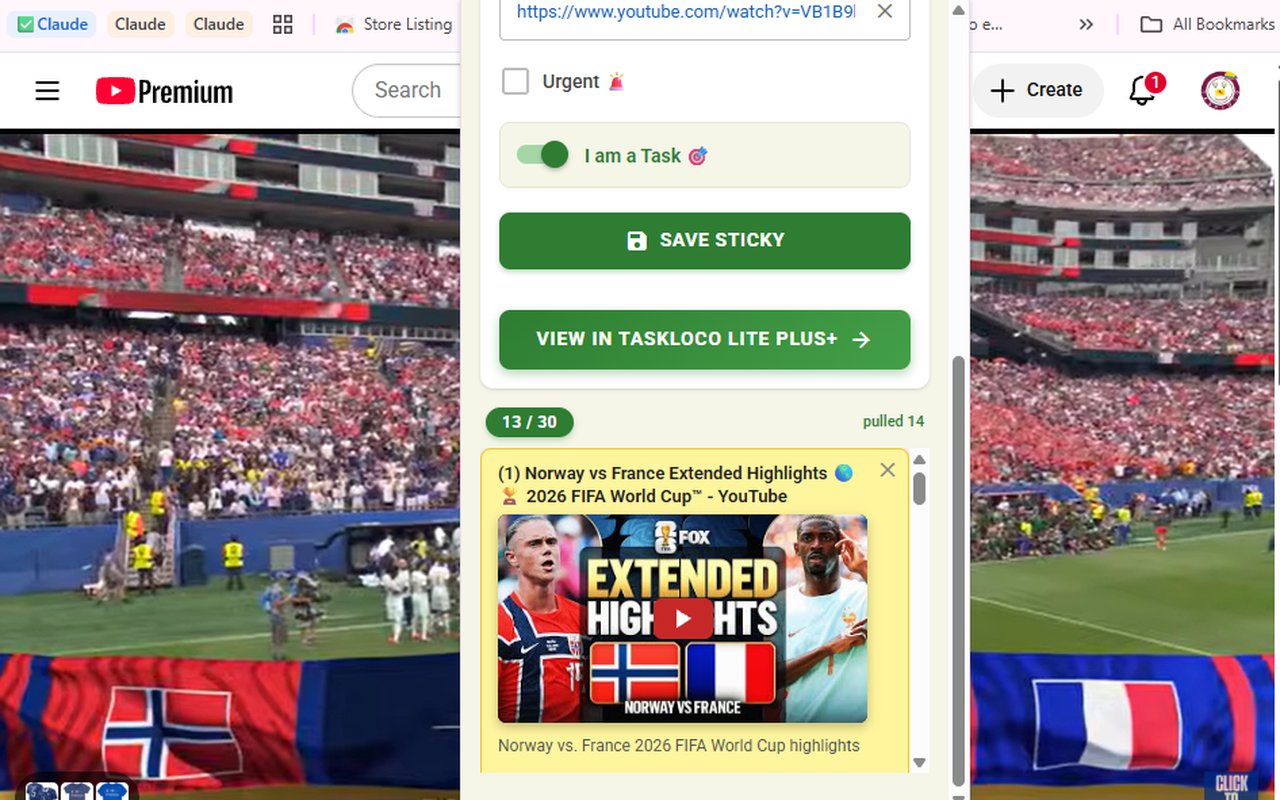
The Sticky Note Web Clipper — a free Chrome extension by TaskLoco — is built exactly for this workflow. Click the toolbar icon on any page and it saves the current tab as a sticky note, with the title and URL auto-filled. No copy-pasting, no form to fill out. YouTube videos embed and play directly inside the note. Everything syncs to TaskLoco, so your saved research is available on your phone and desktop too — not just on the machine where you were browsing.
Tags let you label notes by project, argument, or priority. Search finds anything instantly. And because each note lives in TaskLoco rather than in a browser tab, you can close the tab the moment you clip it — your source isn't going anywhere.
If you're the kind of person who ends research sessions with thirty tabs open because you're afraid to lose anything, the clipper solves the exact fear driving that habit. You don't need the tab open if the page is already saved as a note you can find again.
Putting It All Together: A Research Session That Actually Ends
Here's what an organized research session looks like when the habits and tools are working together:
- You start with a clear question or goal — not just "research Topic X" but "find three sources that support Point Y."
- As you browse, you clip anything promising immediately with the Sticky Note Web Clipper, then close the tab. Your browser stays lean.
- You add a quick tag or note to each clipped item while context is fresh — takes five seconds per clip.
- At the end of the session, you open TaskLoco and see your notes laid out visually. You can drag related ones together, spot what you're missing, and decide what to read next.
- When you come back the next day — on your laptop, your phone, wherever — everything is there.
Compare that to ending a session with forty tabs, not knowing which ones you actually read, and being afraid to close Chrome in case you lose something. The difference isn't willpower. It's having a system that makes saving easier than not saving.
The extension is free. The capture habit is free. The only cost is a few minutes building the discipline — and the payoff is research sessions that produce something useful instead of just producing more tabs.
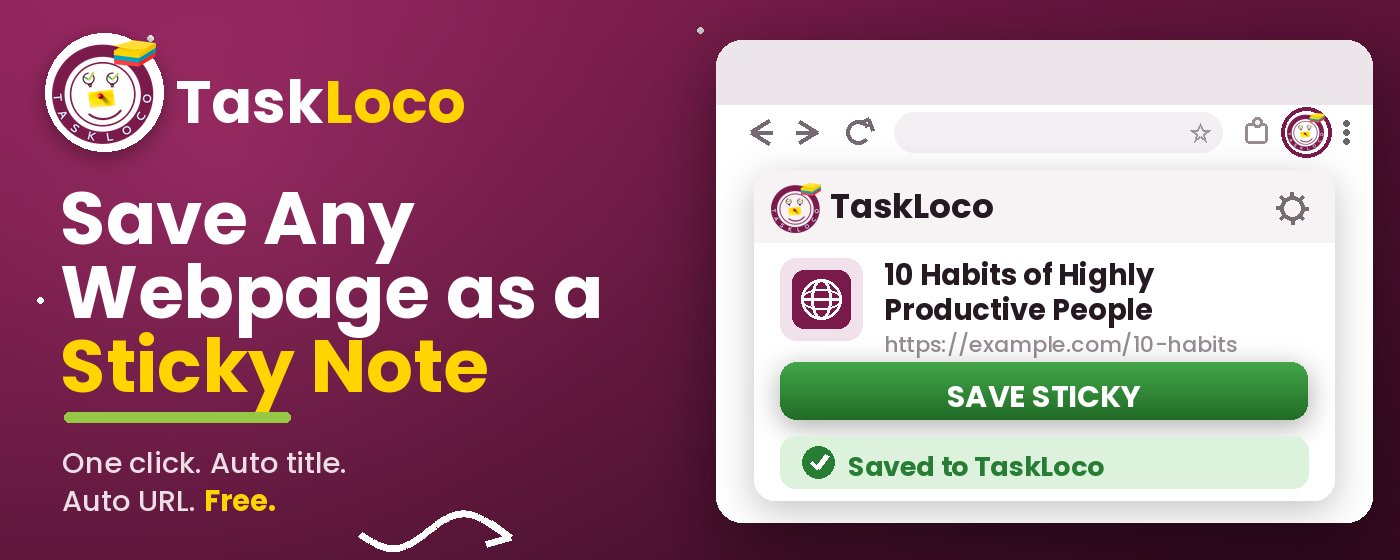
The Sticky Note Web Clipper is free. Install it from the Chrome Web Store, sign in with Google, and every page you clip becomes a sticky note you can find later.
Your clipped notes sync to TaskLoco across Chrome, desktop, iPhone, and Android — also free to start. No credit card to begin.
Get the Free Clipper
Sticky Note Web Clipper
- Free Chrome extension
- One-click save — any page, article, or video
- Title & URL auto-filled
- Tags & search
- Free forever
Synced to TaskLoco
- Sign in free with Google
- Your wall on Chrome, desktop, iPhone, Android
- YouTube videos embed & play in notes
- Visual sticky-note wall
- Free to start
Add It to Chrome — Free
One click saves any page, article, or YouTube video as a sticky note. Title and URL auto-filled.
Add to Chrome — FreeSee TaskLoco in Action
Frequently Asked Questions
How do I stop losing research when I close Chrome?
The root cause is using tabs as storage. The fix is capturing each source the moment you find it — into a note, document, or clipper — and then closing the tab. The Sticky Note Web Clipper is the fastest version of this: one click saves the current page as a sticky note with the title and URL already filled in, and it syncs to TaskLoco so it's accessible on any device. Your research is no longer held hostage by whether Chrome stays open.
What's the best way to organize research across multiple projects?
Keep projects separated at the capture stage, not after the fact. When you clip a source, tag it with the project name immediately. In the Sticky Note Web Clipper and TaskLoco, tags let you filter your saved notes by project in seconds. If you try to sort a pile of undifferentiated sources later, it takes far longer and you'll miss things.
Is there a one-click way to save a webpage for research later?
Yes — that's exactly what the Sticky Note Web Clipper does. Click its icon in your Chrome toolbar and the current page is saved as a sticky note with the title and URL auto-filled. No form, no copy-paste, no extra steps. It's free to install from the Chrome Web Store.
Can I save YouTube videos as part of my research?
Yes. When you clip a YouTube video with the Sticky Note Web Clipper, it embeds inside the note and plays directly there. You don't need to keep a browser tab open to come back to it — the video lives in your TaskLoco notes, accessible on desktop or phone.
How do I find a saved research source later without digging through bookmarks?
Bookmarks are searchable only by title, and most people give their bookmarks no meaningful title at the time of saving. In TaskLoco, every clipped note carries the page title and URL, plus any tags you added. The search function finds notes by keyword across all of that. If you tagged your sources at capture time, a tag filter gets you to the right project's sources in one click.
Is the Sticky Note Web Clipper free?
Yes — the extension is completely free. Install it from the Chrome Web Store, sign in with Google, and start clipping. TaskLoco, where your notes sync and live, also has a free tier. There's no cost required to start using the full capture-and-save workflow described in this article.
Does the Sticky Note Web Clipper work on my phone too?
The Chrome extension itself runs in your desktop browser, but everything you clip syncs to TaskLoco, which is available on iPhone and Android as well as on desktop. So you can clip a source on your laptop and pull it up on your phone later — without emailing yourself links or keeping tabs open across devices.
Born in Brooklyn. Powered by AWS. Your data stays yours.
TaskLoco is available on iPhone, Android, Chrome, and every web browser.