You find a great source mid-research, think you'll remember it, open three more tabs, and an hour later it's gone — buried or closed. That is not a memory problem. It is a workflow problem, and it happens to everyone who researches online without a capture habit.
Keeping track of pages while you research is really about two things: capturing fast enough that nothing gets lost, and organizing clearly enough that you can actually find things again later. This guide covers both — real methods you can use right now, with or without any extension.
The Core Problem: You Find Things Faster Than You Can File Them
Research is non-linear. You start on one page, follow a link, follow another, and suddenly you have eight tabs open and only a vague memory of why you opened half of them. Standard browser behavior works against you here — tabs disappear on crashes, bookmarks pile up with no context, and copy-pasted URLs in a notes app tell you nothing about why you saved them.
The fix is not to slow down your research. It is to make capture so fast it does not interrupt the flow. Whatever tool you use — a text file, a notes app, a browser extension — it needs to work in one or two actions at most. The moment saving a source takes more effort than just leaving the tab open, you will stop doing it.
This means the best research tracking systems share three traits: they are fast to save to, they store the URL automatically, and they let you add a quick note or tag so future-you understands the context.
Practical Methods for Tracking Research Pages
Here are the approaches people actually use, with an honest look at where each one holds up:
- Browser bookmarks: Fast to save, nearly useless for research. Bookmarks strip all context — you get a title and a URL, shoved into a flat folder. After a few sessions, your bookmarks folder becomes a graveyard of links you have no memory of saving. They also do not sync your mental notes, just the URL.
- Open tabs as a to-do list: This is the most common approach and the most fragile. Tabs get closed, browsers crash, sessions expire. Treating open tabs as a research library is like using sticky notes on a whiteboard you plan to erase. Fine for an hour; terrible for anything longer.
- Copy-paste into a doc or notes app: More durable, but slow. Switching to another window, pasting a URL, typing a note, switching back — this breaks your research flow constantly. It also creates a flat list that is hard to scan visually.
- Dedicated web clippers: These save a snapshot of the page or at least the URL and title directly from the browser, often with one click. This is the fastest method that also preserves context. The best ones let you add tags and search your saved items, so you can actually find things again.
For most research workflows, a web clipper beats the other methods not because it does more, but because it removes the friction that causes you to skip saving in the first place.

How to Build a Research Capture Habit That Actually Holds
Having a tool is not enough — the habit matters. Here is a simple process that works regardless of which capture method you use:
1. Save first, read fully later. When you land on a page that looks relevant, save it immediately before you start reading deeply. This way, even if you close the tab or lose the session, the source is already captured.
2. Add one line of context. A URL alone tells you nothing in three days. Add a short note — even three words — about why this source matters. "Stats on sleep and focus," "Counter-argument to main thesis," "Follow up with author's other work." That context is worth more than the URL itself.
3. Tag by project or topic, not by date. Date-based filing sounds organized but is hard to use. Tagging by topic — climate-research, UX-patterns, recipe-ideas — means you can pull up all related sources at once when you need them.
4. Do a quick review at the end of each session. Spend two minutes scanning what you saved and deleting anything that turned out to be irrelevant. Keeping your saved list clean makes it useful. An unreviewed pile of 400 links is just a different kind of chaos.
This process works with a text file, a notes app, or a clipper. The clipper just makes steps one and two take one second instead of thirty.
One Practical Tool: The Sticky Note Web Clipper
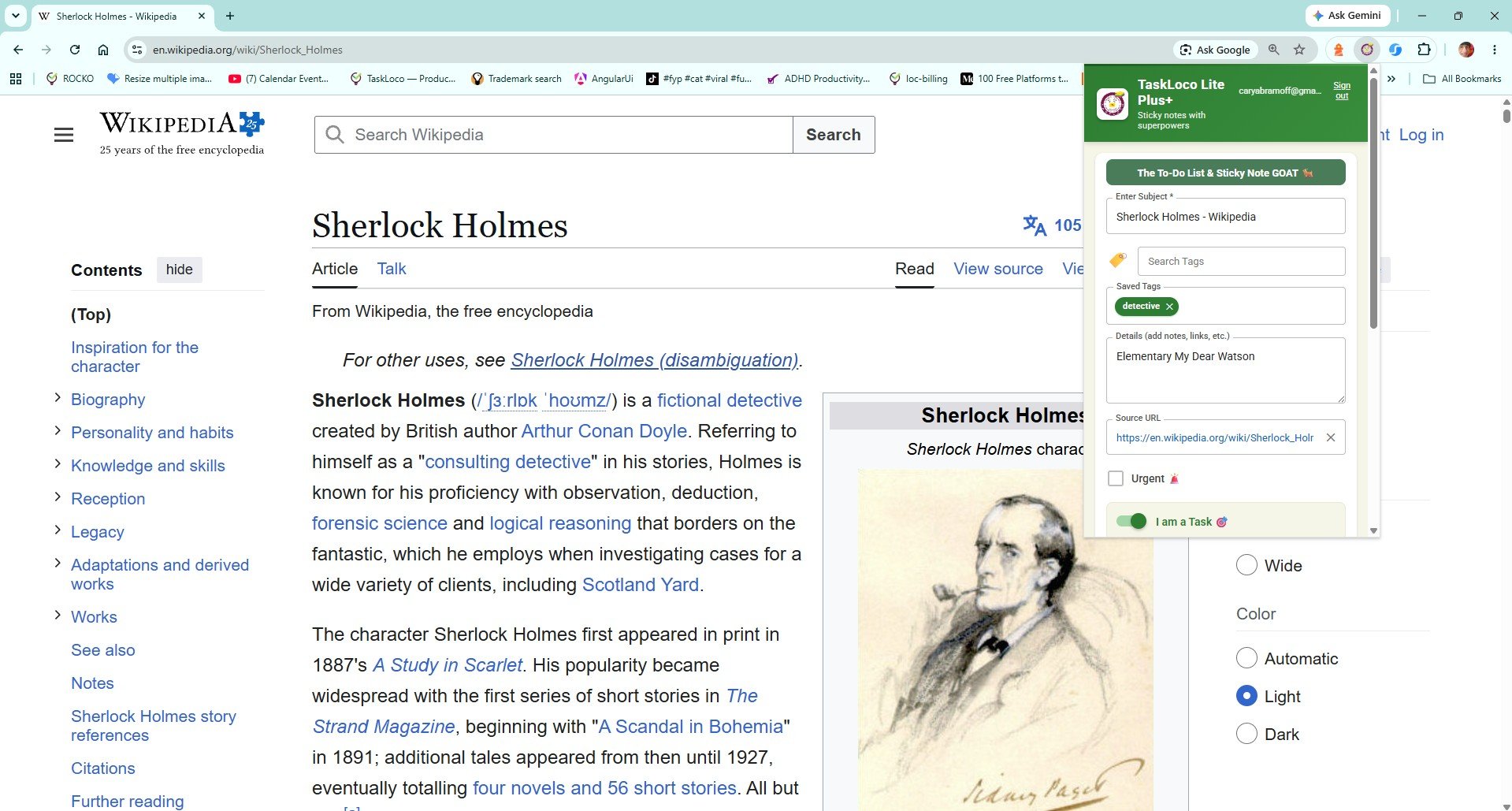
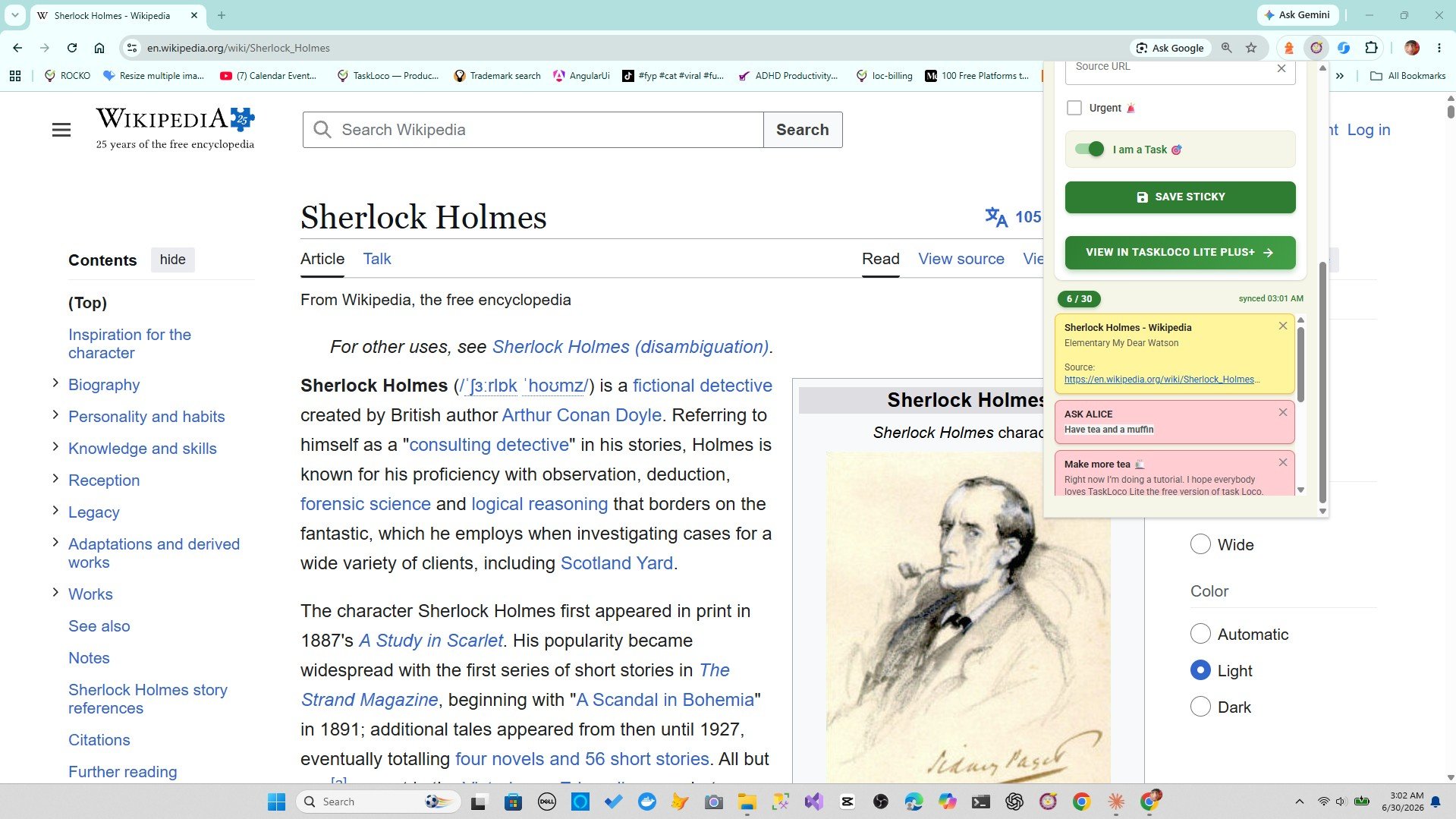
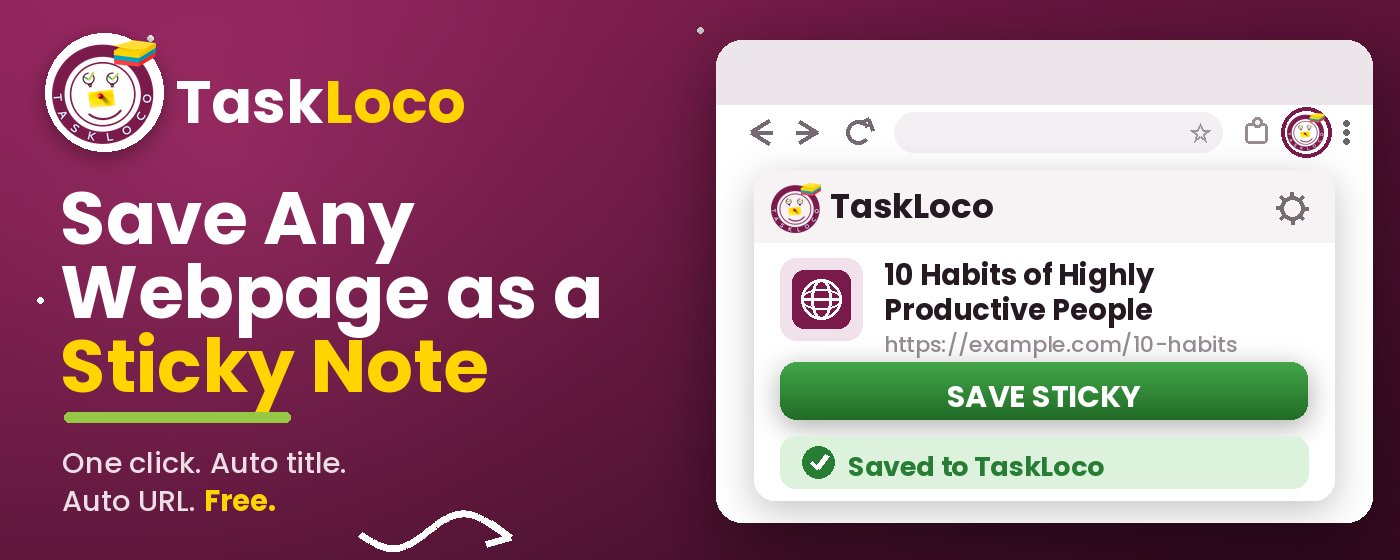
If you want to put the above habit into practice with the least possible friction, the Sticky Note Web Clipper is worth installing. It is a free Chrome extension from TaskLoco. When you are on any page — an article, a research paper, a YouTube video — you click the toolbar icon and the page is saved as a visual sticky note with the title and URL already filled in.
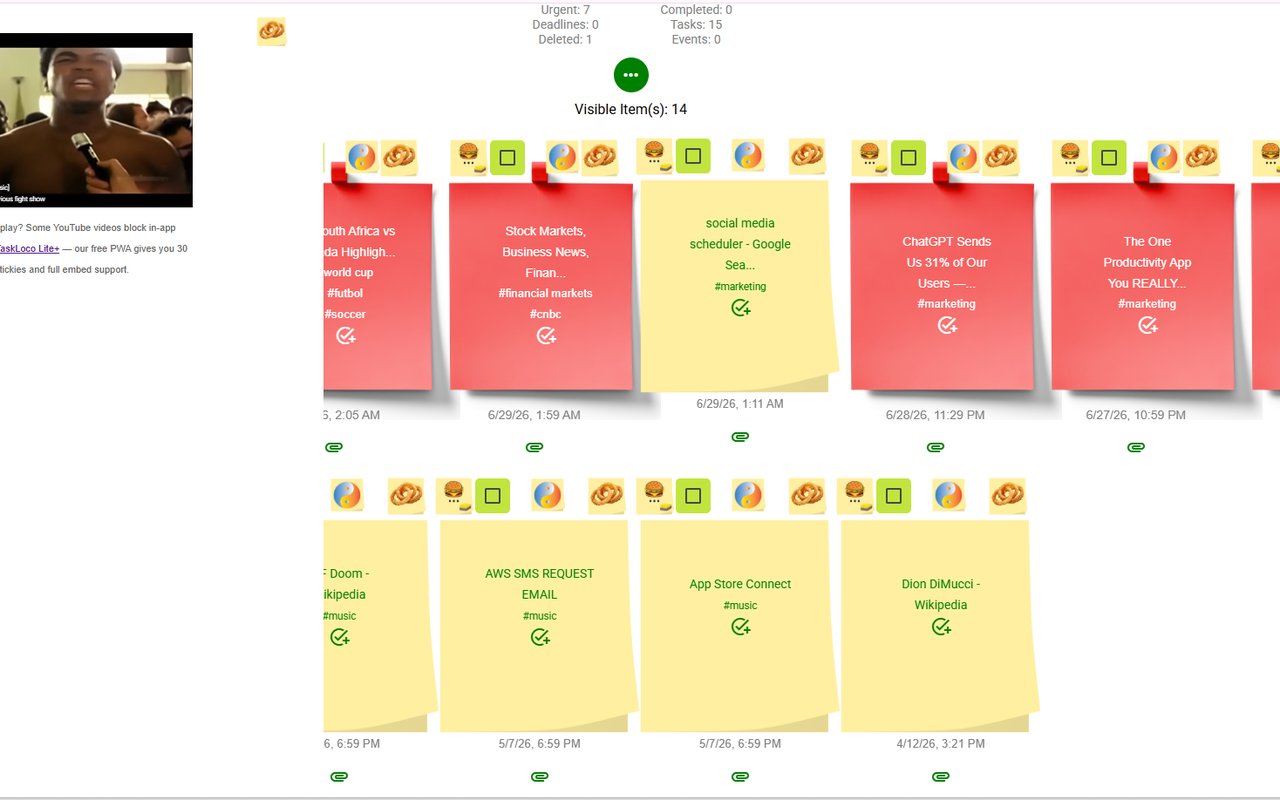
YouTube videos are worth calling out specifically: they embed and play inside the note, so you do not lose your place in a video you were watching as research. For everything else — news articles, academic pages, product pages, documentation — it works the same way: one click, done.
Saved notes live in TaskLoco, which syncs across Chrome, your desktop, and your phone (iPhone and Android). So if you save sources while researching on your laptop, they are waiting for you on your phone when you want to reference them later. Sign-in is free with Google.
Tags and search mean you can find anything you saved without remembering when you saved it — which is the whole point of a research archive.
The Sticky Note Web Clipper is free. Install it from the Chrome Web Store, sign in with Google, and every page you clip becomes a sticky note you can find later.
Your clipped notes sync to TaskLoco across Chrome, desktop, iPhone, and Android — also free to start. No credit card to begin.
Get the Free Clipper
Sticky Note Web Clipper
- Free Chrome extension
- One-click save — any page, article, or video
- Title & URL auto-filled
- Tags & search
- Free forever
Synced to TaskLoco
- Sign in free with Google
- Your wall on Chrome, desktop, iPhone, Android
- YouTube videos embed & play in notes
- Visual sticky-note wall
- Free to start
Add It to Chrome — Free
One click saves any page, article, or YouTube video as a sticky note. Title and URL auto-filled.
Add to Chrome — FreeSee TaskLoco in Action
Frequently Asked Questions
What is the fastest way to save a webpage while researching?
A browser extension that saves with one click is the fastest method. The free Sticky Note Web Clipper captures the current page as a sticky note with the title and URL auto-filled the moment you click the toolbar icon — no switching windows, no copying URLs manually.
Why are browser bookmarks bad for research?
Bookmarks save a URL and a title but nothing else — no context, no notes, no visual layout. After a few research sessions, a bookmarks folder becomes a long list of links you cannot remember saving. There is also no way to search by topic or add tags without a third-party tool on top.
How do I keep track of research across multiple sessions?
Use a capture tool that syncs — not open tabs, which disappear. If you save pages to a web clipper or notes app that is accessible on your phone and desktop, you can pick up your research wherever you left off. The Sticky Note Web Clipper saves to TaskLoco, which syncs across Chrome, desktop, iPhone, and Android for free.
Can I save YouTube videos as research sources?
Yes. The Sticky Note Web Clipper saves YouTube pages as sticky notes that embed the video directly — so the video plays inside the note without you needing to open a new tab. This is useful for tutorials, lectures, or any video-based research you want to come back to.
Is the Sticky Note Web Clipper free?
Yes — the extension is completely free. TaskLoco, where your saved notes live, also has a free tier. Install it from the Chrome Web Store, sign in with Google, and start clipping immediately.
How do I organize research pages so I can actually find them again?
Tag by topic rather than by date, and add a short note to each saved page explaining why it matters. The Sticky Note Web Clipper lets you add notes and tags to each saved page, and TaskLoco's search means you can find anything you saved by keyword or tag — no scrolling through a flat list.
What should I do with research pages I save but never revisit?
Do a quick two-minute review at the end of each research session and delete anything that turned out to be irrelevant. Keeping your saved list clean is what makes it useful. A well-maintained archive of 30 sources beats an uncurated pile of 400 links you never open.
Born in Brooklyn. Powered by AWS. Your data stays yours.
TaskLoco is available on iPhone, Android, Chrome, and every web browser.