You're reading an article you need to act on. Maybe it's a recipe you want to cook this weekend, a product you need to buy, a tutorial you have to follow, or a news story you need to share with someone. You tell yourself you'll come back to it. You don't. The tab closes, the bookmark gets lost, and the task never happens.
The gap between "I found this" and "I did something about it" is a workflow problem, not a memory problem. The fix is making web pages appear where your action items live — your to-do list — at the exact moment you find them, with zero friction. Here's how to do that, and why the method matters more than people realize.
The Core Method: Capture at the Moment of Discovery
The single most important rule for turning web pages into tasks is this: capture at the moment you find the page, not later. Every extra step between discovery and capture is a point where the task dies. You close the tab. You get distracted. You assume you'll remember. You don't.
The practical method is to treat every "I need to do something with this" page as a task the second you land on it. That means your capture tool needs to be right there in the browser — one click away — not a separate app you have to switch to.
Here's how to do it manually if you want zero tools beyond what you already have:
- Copy the URL and paste it into your to-do app as a task. Give it a name that says what you need to do with it, not just the page title. "Read and summarize" or "Buy this" or "Send to Marcus" is more useful than the article headline alone.
- Use your task manager's browser bookmarklet if it has one. Many apps let you drag a button to your bookmark bar that creates a task from the current tab. The quality varies widely — some auto-fill the title, some don't.
- Email the link to yourself with a subject line that is the task. Old-school, but it works if your inbox is also your to-do list. The downside is that it creates clutter fast.
The manual approaches above all work. The problem is that they all require you to leave the page, open another app, fill in context by hand, and mentally switch modes. That is exactly the friction that causes tasks to slip through.
Why Open Tabs Are Not a To-Do List (Even Though We Use Them That Way)
Most people's real to-do list is a graveyard of open tabs. There's a reason for that: keeping a tab open is the path of least resistance when you want to remember something. No switching apps, no typing, no decisions. Just leave it there.
The problem is structural. Tabs have no priority order you set intentionally. They have no context — you can't write "buy the blue one, not the black" next to a product tab. They disappear in crashes, they multiply until the browser slows down, and they carry no signal about what you actually need to do versus what you were just idly browsing.
A tab is a reminder that you were interested in something. It is not a task. The difference matters because tasks have intent attached to them. When a web page lives in your task system as a named, intentional item — "watch this before Thursday's meeting" or "pull the stats from this study" — you are far more likely to act on it.
The habit to build: when you catch yourself leaving a tab open as a reminder, that is your cue to convert it into a real task entry instead. Whatever tool you use for that conversion, doing it deliberately makes the task real in a way a lingering tab never does.
One practical tip: set a rule for yourself. If a tab has been open for more than 24 hours, either convert it to an actual task or close it. There is no middle ground. A tab you are not going to act on is just noise.
Tagging and Searching: How to Find What You Saved Later
Capturing pages is only half the problem. The other half is finding them when you actually need them. A saved link you cannot locate is nearly as useless as one you never saved.
Whatever system you use — a to-do app, a notes tool, or a dedicated clipper — build the habit of adding a short tag or category when you save. It takes three seconds and saves minutes of searching later. Useful tag categories to think about:
- By type of action: read, watch, buy, respond, research, share
- By topic or project: the name of the project or area of life the page relates to
- By urgency: this week, someday, waiting-on
You do not need all three. Even just tagging by action type — so all your "buy" links are together and all your "read" links are together — makes a dramatic difference in how often you actually return to saved items.
Search is your safety net. Any decent capture tool should let you search by title or URL. If you remember even one word from the page's title, you should be able to find it. Before you commit to a system, test the search. If it is slow, buried behind menus, or only searches titles and not URLs, that system will frustrate you over time.
One Practical Way to Wire This Into Your Browser: The Sticky Note Web Clipper
If you want all of the above — instant capture at the moment of discovery, visual notes with context, and fast search — without building an elaborate system, the Sticky Note Web Clipper for Chrome is a straightforward way to get there. It is a free Chrome extension by TaskLoco.
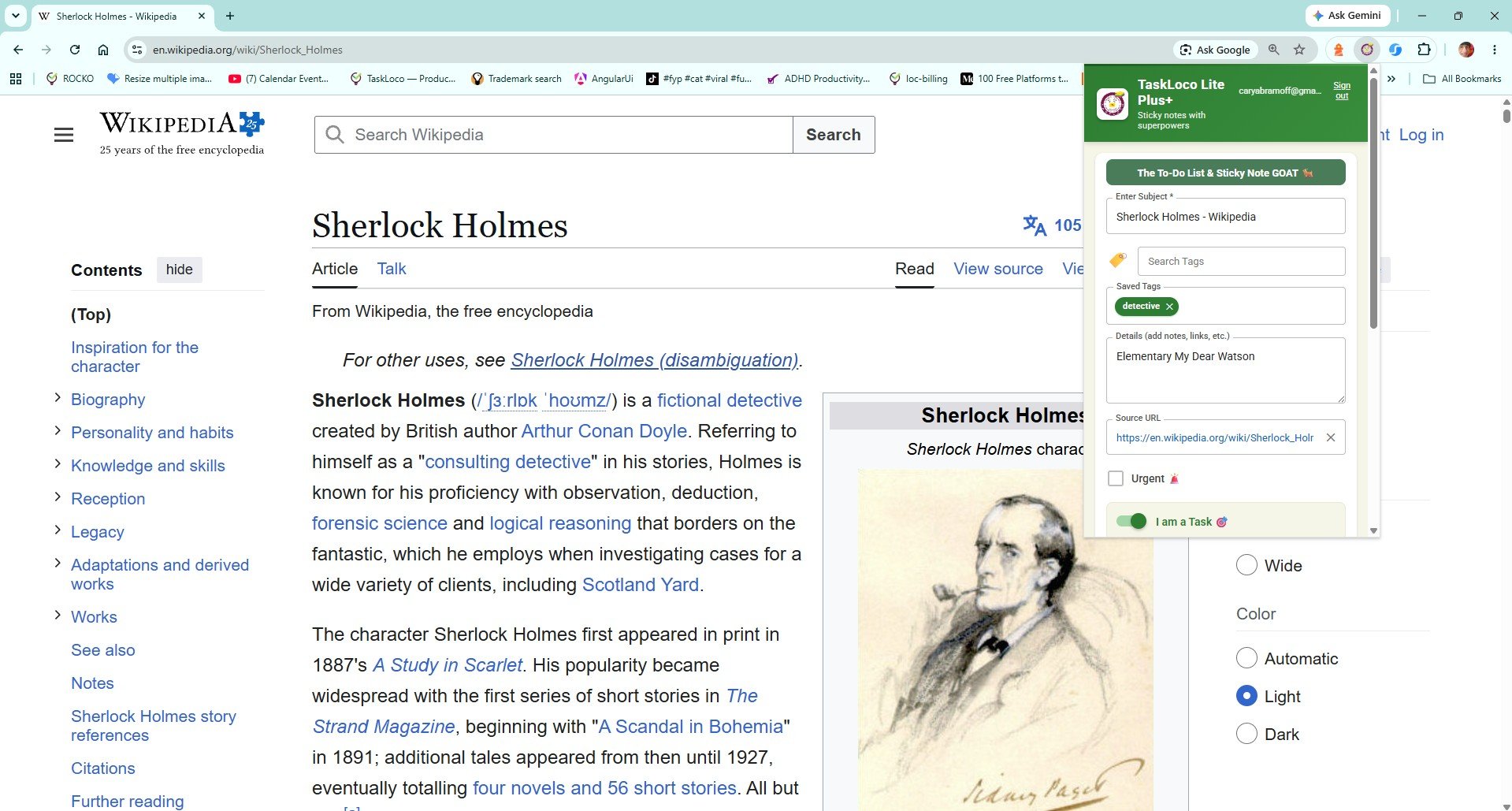
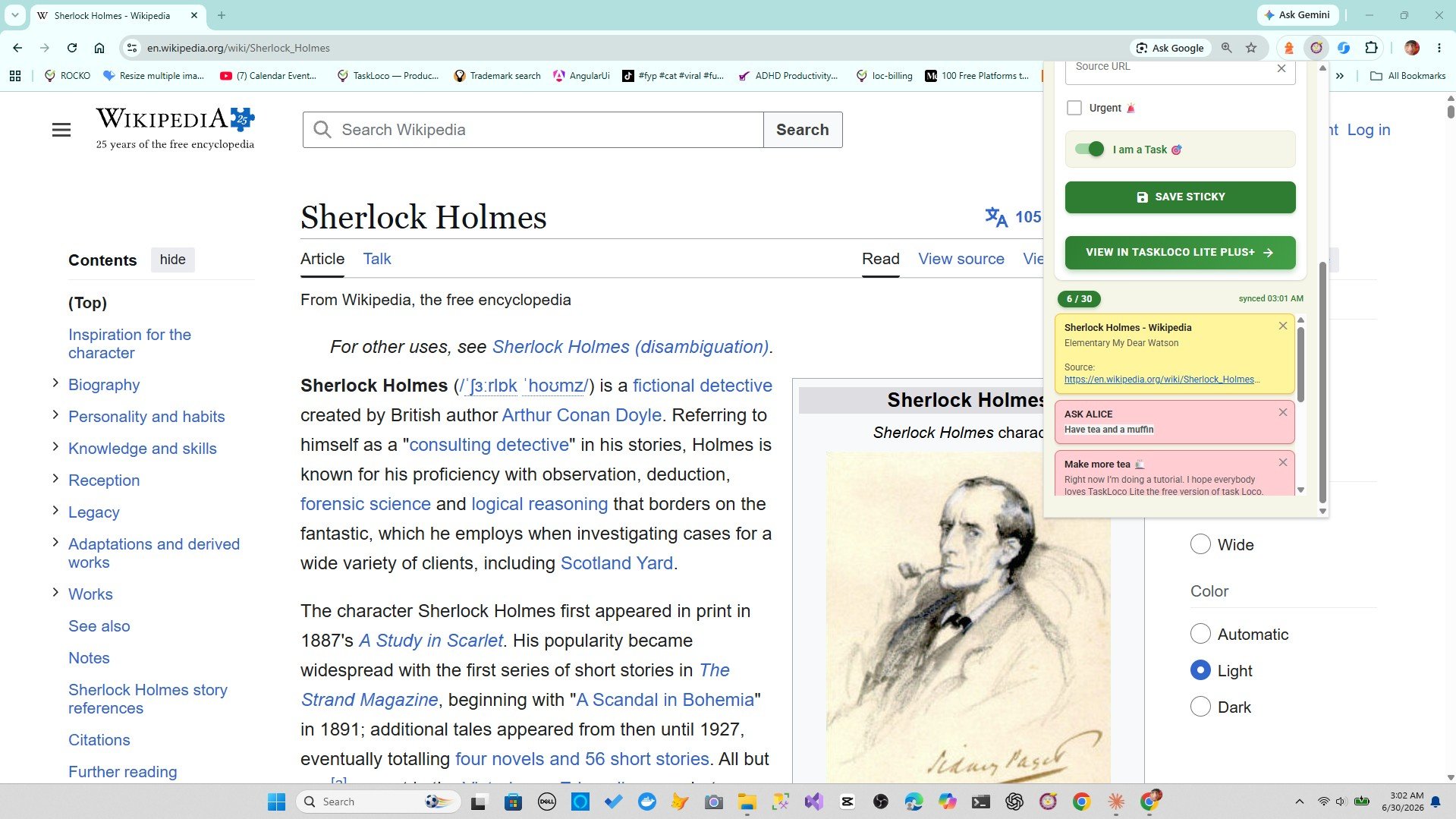
Here is what the workflow looks like: you land on a page you need to act on. You click the extension icon in your Chrome toolbar. A sticky note opens with the page title and URL already filled in. You add a quick note about what you need to do — or just leave the auto-fill and move on. Done. The page now lives in your TaskLoco wall as a visual sticky note, not a forgotten bookmark.
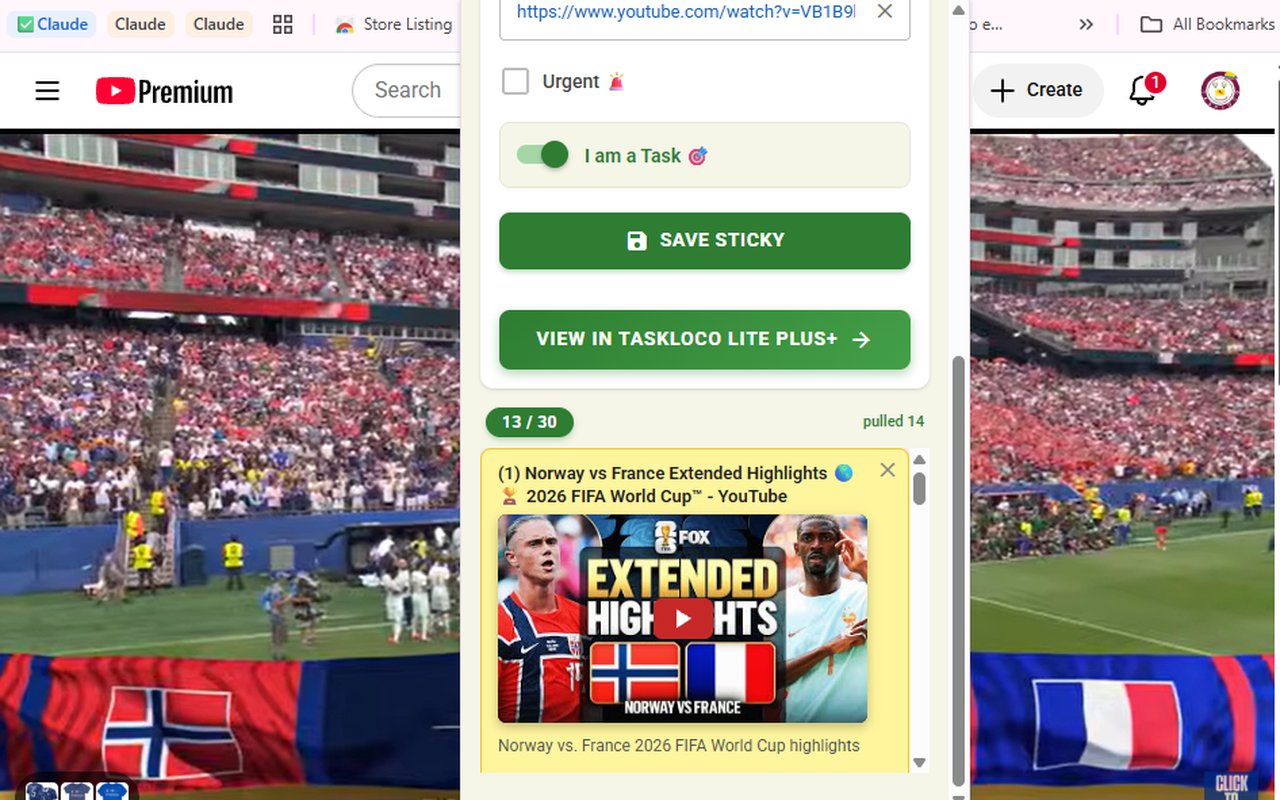
YouTube videos are handled the same way, and they embed directly inside the note so you can watch without navigating back to YouTube. Research sources, news articles, product pages, tutorials — anything with a URL gets captured the same way.
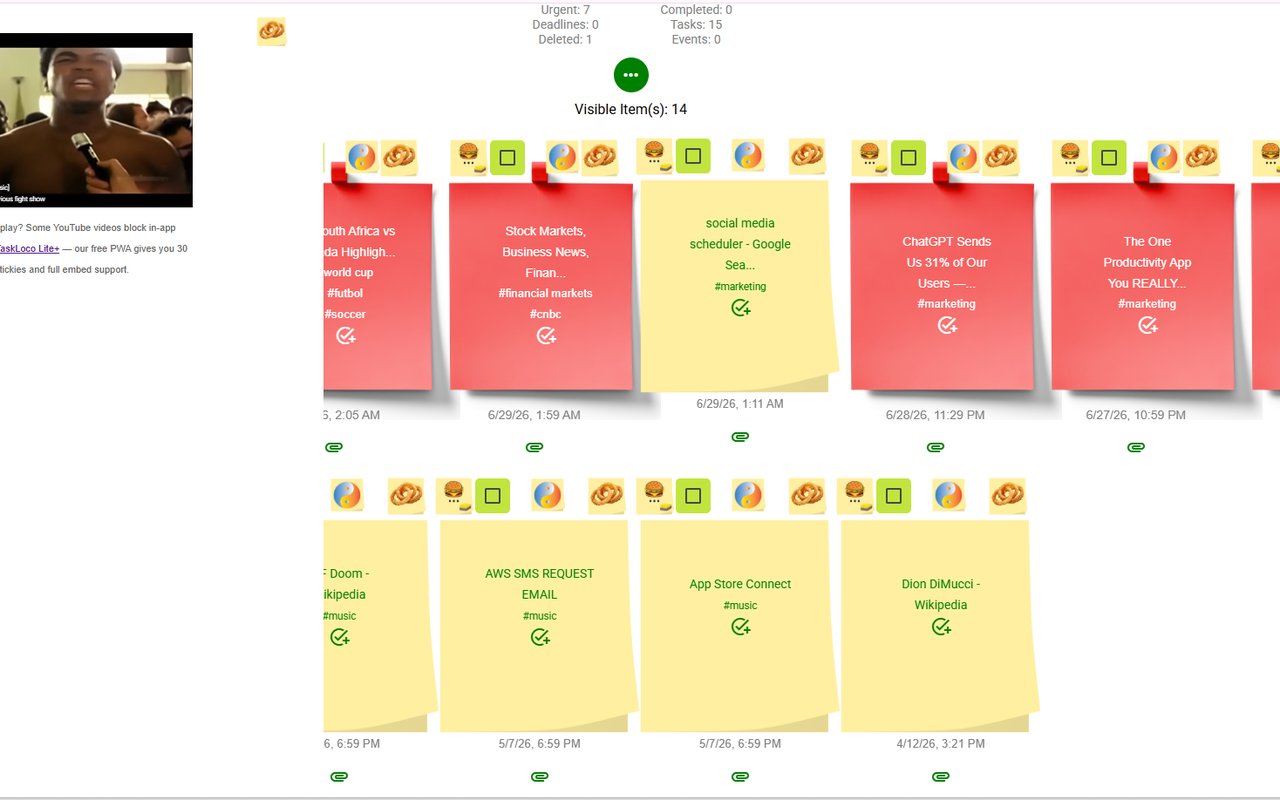
Your saved notes sync to the free TaskLoco web experience, so they show up on your phone and desktop as well as in Chrome. That means the page you clipped on your laptop during your lunch break is waiting for you on your phone when you have time to act on it.
The extension is free. Sign in with Google, click the icon once, and the page is on your list. That is the whole setup.
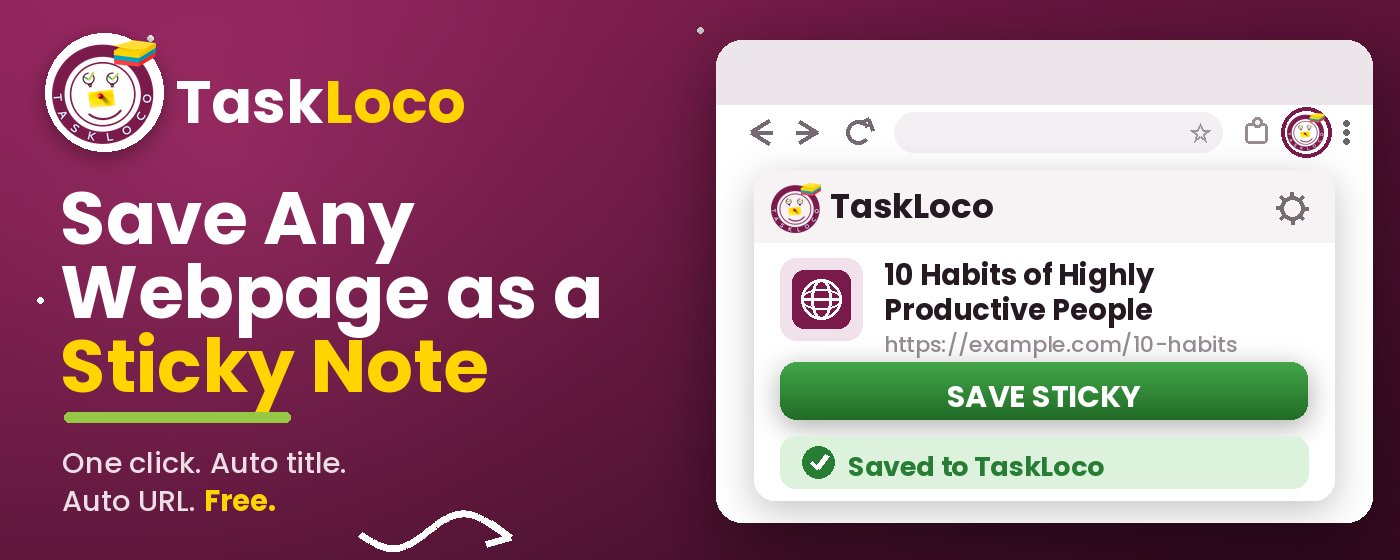
The Sticky Note Web Clipper is free. Install it from the Chrome Web Store, sign in with Google, and every page you clip becomes a sticky note you can find later.
Your clipped notes sync to TaskLoco across Chrome, desktop, iPhone, and Android — also free to start. No credit card to begin.
Get the Free Clipper
Sticky Note Web Clipper
- Free Chrome extension
- One-click save — any page, article, or video
- Title & URL auto-filled
- Tags & search
- Free forever
Synced to TaskLoco
- Sign in free with Google
- Your wall on Chrome, desktop, iPhone, Android
- YouTube videos embed & play in notes
- Visual sticky-note wall
- Free to start
Add It to Chrome — Free
One click saves any page, article, or YouTube video as a sticky note. Title and URL auto-filled.
Add to Chrome — FreeSee TaskLoco in Action
Frequently Asked Questions
What is the easiest way to add a web page to my to-do list?
The easiest method is a browser extension that captures the page in one click without making you switch apps. The free Sticky Note Web Clipper for Chrome saves the current page as a sticky note — title and URL auto-filled — the moment you click the toolbar icon. No copy-pasting, no context-switching.
Can I use open tabs as a to-do list?
Technically yes, but it does not work well in practice. Tabs carry no intent — you cannot write what you need to do with a page, set any priority, or search them meaningfully. They disappear in crashes and multiply until navigation becomes painful. Converting important tabs to actual task entries, even manually, produces far better follow-through.
How do I save a YouTube video to my to-do list so I remember to watch it?
With the Sticky Note Web Clipper, clicking the toolbar icon while on a YouTube video saves it as a sticky note with the video embedded inside — so you can play it directly from the note without going back to YouTube. It is the same one-click process as saving any other page.
How do I find a web page I saved weeks ago?
Use search. Any good capture tool should let you search by title or URL. In TaskLoco, saved notes are searchable and can be tagged, so you can filter by topic or action type. If you remember even a word from the page title, search should surface it immediately.
Is the Sticky Note Web Clipper free?
Yes — the extension is completely free. TaskLoco also has a free tier. Install it from the Chrome Web Store, sign in with Google, and start saving pages as sticky notes right away. No credit card, no trial period.
Does the clipper work on any webpage, or only certain sites?
It works on any page you can open in Chrome — articles, news sites, research sources, product pages, YouTube videos, documentation, anything with a URL. Click the toolbar icon and the current tab is saved as a sticky note with the title and URL already filled in.
Will my saved pages sync to my phone?
Yes. Notes you save with the Sticky Note Web Clipper sync to TaskLoco, which is available on Chrome, desktop, iPhone, and Android. A page you clip in your browser will be waiting for you on your phone when you have time to act on it.
Born in Brooklyn. Powered by AWS. Your data stays yours.
TaskLoco is available on iPhone, Android, Chrome, and every web browser.