You found it. A recipe, a research paper, a product page, a YouTube video someone mentioned in passing. You tell yourself you'll come back to it. You don't close it — you just push it to the end of the tab bar, somewhere past the twelve others you also meant to revisit. Two days later, you can't find it, can't remember what it was called, and can't reconstruct the search that led you there.
This is not a memory problem. It is a workflow problem. Tabs are designed for reading right now, not for saving for later. Bookmarks are closer, but they pile up in folders nobody opens. What you actually need is a way to capture the page in the same second you decide it matters — with zero friction, zero typing, and zero chance of losing it in a list of three hundred other links you also meant to read.
Why Tabs Fail as a Saving System
Leaving a tab open is a promise your future self never agreed to keep. The cognitive load of an overloaded tab bar is real — researchers call it "tab overload," and most people have experienced the moment when Chrome slows to a crawl because forty tabs are fighting for memory. More importantly, open tabs give you no signal about why you saved something. Was that article for work research? A gift idea? A recipe for next week? There is no metadata, no label, no context — just a tiny favicon you have to hover over to identify.
The other common fallback is a bookmark. Bookmarks are better than tabs in one way: they do not eat RAM. But they share the same fatal flaw — they are invisible. Most people dump links into an unsorted bookmarks folder and never look at it again. Bookmark managers try to solve this, but they add steps: you have to choose a folder, add a title, decide on tags. By the time you have done all that, the friction has already cost you.
The only saving system that works consistently is one where the act of capturing is so instant that it never competes with whatever you were doing. One click. Done. That is the standard worth holding everything else to.
The Right Way to Save a Tab You'll Forget — Step by Step
Here is a method that works with zero special tools, and then a faster version once you have the right one installed.
Without any extension:
- When you land on a page you want to keep, immediately copy the URL and paste it into a dedicated note in your notes app — not a bookmarks folder, an actual note where you also write one sentence about why you saved it.
- Give the note a date and a rough category ("reading," "work," "buy later") so you can scan it later without opening every link.
- Review that note once a week and delete anything you no longer care about. If you skip the review, the list becomes another graveyard.
This works. It requires discipline and a habit loop, which is exactly why most people do not stick to it.
With the Sticky Note Web Clipper:
- Install the free extension from the Chrome Web Store and sign in with Google — takes under two minutes.
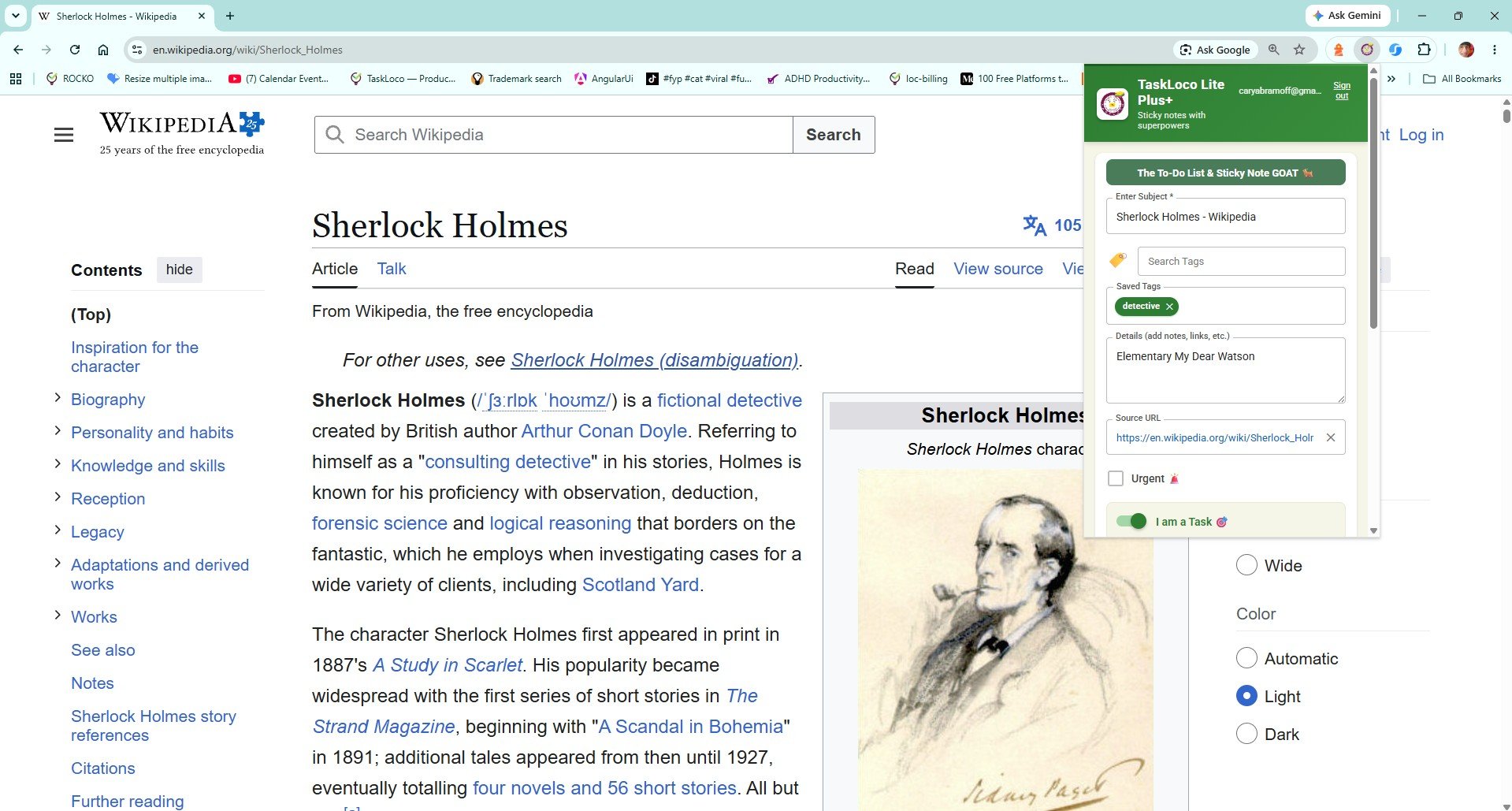
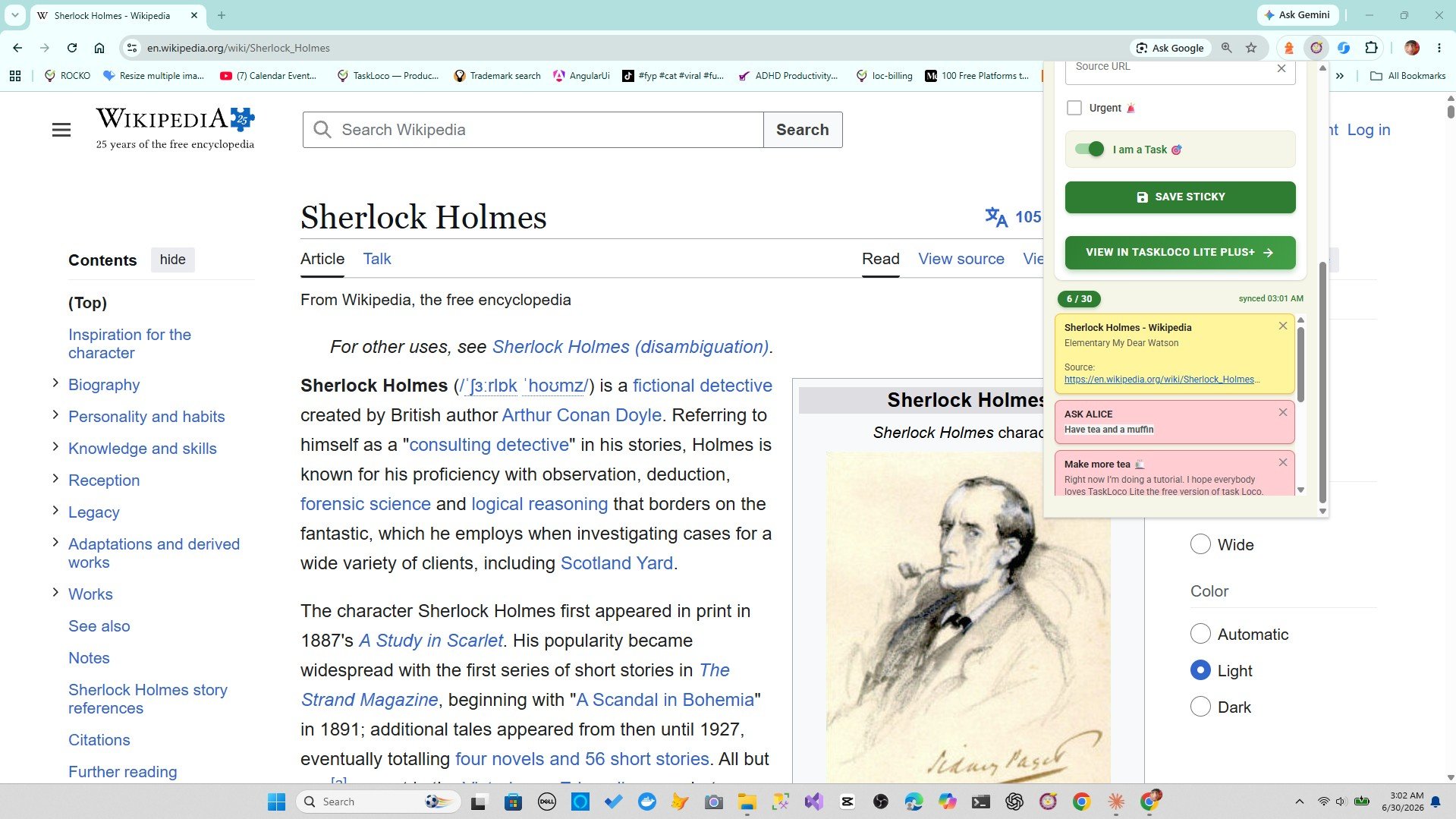
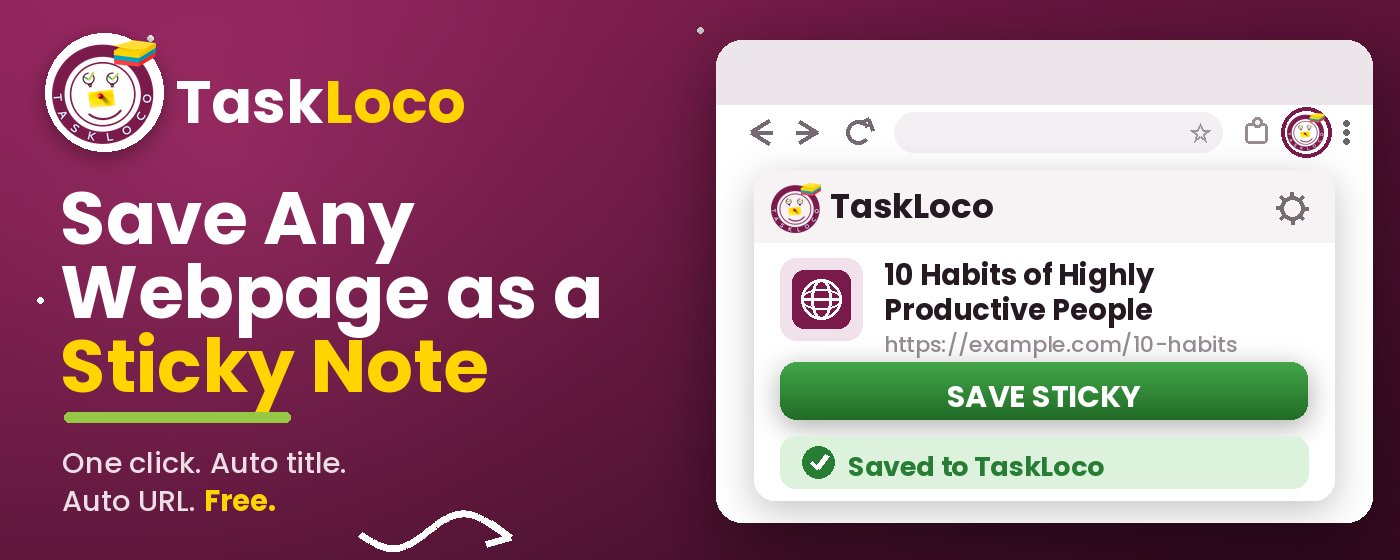
- When you land on any page worth keeping, click the extension icon in your Chrome toolbar. A sticky note appears with the page title and URL already filled in.
- Add a word or two of context if you want, then save. The note is on your TaskLoco wall instantly, and syncs to your phone and desktop.
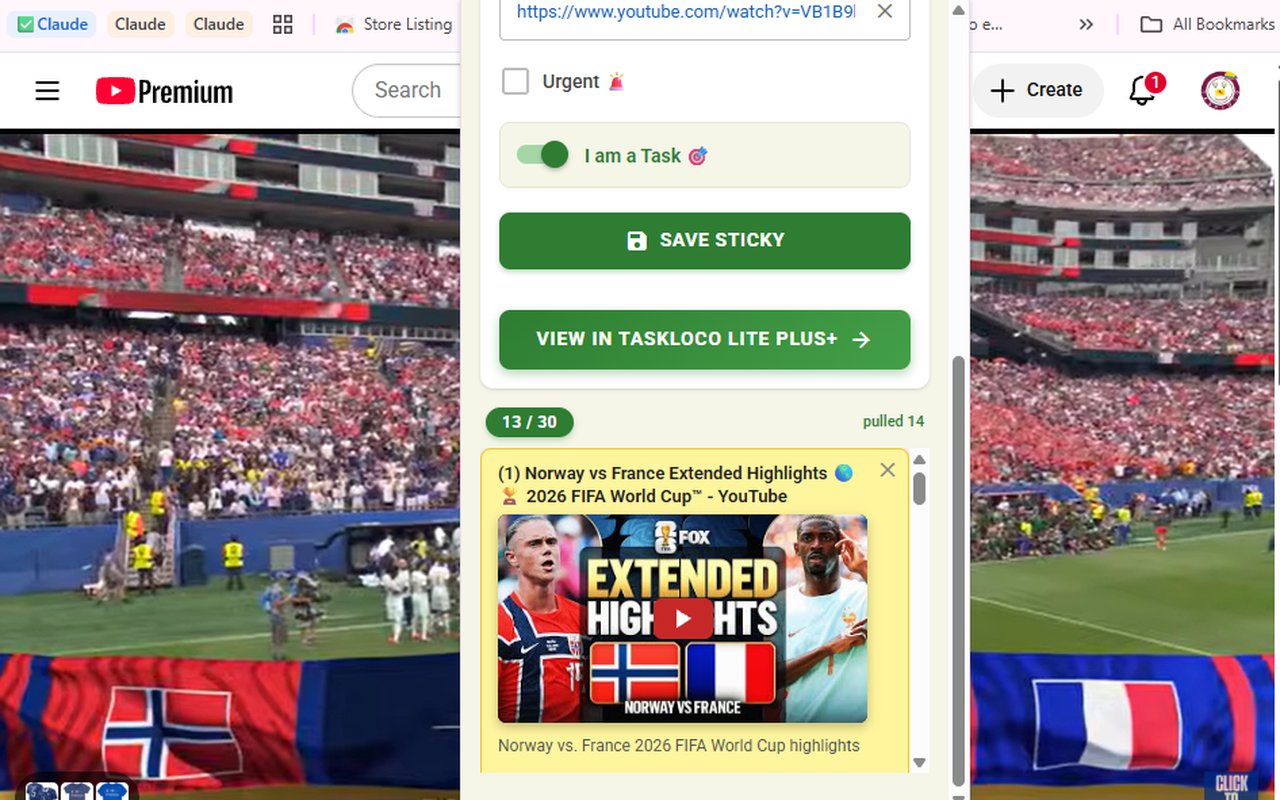
YouTube videos get their own special treatment: clip a video and it embeds directly inside the note, so you can play it right there without hunting for the tab again.
What Makes a Saved Link Actually Retrievable Later
Saving something is only half the problem. The harder half is finding it again when you need it — especially if days or weeks pass between when you saved it and when you want it.
Plain bookmarks fail here because they are unsorted by default and have no visual identity. A URL like medium.com/some-long-slug-with-numbers tells you nothing. You end up scrolling through a list of thirty identical-looking links hoping one rings a bell.
The things that make a saved item retrievable are:
- A readable title — not just a URL. When you can see "How Concrete Became the World's Most Important Building Material" instead of a domain name, your brain finds it in a fraction of the time.
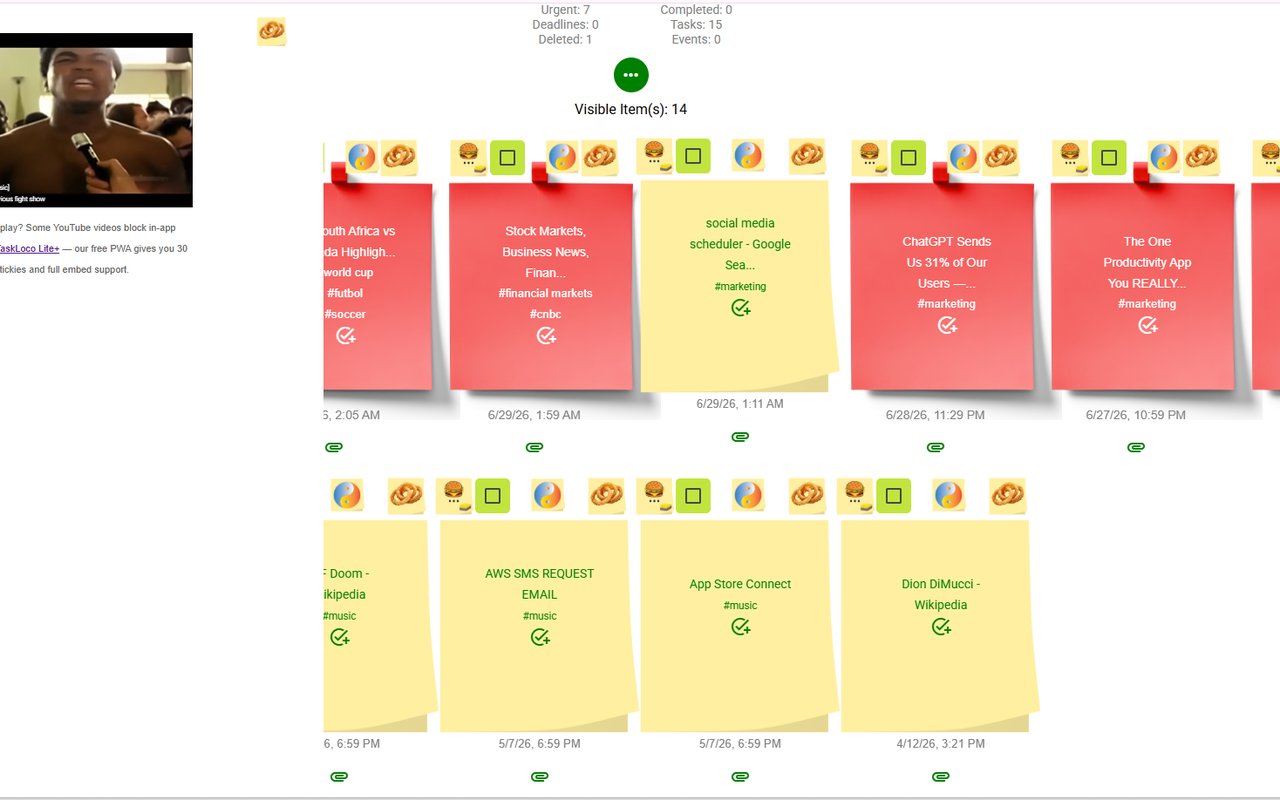
- Visual layout — a wall of cards you can scan beats a flat list you have to read line by line. Spatial memory is real; you remember roughly where on the wall something lives.
- Search and tags — for when visual scanning is not enough. Being able to type one word and surface the right note is the safety net.
- Sync across devices — because you often save something on your laptop and want it on your phone later, or vice versa.
The Sticky Note Web Clipper hits all four. Notes land on a visual wall, are searchable, support tags, and sync across Chrome, desktop, iPhone, and Android through TaskLoco — all free to start with a Google sign-in.
One Practical Habit That Makes This Actually Work
No tool saves you if you never use it. The habit that makes the Sticky Note Web Clipper stick is simple: treat the toolbar icon the same way you treat a physical sticky note on your desk. The moment a page feels worth keeping, click it. Do not decide to "do it later." Later does not exist for tabs.
This works because the clipper removes every micro-decision that kills follow-through. You do not choose a folder. You do not type a title. You do not copy a URL. The note appears, pre-filled, and you confirm it. The whole thing takes about three seconds.
Within a week of using it consistently, most people find they have fewer than five tabs open at a time — because every page they want to keep has been clipped and is safely waiting on their TaskLoco wall, visible and searchable, on any device. The tab bar becomes what it was always meant to be: a place for what you are reading right now, not a chaotic archive of things you once meant to read.
The Sticky Note Web Clipper is free. Install it from the Chrome Web Store, sign in with Google, and every page you clip becomes a sticky note you can find later.
Your clipped notes sync to TaskLoco across Chrome, desktop, iPhone, and Android — also free to start. No credit card to begin.
Get the Free Clipper
Sticky Note Web Clipper
- Free Chrome extension
- One-click save — any page, article, or video
- Title & URL auto-filled
- Tags & search
- Free forever
Synced to TaskLoco
- Sign in free with Google
- Your wall on Chrome, desktop, iPhone, Android
- YouTube videos embed & play in notes
- Visual sticky-note wall
- Free to start
Add It to Chrome — Free
One click saves any page, article, or YouTube video as a sticky note. Title and URL auto-filled.
Add to Chrome — FreeSee TaskLoco in Action
Frequently Asked Questions
What is the fastest way to save a tab before I close Chrome?
Click the Sticky Note Web Clipper icon in your Chrome toolbar. It saves the current tab as a sticky note — title and URL filled in automatically — in about three seconds. No folder to choose, no typing required.
Why do I keep losing tabs I meant to come back to?
Open tabs have no metadata and no visual identity. When you have more than a handful open, individual tabs become invisible. The fix is to clip pages the moment you decide they matter, not leave them open as a reminder — the act of saving has to be instant or it gets skipped.
Is the Sticky Note Web Clipper free?
Yes — the extension is completely free. Install it from the Chrome Web Store, sign in with Google, and start clipping. TaskLoco, where your notes sync, also has a free tier.
Can I save YouTube videos as well as regular web pages?
Yes. Clip any YouTube video with the extension and it embeds directly inside the sticky note, so you can play it later without searching for the tab again.
Will my saved notes be available on my phone?
Yes. Notes you clip in Chrome sync to your TaskLoco wall, which is accessible on iPhone, Android, and desktop. Sign in with the same Google account anywhere.
How is this different from just bookmarking a page?
Bookmarks are invisible by design — a flat list of URLs you rarely revisit. Sticky notes are visual cards with readable titles laid out on a wall you can actually scan. They also support tags and search, and sync across your devices automatically.
Do I need to add a title or description manually when I clip something?
No. The extension auto-fills the page title and URL the moment you click the toolbar icon. You can add a note or tag if you want, but you do not have to — the saved note is already useful as-is.
Born in Brooklyn. Powered by AWS. Your data stays yours.
TaskLoco is available on iPhone, Android, Chrome, and every web browser.