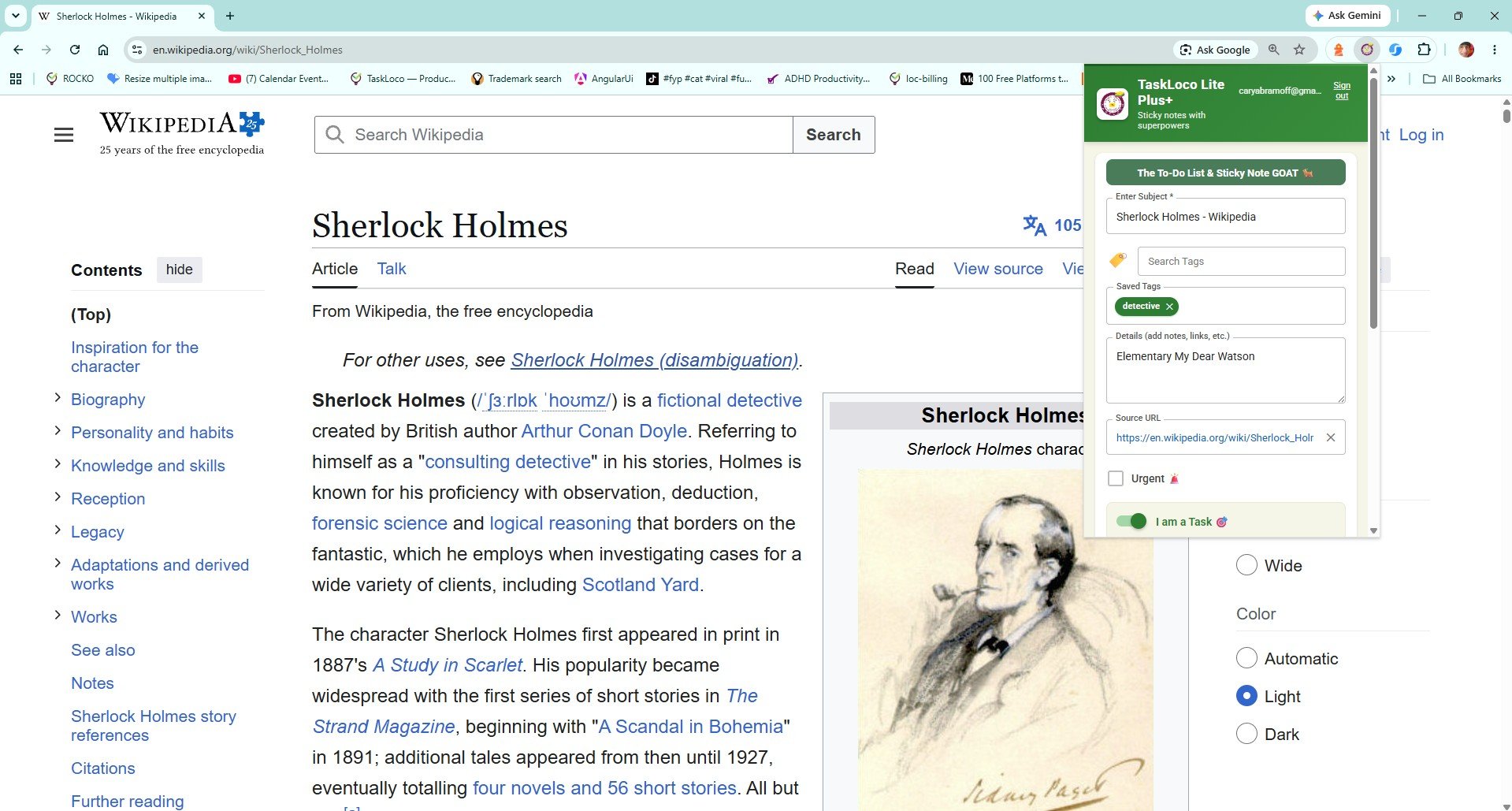
You find a great article. You mean to read it later. Then you close the tab, open something else, and it's gone — not just closed, but genuinely gone, because you have no idea what it was called or where you found it. This happens dozens of times a week to anyone who uses the internet seriously, and the fix is not "just remember to bookmark it."
There are several real methods for saving articles before you close the tab, and they're not all equal. Some take four steps. Some dump links into a list you'll never look at again. Some work great on your laptop and vanish on your phone. This article walks through every practical option — what actually works, what just feels like it works, and the one-click approach that removes the friction entirely.
The Methods That Actually Work (No App Required)
Before getting into extensions or tools, here are the baseline methods — things you can do right now with what you already have.
- Browser bookmarks: Press Ctrl+D (Windows) or Cmd+D (Mac) to bookmark the current tab instantly. It works, it's built in, and it's fast. The problem is the graveyard effect — most people have hundreds of bookmarks they've never looked at again because there's no visual reminder and no context. A link called "Article - The Atlantic" tells you almost nothing six weeks later.
- Bookmark folders: You can create folders (Research, Read Later, Work) to organize bookmarks as you save them. This helps, but it adds a step every time and requires you to already know where something belongs. Under time pressure — like when you're about to close a tab — you usually just dump it in the bar and forget it.
- Copy the URL into a notes app: Open Apple Notes, Google Keep, Notion, or any text editor and paste the link. This works and gives you a place to add context. It's also three to five steps per article, which means you won't do it consistently.
- Email it to yourself: A surprisingly common habit. Open your email client, paste the URL, send. It works, it crosses devices, and your inbox becomes a read-later list. It also turns your inbox into a read-later list, which most people find unbearable after a week.
- Share to a phone app: On mobile, the share sheet lets you send links to apps like Pocket or Apple Notes. On desktop, this doesn't exist natively, which is exactly why browser extensions exist.
Why Most People Lose Articles Anyway
Saving an article feels like a two-second task, so people assume they'll handle it "in a moment" — which is exactly when they close the tab. The friction isn't technical. It's that every existing method asks you to make a decision (where does this go? what do I call it?) at the worst possible moment, when you're already moving on to something else.
Bookmarks don't show you what the article looked like. A list of URLs is almost impossible to scan visually. And if your saves don't sync to your phone, anything you saved on your laptop is effectively inaccessible the next time you're on the couch wanting to read.
There's also the retrieval problem, which is separate from the saving problem. Even if you save something perfectly, if you can't find it later — by keyword, by topic, by when you saved it — it might as well be lost. A flat bookmark folder with 300 links is not a retrieval system.
This is why dedicated web clippers exist, and why the ones that reduce saving to a single click have a genuine advantage over everything else. When saving costs you zero decisions and under a second, you do it every time without thinking about it.
How a One-Click Clipper Changes the Habit
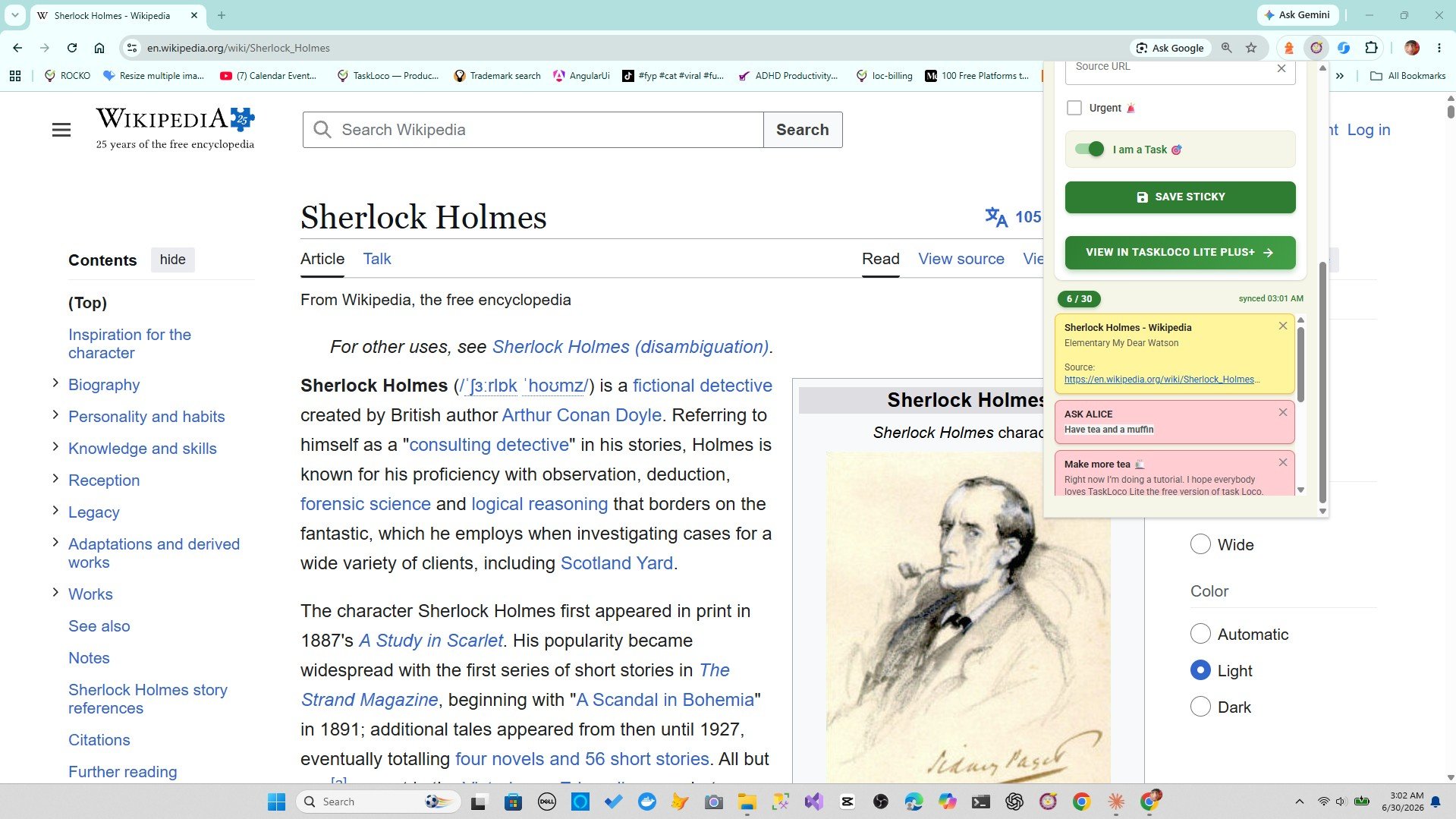
A web clipper is a browser extension that sits in your toolbar and captures the current page when you click it. The best ones auto-fill the title and URL so you don't have to type anything. The difference between a one-click clipper and a bookmark is mostly visual and organizational — a clipper saves to a dedicated space that's designed for retrieval, not just storage.
The Sticky Note Web Clipper (free, from TaskLoco) takes this a step further by saving each page as a visual sticky note. When you click the toolbar icon on any article, news story, or YouTube video, it captures the page title and URL automatically and creates a note on your TaskLoco wall. You can add tags, search by keyword, and the whole thing syncs across Chrome, desktop, iPhone, and Android — so what you clip at your desk is waiting on your phone when you want to read it.
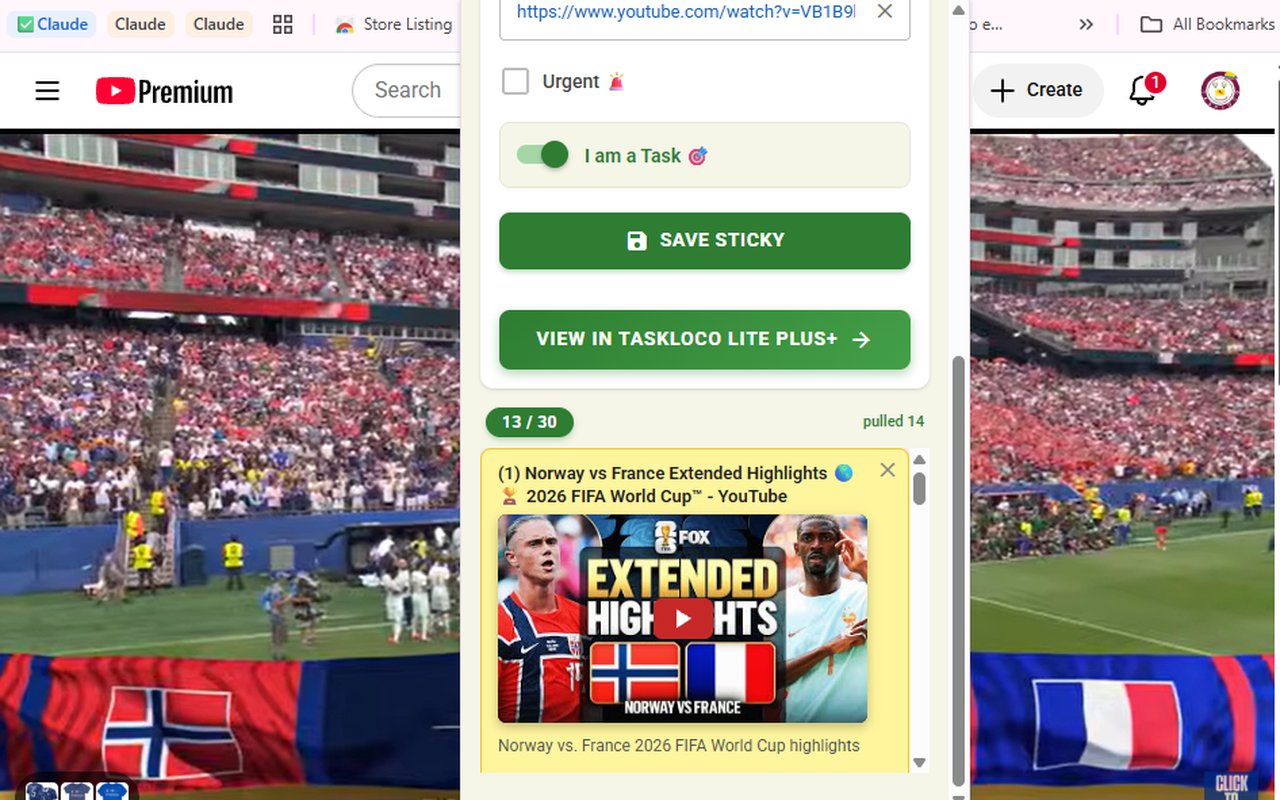
YouTube videos are handled especially well: the saved note embeds the video so it plays directly inside the note, without needing to go back to YouTube. For research, recipes, tutorials, or anything visual, that's a meaningful difference from a plain URL in a bookmark folder.
- One click: No form, no folder selection, no naming. The page is saved the moment you click.
- Auto-filled title and URL: You don't type anything. The note is already labeled correctly.
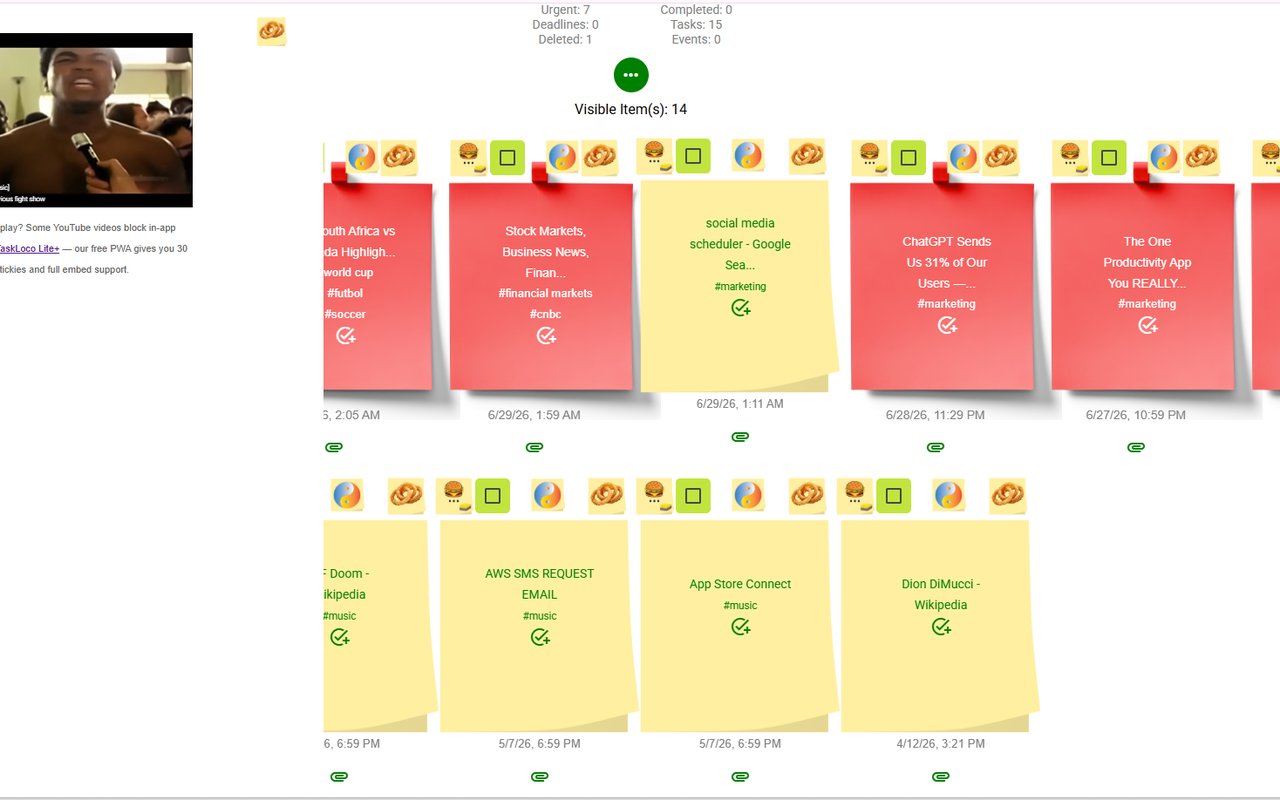
- Visual layout: Notes look like notes, not a list of blue links. You can scan what you saved.
- Tags and search: Find anything you clipped by keyword or tag without scrolling through a list.
- Syncs everywhere: Clip on Chrome, read on your phone. No manual export required.
Building a Saving Habit That Actually Holds
The goal isn't just to save one article — it's to stop losing things you meant to come back to. That requires a habit, and habits only stick when they're frictionless enough to do automatically.
A few things that help:
- Keep your clipper icon visible: Pin your extension to the Chrome toolbar so it's always in sight. Out of sight genuinely means out of mind when you're moving fast between tabs.
- Clip first, read later: Don't decide whether something is worth saving before you save it. If you opened the tab, clip it. You can always delete it. You can't recover a closed tab you forgot to save.
- Use tags immediately: When you clip, add one tag — "read," "research," "recipes," whatever fits. One tag takes three seconds and transforms retrieval from a search into a filter.
- Review your wall weekly: Set a five-minute habit of going through what you've clipped. Delete what's no longer relevant. This keeps your saved items useful instead of becoming the digital equivalent of a junk drawer.
- Clip YouTube videos too: If a tutorial or explainer is worth watching, clip it the same way. The embedded playback in the Sticky Note Web Clipper means you'll actually go back and watch it, instead of losing the URL in a tab you eventually closed.
The underlying principle is simple: the best saving system is the one you actually use. A complicated system with perfect organization that you use inconsistently is worse than a simple system you use every single time. One click, no decisions, syncs to your phone — that's the version that holds.
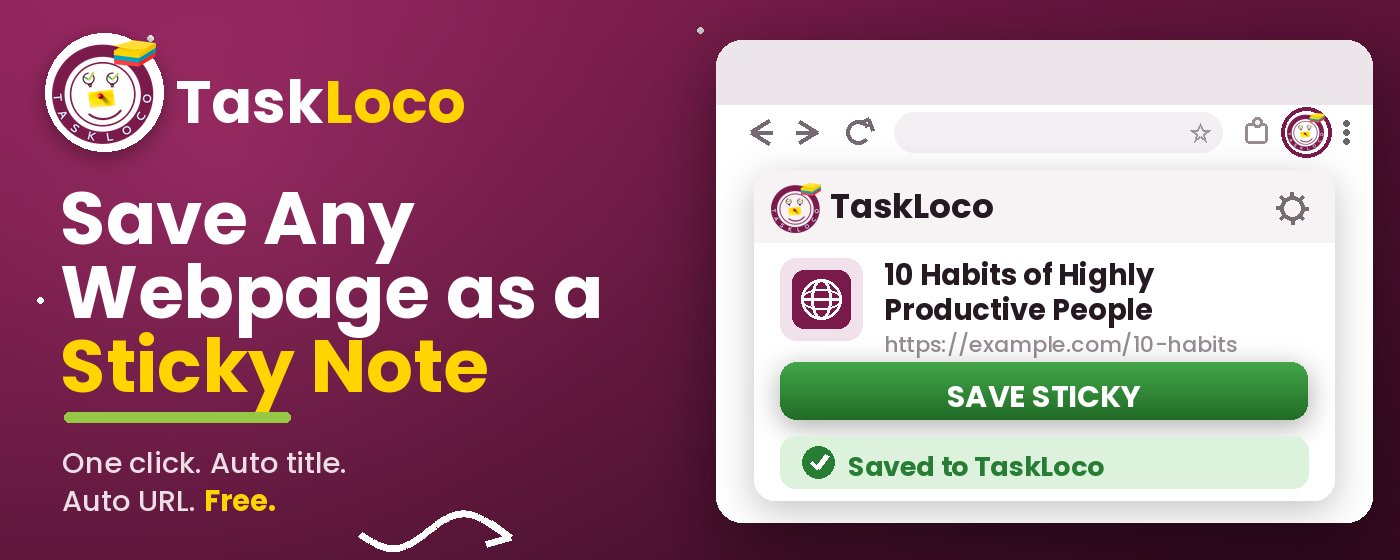
The Sticky Note Web Clipper is free. Install it from the Chrome Web Store, sign in with Google, and every page you clip becomes a sticky note you can find later.
Your clipped notes sync to TaskLoco across Chrome, desktop, iPhone, and Android — also free to start. No credit card to begin.
Get the Free Clipper
Sticky Note Web Clipper
- Free Chrome extension
- One-click save — any page, article, or video
- Title & URL auto-filled
- Tags & search
- Free forever
Synced to TaskLoco
- Sign in free with Google
- Your wall on Chrome, desktop, iPhone, Android
- YouTube videos embed & play in notes
- Visual sticky-note wall
- Free to start
Add It to Chrome — Free
One click saves any page, article, or YouTube video as a sticky note. Title and URL auto-filled.
Add to Chrome — FreeSee TaskLoco in Action
Frequently Asked Questions
What's the fastest way to save an article before closing a tab?
The fastest method is a one-click browser extension. The free Sticky Note Web Clipper adds a toolbar icon to Chrome — click it on any page and the article is saved as a sticky note with the title and URL auto-filled. No typing, no folder selection, no decisions.
Can I just use browser bookmarks to save articles?
Yes, and bookmarks are a perfectly valid starting point. The limitation is that bookmarks are flat links with no visual layout and no built-in search or tagging system. After you've saved a few hundred, finding a specific article becomes difficult. A visual clipper like the Sticky Note Web Clipper makes retrieval much easier because notes are scannable and searchable.
What happens if I close a tab before I save it?
In Chrome, you can press Ctrl+Shift+T (Windows) or Cmd+Shift+T (Mac) to reopen the most recently closed tab. This works for a session, but once you close the browser or clear history, recently closed tabs are gone. The reliable fix is to clip articles before you close them — one click is faster than any recovery method.
Will my saved articles be available on my phone?
Yes. When you clip a page using the Sticky Note Web Clipper, it saves to your TaskLoco wall, which syncs across Chrome, desktop, iPhone, and Android. Sign in with your free Google account and everything you clip on your computer is available on your phone.
Can I save YouTube videos the same way as articles?
Yes. The Sticky Note Web Clipper works on YouTube pages just like any other tab. When you clip a YouTube video, it saves as a note that embeds the video — so you can play it directly from your TaskLoco wall without navigating back to YouTube.
Is the Sticky Note Web Clipper free?
Yes — the extension is completely free. Install it from the Chrome Web Store, sign in with Google, and start clipping. TaskLoco, where your notes sync, also has a free tier.
How do I find an article I saved weeks ago?
In TaskLoco, you can search by keyword or filter by tags you applied when you clipped. If you added even a single tag — like 'research' or 'recipes' — finding the right note takes seconds. This is the main advantage over a bookmarks folder, where you'd have to scroll through everything manually.
Born in Brooklyn. Powered by AWS. Your data stays yours.
TaskLoco is available on iPhone, Android, Chrome, and every web browser.