You're three paragraphs into a long read — a deep investigation, a technical tutorial, a recipe with a story you actually want to follow — and something yanks you away. You bookmark it and forget it. You leave the tab open until it vanishes in a crash. You screenshot it, and the screenshot lives in your camera roll forever, untouched.
None of those approaches solve the actual problem: you need to save the article in a way that puts it back in front of you at the right moment, with zero effort to retrieve it. That takes more than a bookmark. This guide covers the real options — including what makes some work and most fail — and finishes with the fastest method that actually sticks.
Why Most Save Methods Fail Before You Come Back
The core problem is not saving — it is retrieval. Most people are reasonably good at stashing things away. The failure happens 48 hours later when you have no memory of where you put it.
Browser bookmarks are the default choice, and they are genuinely terrible for this use case. Bookmarks have no visual thumbnail, no context, and no organization beyond folders you probably stopped maintaining. Research consistently shows that people retrieve bookmarks at shockingly low rates. They go in, they do not come out.
Open tabs feel like a solution because the article is right there. But tabs multiply. A browser session with 40 tabs is not a reading list — it is anxiety. Tabs are also fragile: a crash, a forced restart, or a device switch wipes them. And on mobile, Chrome aggressively suspends or discards tabs you haven't touched in a few days.
Screenshots and copy-pasted notes strip the URL. You capture the content but lose the source. Going back later to find the original, verify a quote, or share it becomes a mini investigation.
The Right Way to Save an Unfinished Article (Step by Step)
The most reliable method pairs a low-friction capture with a system that resurfaces items visually. Here is how to build that habit:
- Capture the moment you decide to save — not after you finish, not when you switch apps. The decision to save should happen in the same second as the save itself. Any extra steps create drop-off.
- Keep the URL attached — always. A title without a URL is nearly useless for finding the original. Make sure whatever you use auto-captures the link, not just the headline.
- Save to a place you actually look — not a folder buried in Bookmarks Manager, not a notes app you open once a month. Your save destination needs to be somewhere in your regular workflow.
- Make it visual — a wall of link text is just as forgettable as a folder of bookmarks. When saved items show a title card, a snippet, or a visual note, your brain re-recognizes them faster and you actually go back.
- Make sure it works on your phone — half of the time you will want to finish that article on a commute or on the couch. If your saves don't sync to mobile, you've solved only half the problem.
That's the framework. The tool you use to execute it matters, but the discipline of capturing immediately and saving somewhere visible is the real habit to build.
One Method That Checks Every Box: The Sticky Note Web Clipper
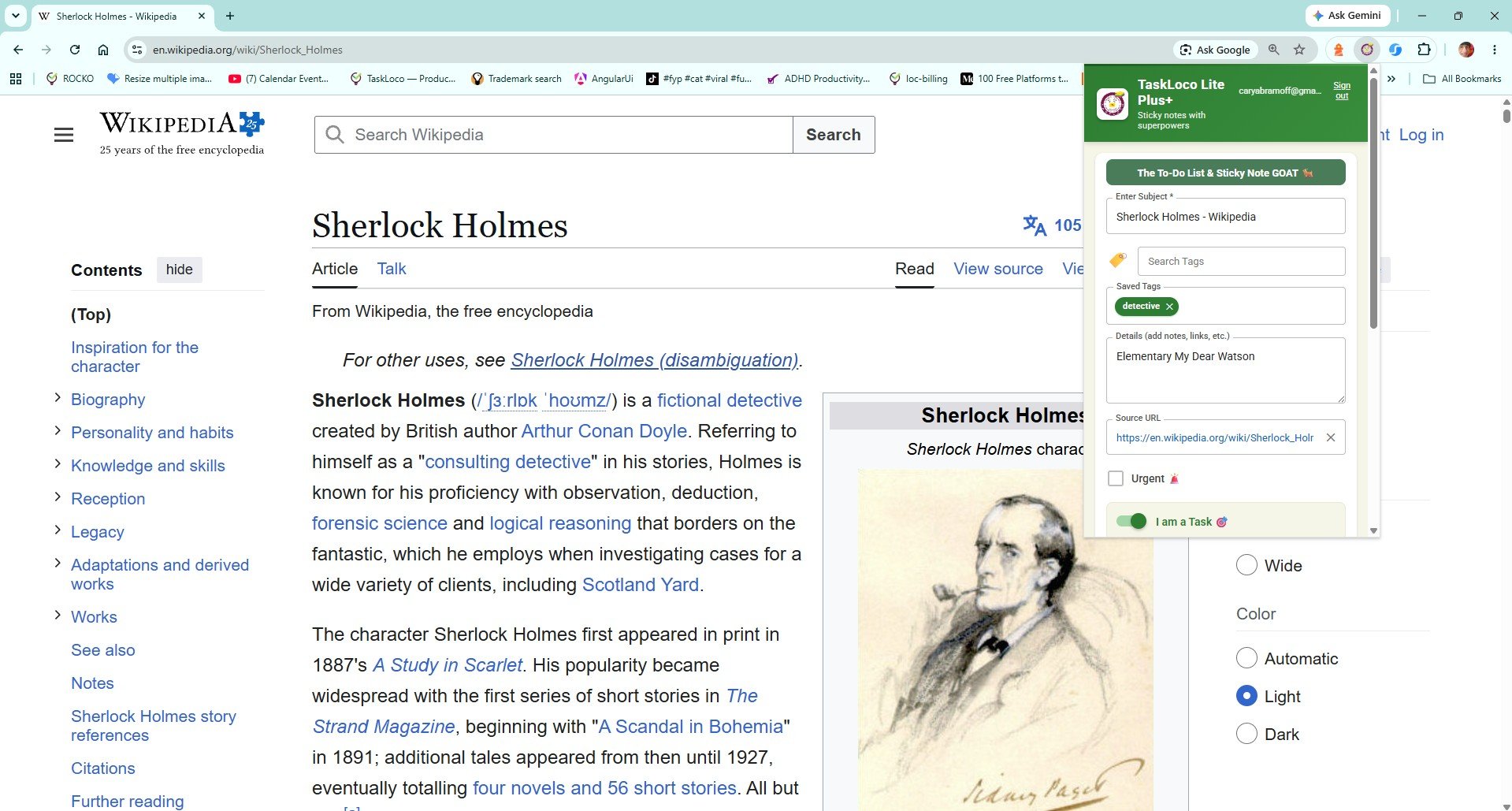
If you want a tool built exactly for this workflow, the Sticky Note Web Clipper — a free Chrome extension by TaskLoco — handles the entire checklist above in a single click.
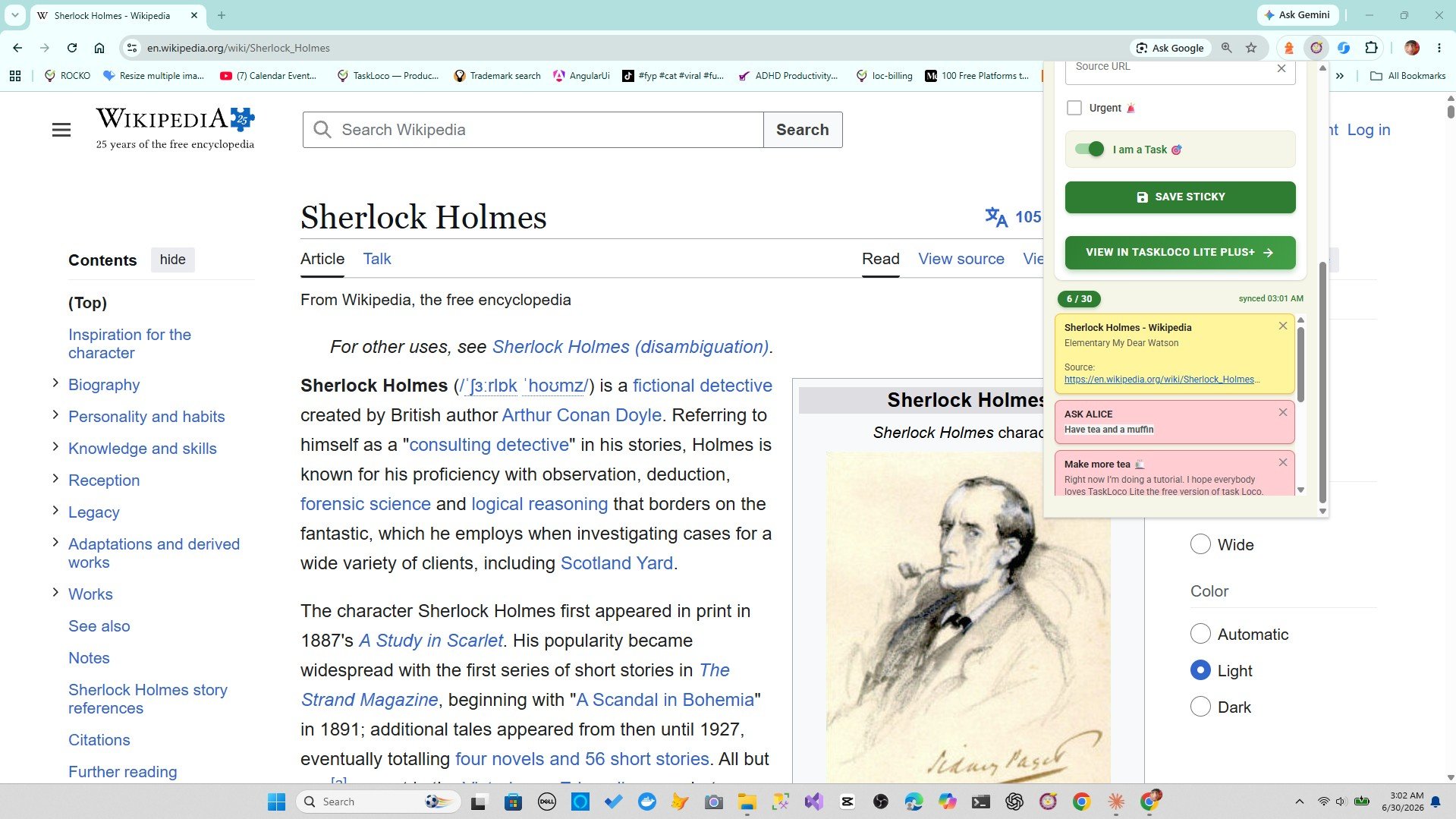
When you hit an article you can't finish, you click the toolbar icon. The extension saves the page as a sticky note with the title and URL already filled in. No copy-pasting, no renaming, no folder-picking. The tab can close. The article isn't going anywhere.
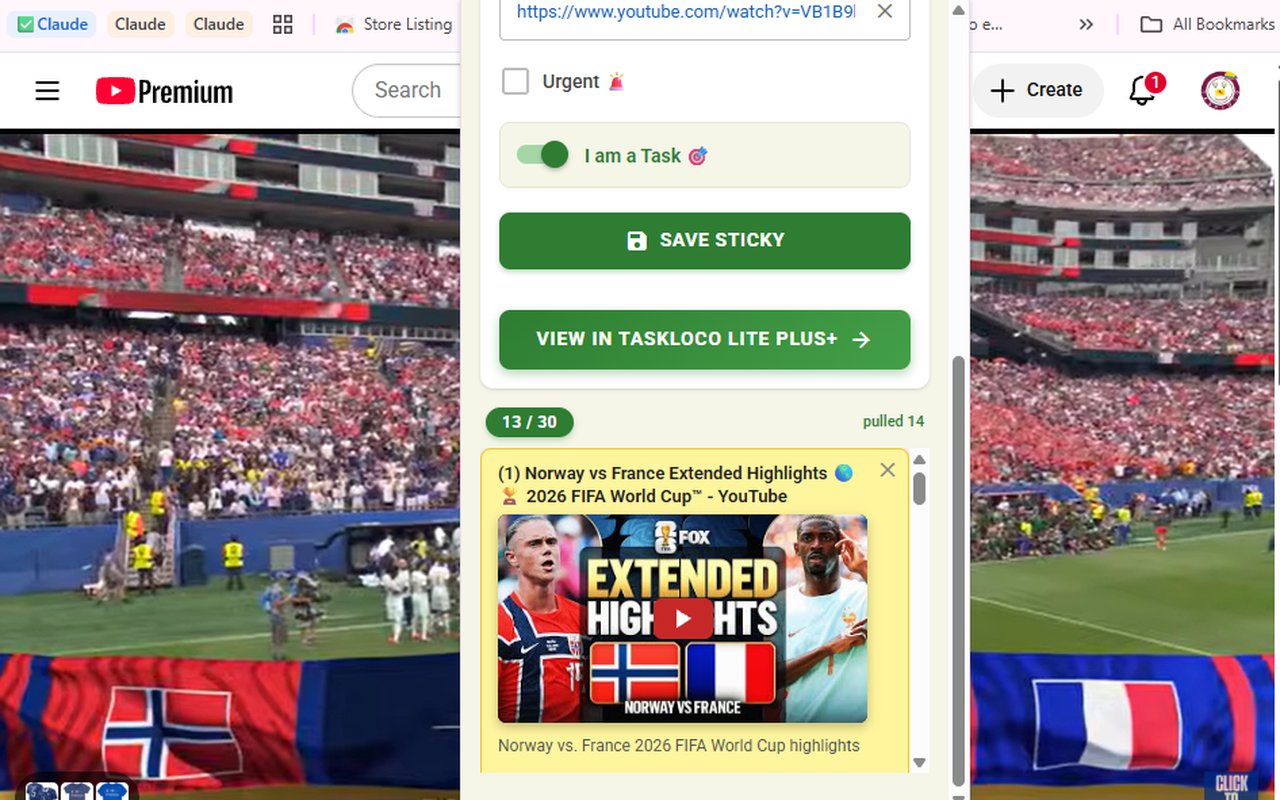
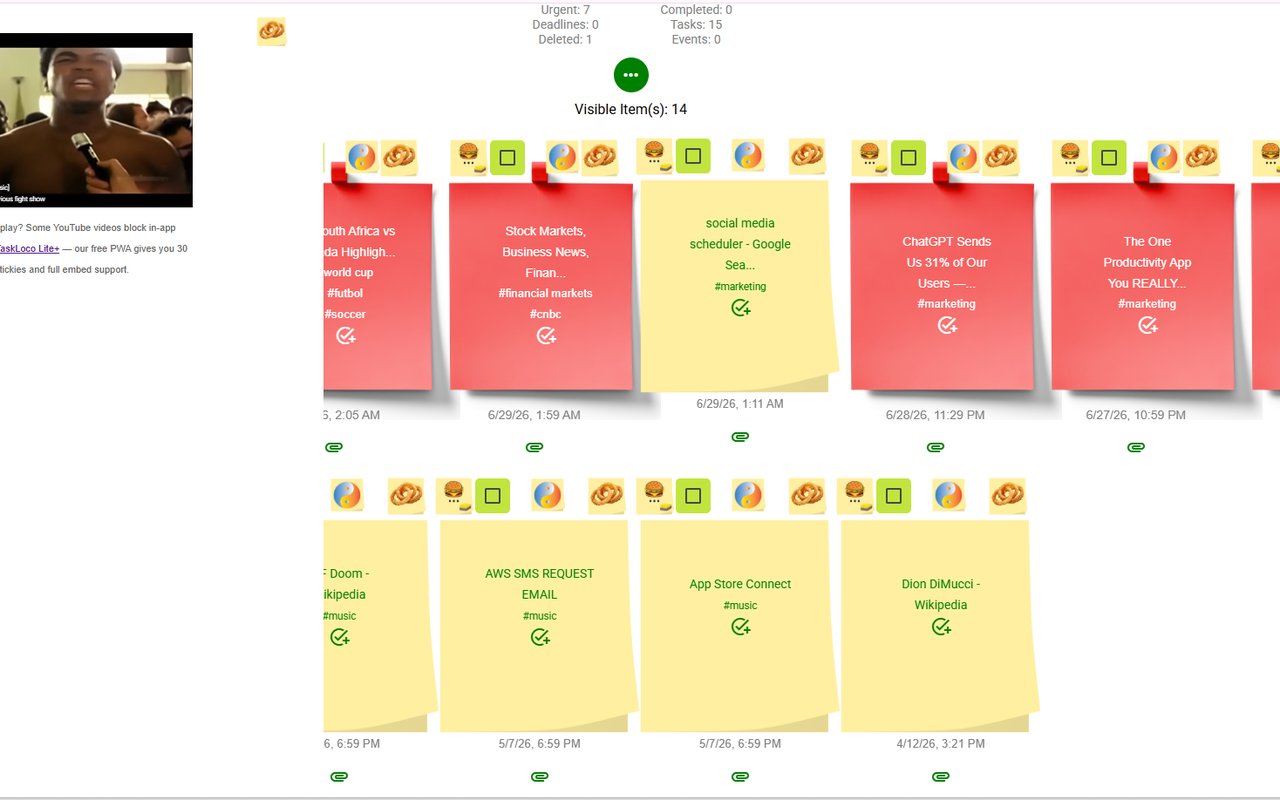
What makes it different from a bookmark is the format. Each saved page becomes a visual note on a wall you can actually browse — not a list of blue text links in a drawer you never open. YouTube videos clip too, and they embed inside the note so you can watch without hunting for the original tab.
Everything syncs free to TaskLoco across Chrome, desktop, iPhone, and Android. So the article you clip on your laptop at work is waiting on your phone tonight. Tags and search let you find it by topic when you're ready to read.
Building a Habit That Actually Gets You Back to Your Saved Articles
A tool is only as good as the habit around it. Here are the behaviors that separate people who have a working read-later system from people who just have a longer bookmark graveyard:
Use one place. The biggest mistake is spreading saves across bookmarks, notes apps, screenshots, and a read-later service simultaneously. Pick one destination and route everything there. When you know every saved article is in the same place, retrieval becomes automatic.
Review on a trigger, not a schedule. Telling yourself you'll read saved articles every Sunday at 9am rarely works. Instead, link the review to something you already do — waiting for coffee, a commute, the first five minutes of lunch. The visual wall makes this easy because you can see at a glance what looks interesting right now.
Save generously, cull occasionally. Don't over-filter at the point of saving. If something looks interesting, clip it. Once a week, delete the things that no longer seem relevant. A slightly overfull visual wall is far more useful than an empty one because you were too selective.
Keep the extension in your toolbar. If the clipper is buried in an overflow menu, you will not use it. Pin it so the save action is one visible click away from any article.
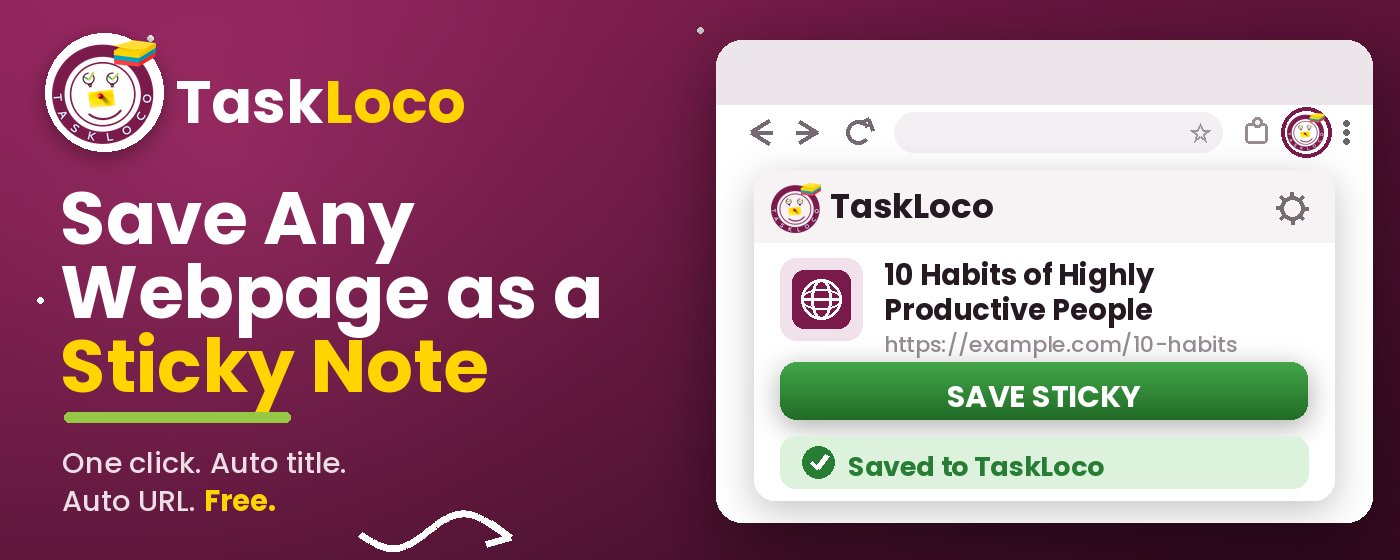
The Sticky Note Web Clipper is free. Install it from the Chrome Web Store, sign in with Google, and every page you clip becomes a sticky note you can find later.
Your clipped notes sync to TaskLoco across Chrome, desktop, iPhone, and Android — also free to start. No credit card to begin.
Get the Free Clipper
Sticky Note Web Clipper
- Free Chrome extension
- One-click save — any page, article, or video
- Title & URL auto-filled
- Tags & search
- Free forever
Synced to TaskLoco
- Sign in free with Google
- Your wall on Chrome, desktop, iPhone, Android
- YouTube videos embed & play in notes
- Visual sticky-note wall
- Free to start
Add It to Chrome — Free
One click saves any page, article, or YouTube video as a sticky note. Title and URL auto-filled.
Add to Chrome — FreeSee TaskLoco in Action
Frequently Asked Questions
What is the fastest way to save an article to read later?
Click a browser extension that captures the current page in one action — title and URL auto-filled, no copy-pasting. The free Sticky Note Web Clipper does exactly that: one click on the toolbar icon and the article is saved as a visual sticky note you can find again on any device.
Will leaving a tab open save the article reliably?
Not reliably. Tabs disappear in crashes, get discarded by the browser when memory runs low, and don't sync across devices. A tab is a placeholder, not a save. Clipping the article to a persistent note is far more dependable.
Do browser bookmarks work for saving articles to read later?
Technically yes, but practically they fail most people. Bookmarks have no visual preview, no snippet, and quickly pile into folders nobody revisits. Studies on bookmark retrieval are not encouraging. A visual clip with the URL attached is far more likely to get you back to the article.
How do I save an article on my computer and read it later on my phone?
You need a save method that syncs across devices. The free Sticky Note Web Clipper saves articles from Chrome on your computer. The notes sync to TaskLoco, which is available on iPhone and Android, so the article is waiting on your phone without any extra steps.
Can I save YouTube videos the same way as articles?
Yes — the Sticky Note Web Clipper clips YouTube videos just like any other page. The video embeds inside the sticky note and plays right there, so you don't need to hunt for the original tab or remember the video title.
Is the Sticky Note Web Clipper free?
Yes. The extension is free to install from the Chrome Web Store. TaskLoco, where your clipped notes live, also has a free tier. Sign in with Google and start saving — no payment required.
How do I find a saved article after I clip it?
In TaskLoco, your saved notes appear on a visual wall you can browse at a glance. You can also use tags to categorize articles by topic and search to find any saved item by keyword. Both work on the free tier across Chrome, desktop, and mobile.
Born in Brooklyn. Powered by AWS. Your data stays yours.
TaskLoco is available on iPhone, Android, Chrome, and every web browser.