You open an article, think I'll read this later, and hit bookmark. Three months later you have six folders, two named 'Misc', and zero memory of why you saved any of it. Bookmarks were designed for navigation, not reading queues — and that mismatch is why they turn into digital landfill so fast.
There's a better mental model: save things the way you'd stick a note on a wall. Visual, scannable, no hierarchy required. This article walks through why bookmark folders fail, what actually works instead, and the free one-click tool that makes the whole thing effortless.
Why Bookmark Folders Always Collapse Into Chaos
The core problem with bookmarks isn't volume — it's that the act of saving and the act of organizing are forced to happen at the same moment. When you hit Cmd+D, Chrome immediately asks: which folder? You're mid-article, mid-thought, and now you're playing librarian. Most people either dump everything into Bookmarks Bar or spend thirty seconds picking a folder they'll never open again.
Even when you do organize carefully, folders are one-dimensional. An article about remote work productivity could live in 'Work', 'Productivity', 'Reading List', or 'Tools' — and it will only ever be in one of them. When you want it back, you have to remember which category you were in when you saved it. That's a memory test disguised as a filing system.
Then there's the visual problem. A bookmark is a line of text. Forty bookmarks look identical. There's no thumbnail, no context, no at-a-glance signal about what the page actually was. Studies on memory recall consistently show that visual cues dramatically outperform text-only lists for recognition — yet bookmarks give you nothing visual at all.
The result is predictable: most people bookmark aggressively for a few weeks, the folder gets unwieldy, they stop trusting it, and they go back to keeping seventeen tabs open instead.
Three Methods That Actually Work (No Special App Required)
Before reaching for any tool, it helps to understand what actually makes saved content retrievable. Three principles matter most: low friction at save time, visual or descriptive context, and searchability. Any system that nails all three will serve you better than a perfectly organized bookmark folder that costs you ten seconds per save.
1. Use your browser's Reading List instead of Bookmarks Bar. Chrome and Edge both have a built-in Reading List (separate from bookmarks) designed specifically for 'read later' content. It's not visual, but it keeps your to-read pile separate from your navigation bookmarks, which alone reduces the chaos considerably. Access it via the sidebar icon in Chrome. This costs nothing and requires zero setup.
2. Paste links into a plain text file or note. Old-fashioned but underrated. Keep a single rolling document — in Notepad, TextEdit, Apple Notes, or Google Keep — where you paste URLs with a one-line note about why you saved each one. No hierarchy, just chronological. Searchable with Ctrl+F. Ugly but honest. The discipline of writing even four words of context forces you to articulate why something is worth saving, which also filters out the noise.
3. Tag instead of folder. If you're committed to using a bookmark manager, choose one that supports tags rather than folders. Tags are many-to-many: that remote work article can have tags for 'productivity', 'remote', and 'tools' simultaneously. Firefox's bookmark system supports tags natively. Raindrop.io is a popular free bookmark manager that makes tagging its primary organizational model.
None of these require a paid subscription or a new app. If your current system is already one of these and it's working, you don't need to change anything. The next section is for people who want something faster and more visual.
Why Visual Sticky Notes Beat Folders for Reading Queues
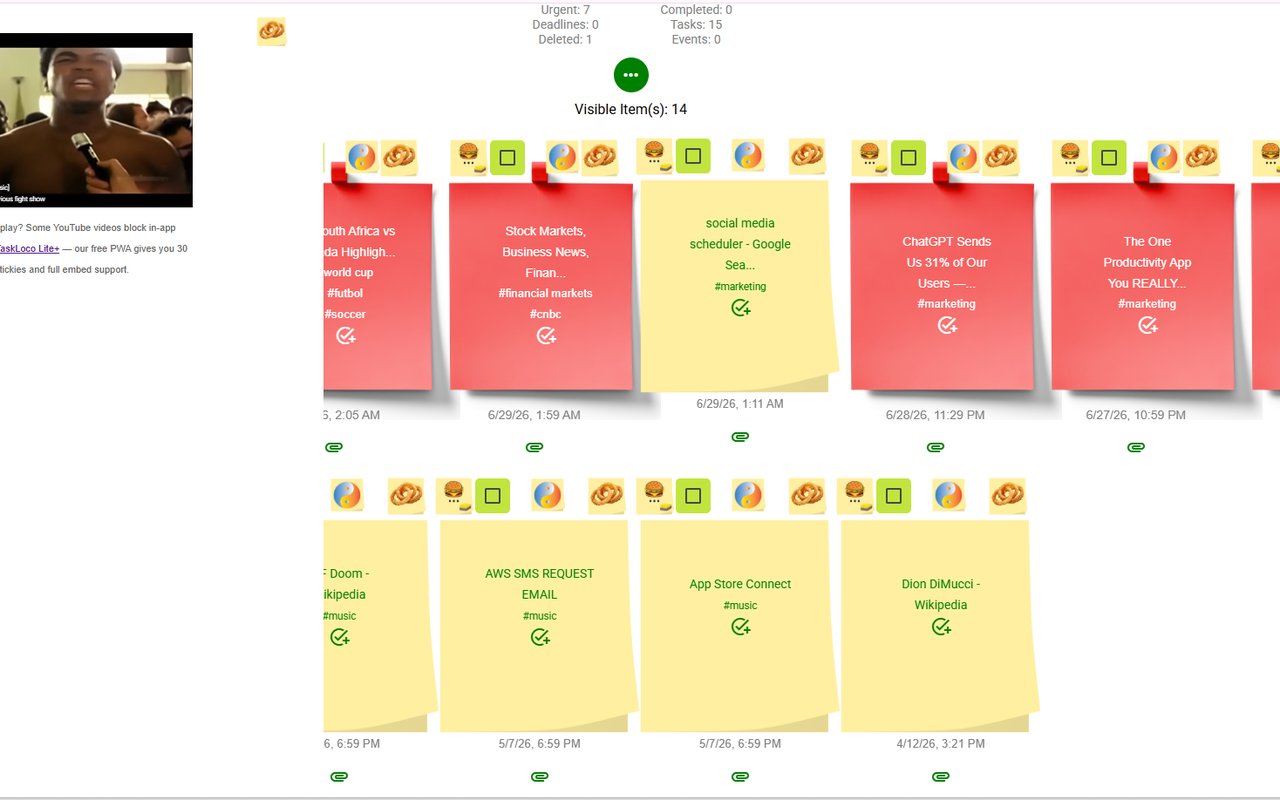
The mental model of a sticky note wall maps surprisingly well onto how people actually manage reading queues. You glance at the wall, spot something by shape and position, grab it. There's no hierarchy to navigate, no folder to remember. Your brain does the spatial indexing automatically.
When a saved article becomes a note card with a title, a URL, and optional tags, a few useful things happen. First, you can scan thirty saved items at once without reading a single line — you're recognizing, not searching. Second, adding a tag like research or longread takes two seconds and doesn't require you to decide where in a hierarchy the item belongs. Third, when you search, you're searching across everything — title, URL, tags — not trying to remember which folder you were in.
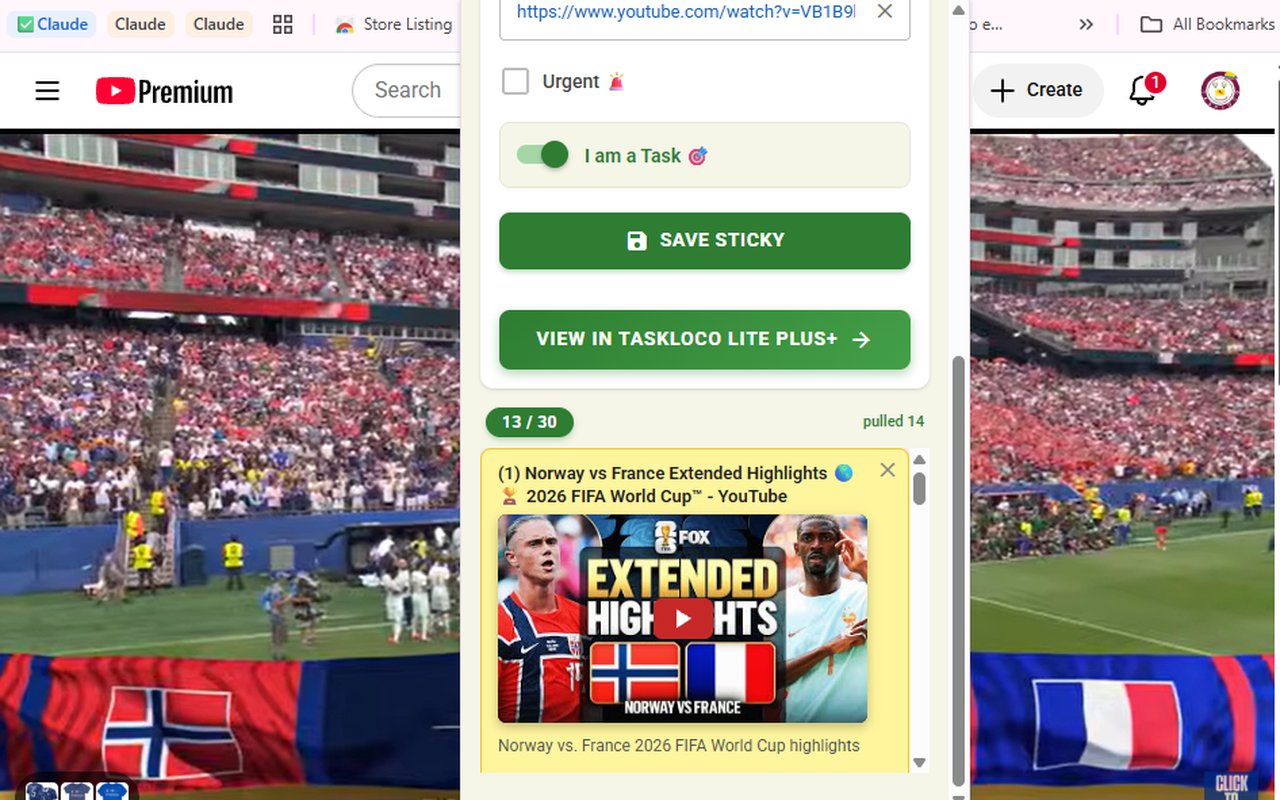
YouTube videos work particularly well in this model. Instead of bookmarking a video URL and losing it in the list, a note can embed the video so it plays directly inside the card — no tab-switching, no hunting for the link. That single feature changes how useful saved video content is in practice.
The downside of doing this manually is obvious: pasting titles, URLs, and thumbnail images into a notes app for every article you want to save takes longer than bookmarking. The only way the sticky note model wins on speed is if the capture step is automated. That's exactly what the one-click approach in the next section does.
One Click to Clip: How the Sticky Note Web Clipper Works
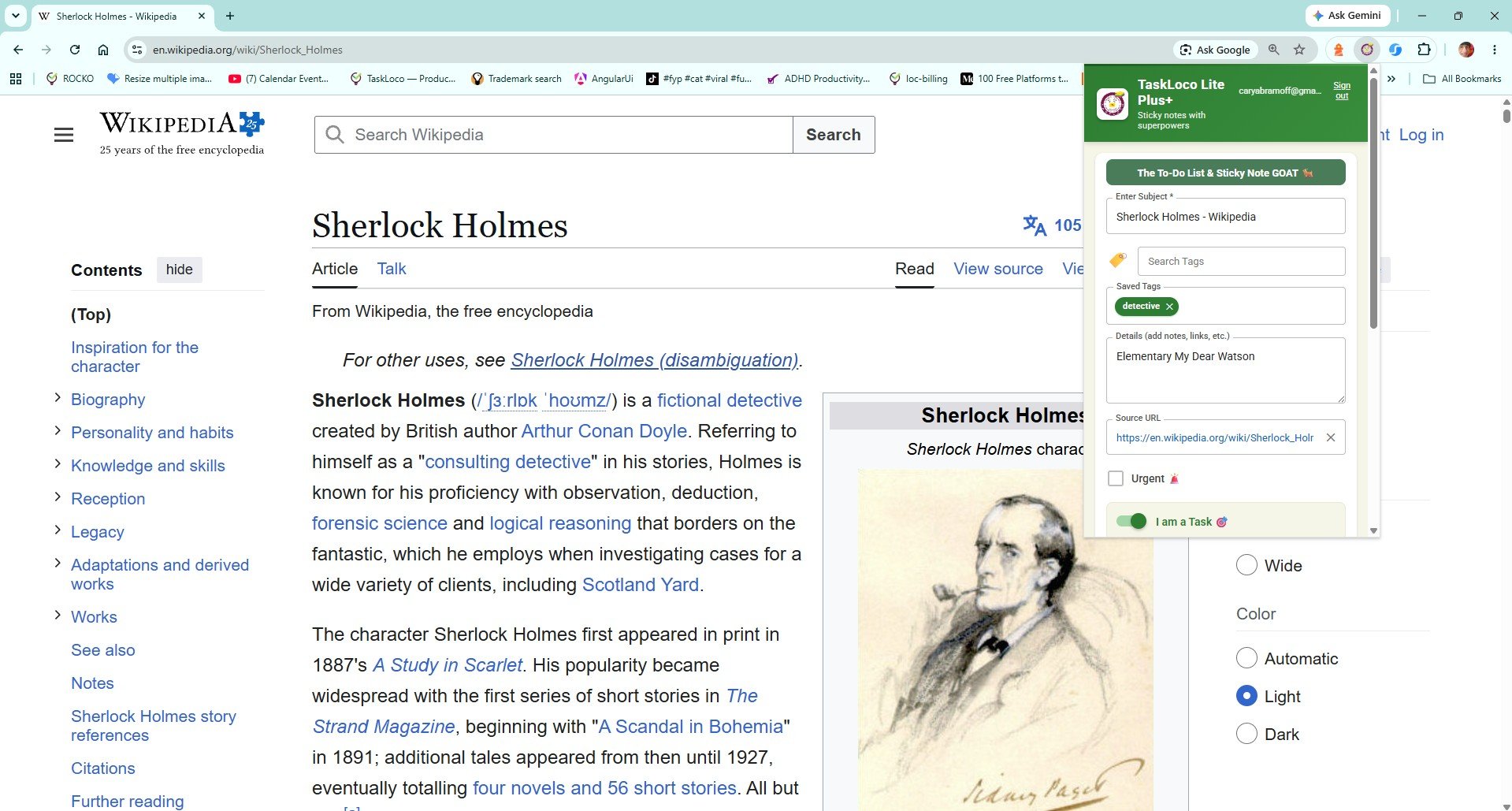
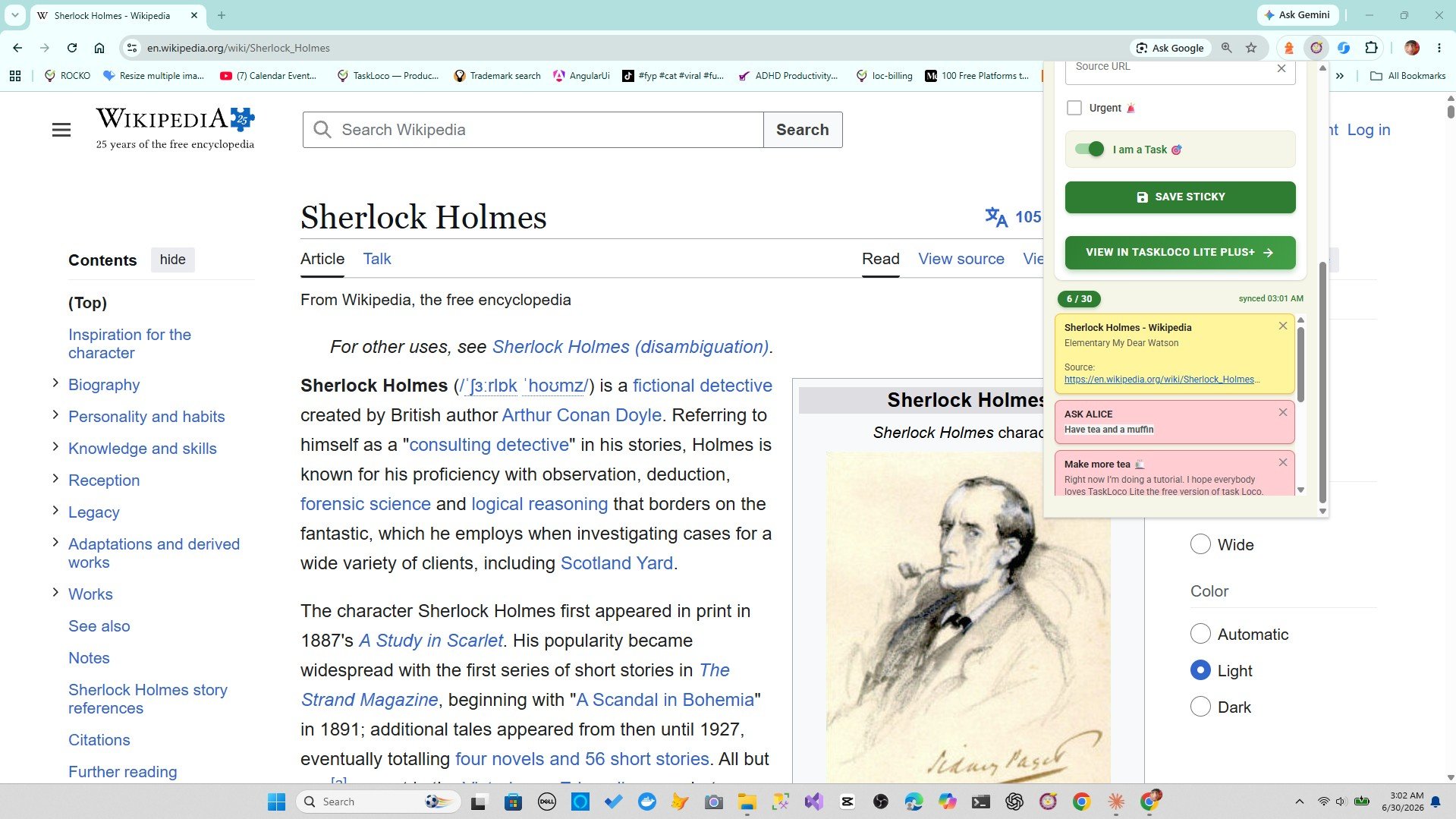
The Sticky Note Web Clipper is a free Chrome extension made by TaskLoco. The whole interaction is one click: you're on any webpage, article, or YouTube video, you click the extension icon in your Chrome toolbar, and the page is saved as a sticky note — title and URL already filled in. That's it. No folder prompt, no copy-paste, no form to fill out.
What you get on the other side is a visual wall of note cards in TaskLoco. Each card shows the page title and URL. You can add tags in a second. YouTube videos embed directly in the note and play without leaving the wall. When you want to find something, you search across all your notes — titles, URLs, tags — in one box.
Because the notes live in TaskLoco, they sync across Chrome, desktop, iPhone, and Android. You clip something on your laptop, pull it up on your phone on the commute home. Sign-in is free with Google.
If you've been managing a folder full of bookmarks that you never revisit, or keeping tabs open because you don't trust your save system, this is the exact problem the clipper was built for. It's free to install from the Chrome Web Store — click Add to Chrome, sign in with Google, and the next article you want to save takes one click.
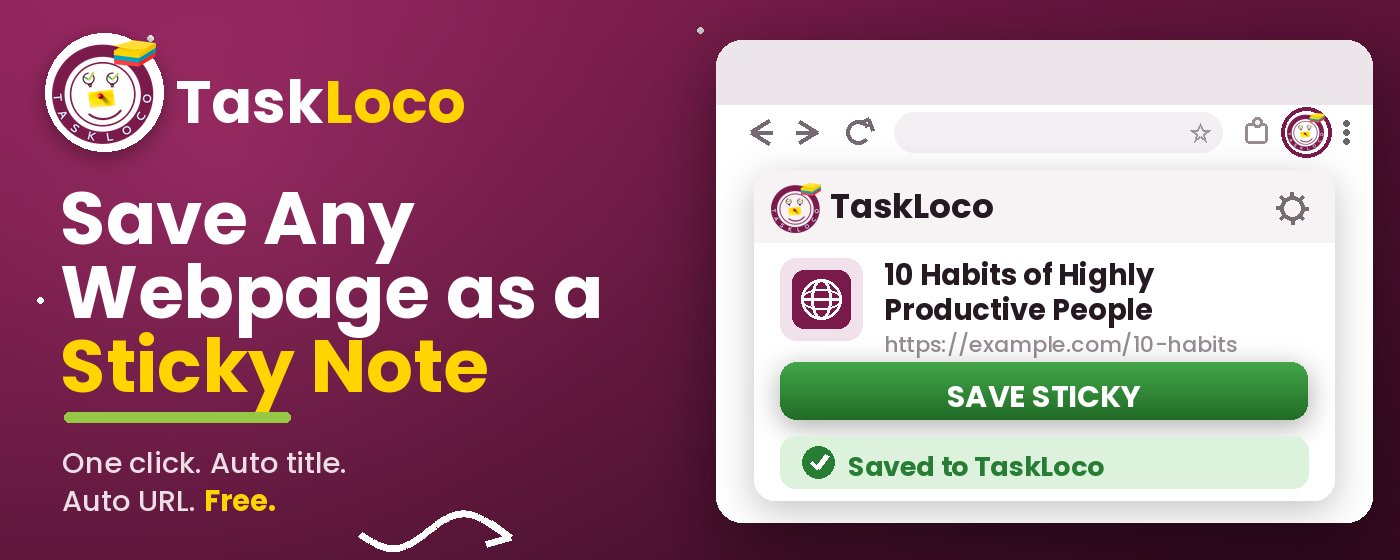
The Sticky Note Web Clipper is free. Install it from the Chrome Web Store, sign in with Google, and every page you clip becomes a sticky note you can find later.
Your clipped notes sync to TaskLoco across Chrome, desktop, iPhone, and Android — also free to start. No credit card to begin.
Get the Free Clipper
Sticky Note Web Clipper
- Free Chrome extension
- One-click save — any page, article, or video
- Title & URL auto-filled
- Tags & search
- Free forever
Synced to TaskLoco
- Sign in free with Google
- Your wall on Chrome, desktop, iPhone, Android
- YouTube videos embed & play in notes
- Visual sticky-note wall
- Free to start
Add It to Chrome — Free
One click saves any page, article, or YouTube video as a sticky note. Title and URL auto-filled.
Add to Chrome — FreeSee TaskLoco in Action
Frequently Asked Questions
What's the fastest way to save articles to read later?
The fastest method is a one-click browser extension that auto-fills the title and URL — no copy-paste, no folder prompt. The free Sticky Note Web Clipper does this: click the Chrome toolbar icon and the page is saved as a visual sticky note instantly.
Why do my bookmark folders always get out of control?
Because bookmarks force you to organize at the moment of saving — exactly when you least want to stop and think about filing. The folder decision creates friction, and when you're in a hurry you either skip it (dumping everything into one place) or you pick a folder you'll forget about. A tag-based or visual note system removes that forced decision.
Is there a way to save web pages as visual notes instead of bookmarks?
Yes. The Sticky Note Web Clipper saves any webpage as a visual sticky note in one click — title and URL auto-filled — which you can scan, tag, and search on a visual wall in TaskLoco. It's a free Chrome extension.
Can I save YouTube videos the same way I save articles?
Yes. When you clip a YouTube page with the Sticky Note Web Clipper, the video embeds directly inside the note and plays without leaving your TaskLoco wall. It works the same way as saving any other page — one click on the toolbar icon.
Does the Sticky Note Web Clipper cost anything?
The extension is free. TaskLoco, where your clipped notes are saved, also has a free tier. Install from the Chrome Web Store, sign in with Google, and you can start clipping immediately at no cost.
Will my saved notes be available on my phone?
Yes. Notes you clip in Chrome sync to TaskLoco and are accessible on iPhone, Android, and desktop. You clip on your laptop and can pull up the same notes on your phone — all on the free tier.
What's better than bookmarks for saving research and reading material?
For reading queues and research, a visual note system with tags and search beats bookmark folders because you organize on your own schedule rather than at save time, and you can scan what you've saved at a glance. The free Sticky Note Web Clipper turns any page into a searchable, visual sticky note in one click — making it a practical upgrade over bookmarks for anyone who actually wants to find things again.
Born in Brooklyn. Powered by AWS. Your data stays yours.
TaskLoco is available on iPhone, Android, Chrome, and every web browser.