Dwight Eisenhower allegedly said: 'I have two kinds of problems — the urgent and the important. The urgent are not important, and the important are never urgent.' Whether he said it in exactly those words is debated. What isn't debated is that he ran the Allied Forces in World War II, then ran the United States for two terms, and still found time to paint, golf, and write. The man clearly had a system.
The Eisenhower Matrix — sometimes called the Urgent-Important Matrix — is that system distilled into a 2×2 grid. It sounds deceptively simple. And like most deceptively simple frameworks, the value isn't in the grid itself. It's in the thinking the grid forces you to do. This page explains what the matrix actually is, why it works, where it quietly fails, and how to get the benefit of the framework without ever drawing a box.
The Four Quadrants — What They Mean and Why They're Ordered That Way
The matrix plots every task on two axes. The horizontal axis runs from Not Urgent to Urgent. The vertical axis runs from Not Important to Important. The intersection creates four quadrants, each with a prescribed action:
- Quadrant 1 — Do (Urgent + Important): Crisis work, deadlines, emergencies. These tasks demand your attention now. The goal isn't to fill this quadrant — it's to drain it.
- Quadrant 2 — Schedule (Not Urgent + Important): Strategic planning, relationship-building, skill development, health. This is where long-term outcomes actually get decided. Most people chronically underinvest here because nothing is screaming for their attention.
- Quadrant 3 — Delegate (Urgent + Not Important): Interruptions, certain meetings, requests that feel pressing but don't actually move your needle. If someone else can handle it, let them.
- Quadrant 4 — Eliminate (Not Urgent + Not Important): Busywork, mindless scrolling, tasks you keep rescheduling because you don't actually need to do them. Cut them.
The ordering matters. Eisenhower's insight — and the reason Stephen Covey popularized this framework in The 7 Habits of Highly Effective People — is that Quadrant 2 is where effective people spend the majority of their time. When you live in Q1, you're in permanent firefighting mode. Q2 work is what prevents Q1 fires from starting in the first place.
Why the Framework Works — and Where It Quietly Breaks Down
The power of the Eisenhower Matrix is in the forced binary. You cannot place a task in 'kind of important.' You have to decide. That decisiveness is the whole point. Most people's productivity problems aren't execution problems — they're prioritization problems. They're doing real work on the wrong things. The matrix fixes that by making the sorting explicit.
There's also a psychological benefit: the framework gives you permission to say no. When you can see that a task is genuinely Q3 or Q4, it's much easier to decline, delegate, or delete it without guilt. The matrix provides a rationale that feels objective, even if the judgment calls underneath are subjective.
That said, the framework has real limitations that practitioners don't talk about enough:
- Urgency is contextual and contagious. If your boss marks everything urgent, your Q1 becomes meaningless. The matrix assumes you have some control over how urgency is defined. In hierarchical environments, you often don't.
- Importance is personal — until it isn't. What's important to you may not align with what's important to your organization or your team. The matrix doesn't account for stakeholder misalignment.
- The grid is a snapshot, not a flow. Tasks migrate between quadrants as deadlines approach and contexts change. A Q2 item from Monday becomes a Q1 item by Friday if you ignored it. Static grids don't capture this drift.
- It doesn't scale with volume. Sorting 15 tasks into four quadrants is clarifying. Sorting 150 tasks is a project in itself. At scale, the act of maintaining the grid becomes its own Q4 activity.
- It ignores effort and dependencies. A task can be urgent, important, and still the wrong thing to do right now because it's blocked by something else or takes six hours you don't have today.
Running the Matrix Without Drawing the Grid
The grid is a teaching tool. Once the mental model is internalized, you don't need to fill out a 2×2 chart every morning. What you actually need are two questions asked about every task before it touches your calendar or your to-do list:
- Does this move something that genuinely matters — to me, to my team, to my goal? (Importance)
- Is there a real, time-sensitive consequence if I don't do this today? (Urgency)
The answers to those two questions are the matrix. Everything else — the quadrant labels, the color coding, the elaborate templates — is scaffolding. Useful when you're learning the framework, expendable once the habit is formed.
Practically, this means your task capture system should make those two questions easy to answer at a glance. Not with a custom field called 'Eisenhower Quadrant' — that's the grid problem in digital form — but with the way a task is written. A task that says 'email back re: invoice' tells you nothing about importance or urgency. A task that says 'send corrected invoice to client — payment blocked until received' answers both questions in one sentence. The context is the classification.
This is why the format of your notes matters as much as the system you use. Capturing tasks as full thoughts — with enough context to make the urgency and importance self-evident — lets you scan a list and apply Eisenhower logic without any formal sorting ceremony.
How TaskLoco Fits Into This Thinking
TaskLoco isn't an Eisenhower Matrix app. It doesn't have quadrant views, it doesn't ask you to tag tasks with Q1 through Q4, and it doesn't have a built-in template for the framework. What it has is something that works better for how most people actually think: sticky notes that travel with context.
In TaskLoco Premium, every note can carry a reminder — delivered as a push notification that deep-links directly back to that note when it fires, so you land exactly where the task lives. That's the urgency layer handled without a separate calendar. Importance is handled by what you write and how you organize your wall: the visual layout of your notes is your priority map, and you arrange it to reflect what actually matters this week.
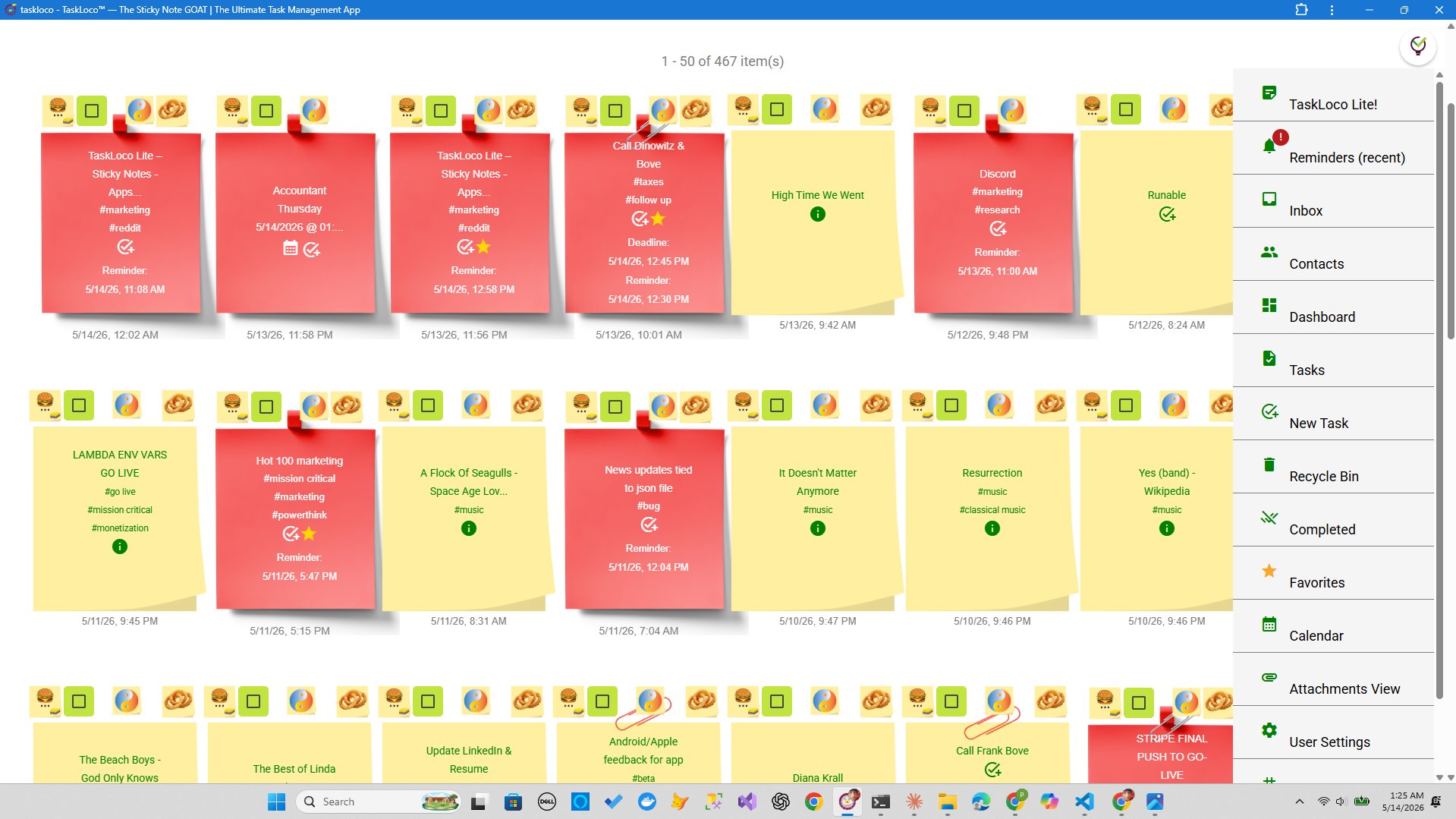
The wall view — the board where all your notes live — functions as a living, rearrangeable version of the Eisenhower logic without the overhead of maintaining a formal grid. Move the urgent and important note to the top left. Move the 'someday maybe' note to the back. The spatial arrangement does the work the quadrant labels are supposed to do, and it updates in real time as your week changes.
Team sharing means the context you capture doesn't stay in your head — it moves to the right person, exactly as a well-run Q3 delegation should. A shared note is cloned by the recipient and becomes their own to act on, no permission juggling required.
For people who want the Eisenhower discipline without building a second job out of maintaining it, TaskLoco is worth a look.
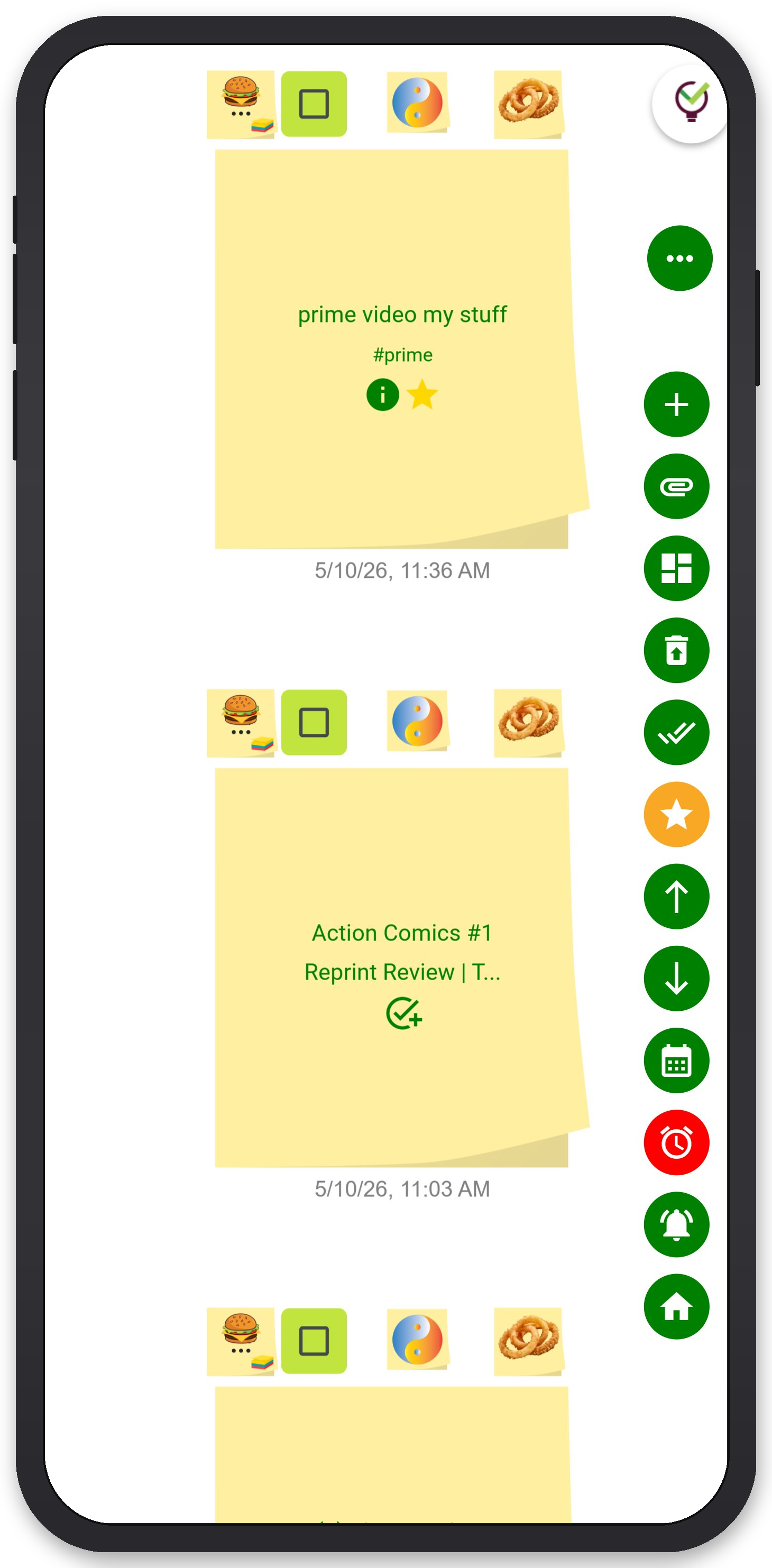
TaskLoco Premium is regularly $9.99/month per person. Right now, charter members can lock in 50% off the regular price — forever. That means $4.99/month per person today. And if our price ever goes up, you still pay half. Always.
Code CHARTER50 auto-applies at checkout. First 500 spots only — once they're gone, this offer is gone permanently. Act fast while spots last.
Every Premium subscription includes unlimited notes, 10GB file storage, reminders, calendar, and team sharing. Each team member requires a separate subscription. 7-day free trial — no charge until day 8. Cancel anytime.
Free Options: TaskLoco
TaskLoco Lite
- Native iPhone & Android app
- Completely anonymous — no sign-in
- Data stays on your device
- Up to 20 notes
- Free forever
TaskLoco Lite Plus+
- Web app + Chrome extension
- Sign in with Google
- Wall syncs across all devices
- Up to 30 notes
- Free forever
Lock In 50% Off — Forever
7-day free trial. No charge until day 8. CHARTER50 auto-applies at checkout.
🔒 Lock In My Charter SpotSee TaskLoco in Action
Frequently Asked Questions
What is the Eisenhower Matrix in simple terms?
The Eisenhower Matrix is a prioritization framework that sorts every task into one of four categories based on whether it is urgent, important, both, or neither. Tasks that are both urgent and important get done now. Tasks that are important but not urgent get scheduled. Tasks that are urgent but not important get delegated. Tasks that are neither get cut. The goal is to spend more time in the 'important but not urgent' category — where strategic, long-term work lives — and less time in reactive firefighting mode.
Did Eisenhower actually invent the Eisenhower Matrix?
The framework is attributed to Dwight D. Eisenhower based on a 1954 speech where he quoted a university president distinguishing between urgent and important problems. However, the 2×2 matrix format as most people know it today was popularized by Stephen Covey in his 1989 book The 7 Habits of Highly Effective People, where it appears as the 'Time Management Matrix.' Eisenhower articulated the philosophy; Covey gave it the grid.
What are the four quadrants of the Eisenhower Matrix?
Q1 — Do: Urgent and important. Handle these immediately — deadlines, crises, emergencies. Q2 — Schedule: Important but not urgent. This is strategic work — planning, learning, relationships. Block time for it or it never happens. Q3 — Delegate: Urgent but not important to you. These feel pressing but don't require your specific attention. Hand them off if you can. Q4 — Eliminate: Neither urgent nor important. These are distractions and busywork. Cut them without guilt.
What is the biggest mistake people make with the Eisenhower Matrix?
Treating urgency and importance as the same thing. Urgency is a time pressure — something has a deadline or someone is waiting. Importance is about impact — does this outcome actually matter? Many people spend their days on tasks that feel urgent but aren't important, because urgent tasks create external pressure while important tasks require internal discipline. The matrix forces you to separate these two feelings and act on the distinction.
Can the Eisenhower Matrix work for team task management?
Yes, but with a significant caveat: importance is often defined differently across a team. What's Q2 for one person may be Q1 for another, depending on their role and what they're accountable for. When using the matrix in a team context, it helps to align on definitions first — what counts as 'important' for this team, this quarter — before sorting tasks. Without that shared definition, the matrix can fragment rather than align priorities.
Do I need a special app to use the Eisenhower Matrix?
No. The matrix is a mental model, not a software feature. You can run it on paper, in any note-taking tool, or entirely in your head once you've internalized the two questions: Is this important? Is this urgent? That said, the tool you use should make it easy to capture tasks with enough context that the answers to those questions are self-evident when you review your list. A task with full context is its own prioritization signal.
Where does the Eisenhower Matrix break down?
It breaks down in a few predictable places: when urgency is externally defined and out of your control (everything is 'urgent' by default); when task volume is high enough that maintaining the grid becomes its own overhead; when tasks are blocked by dependencies the matrix doesn't track; and when importance is poorly defined or misaligned between stakeholders. The framework is best used as a judgment-training tool rather than a permanent bureaucratic system.
Born in Brooklyn. Powered by AWS. Your data stays yours.
TaskLoco is available on iPhone, Android, Chrome, and every web browser.