You found the perfect source. You read the abstract, skimmed the key findings, and thought: I need this later. So you bookmarked it. Three weeks later you're staring at a folder called 'Research' with 47 untitled links and absolutely no memory of why any of them seemed important.
The problem isn't that you saved too much — it's that you saved nothing about what you saved. A URL without context is just noise. What actually helps you later is the one-sentence reason you had in your head the moment you hit save: this contradicts the Müller study, good stats for the intro, follow up on the methodology section. The Sticky Note Web Clipper is built around exactly that idea — capture the page and capture your thought about the page, in one click, before the thought disappears.
What to Look for in a Research-Saving Tool
Before recommending anything, it's worth being precise about what makes a saving tool actually useful for research — as opposed to one that just feels productive in the moment.
1. Context capture, not just URL capture. The bare minimum a tool should do is let you attach a note to whatever you saved — right at the moment of saving, before you move on. If adding a note requires opening a second app or switching tabs, most people skip it. The note never gets written. The link becomes meaningless. A good research-saving tool makes the note as fast as the save.
2. Visual retrieval. When you return to your saved sources days or weeks later, you need to recognize them quickly. A wall of identical text links forces you to re-read every entry. Visual cards — with titles, source previews, and your own note visible at a glance — let you scan instead of search. The difference between scanning and searching is often the difference between actually using your archive and abandoning it.
3. Works where you work. Research doesn't happen in one place. You read on your laptop, find a source on your phone, and write your paper somewhere else entirely. A saving tool that only lives in one browser tab or one device creates friction every time you switch contexts. Cross-device sync — without a complicated setup — is a baseline requirement, not a bonus feature.
Why Most Clippers Leave You Without Context
Browser bookmarks handle URL capture well enough, but they were designed for pages you return to repeatedly — your bank, your email, your favorite news site. They were not designed for the messy, one-time-visit world of research. There's no obvious place to write why you saved something, no visual layout to help you scan 50 sources later, and folder organization only helps if you're disciplined enough to maintain it under deadline pressure. Most people aren't, and that's not a personal failing — it's a design problem.
Dedicated web clippers like Evernote's are more powerful, but that power comes with weight. You're importing entire page layouts, managing notebooks, and dealing with a full-featured app when all you wanted was to flag a source and write one sentence. The friction is different from bookmarks, but it's still friction.
Open tabs — the default behavior for most researchers — are the worst of all worlds. They feel like saving but offer no organization, no notes, no persistence across sessions, and a browser that slows down the more 'research' you do. Every session restart is an amnesia event.
That's the gap the Sticky Note Web Clipper is built for.
How the Sticky Note Web Clipper Handles Research Context
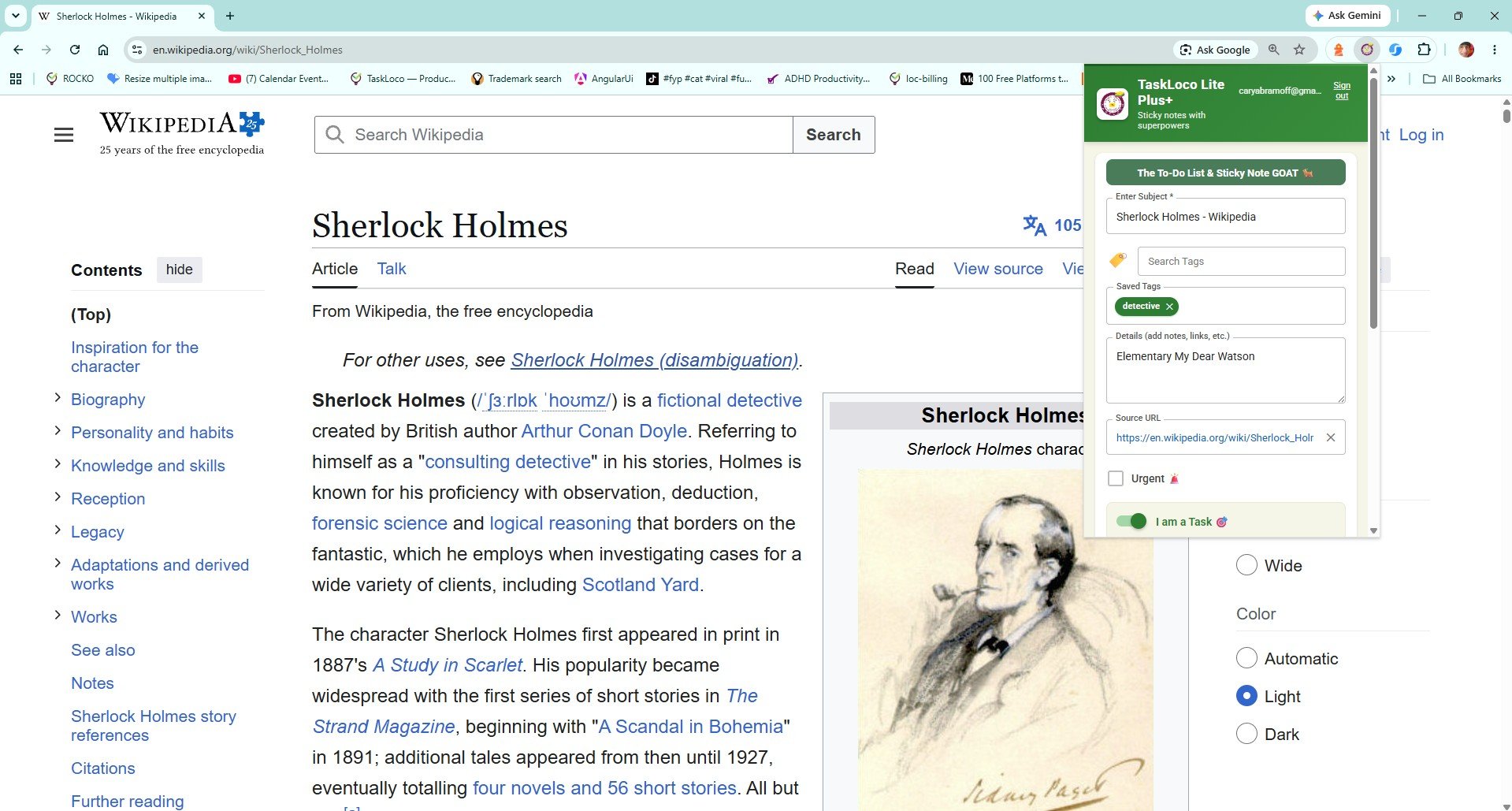
When you click the Sticky Note Web Clipper icon in your Chrome toolbar, it opens a small popup with the current page's title and URL already filled in. That's the starting point — not the ending point. Below those auto-filled fields, you have a note area. You type your thought: argues against the consensus in Section 3, check the sample size — might be too small, use this in the background section. Then you save. The whole interaction takes about ten seconds.
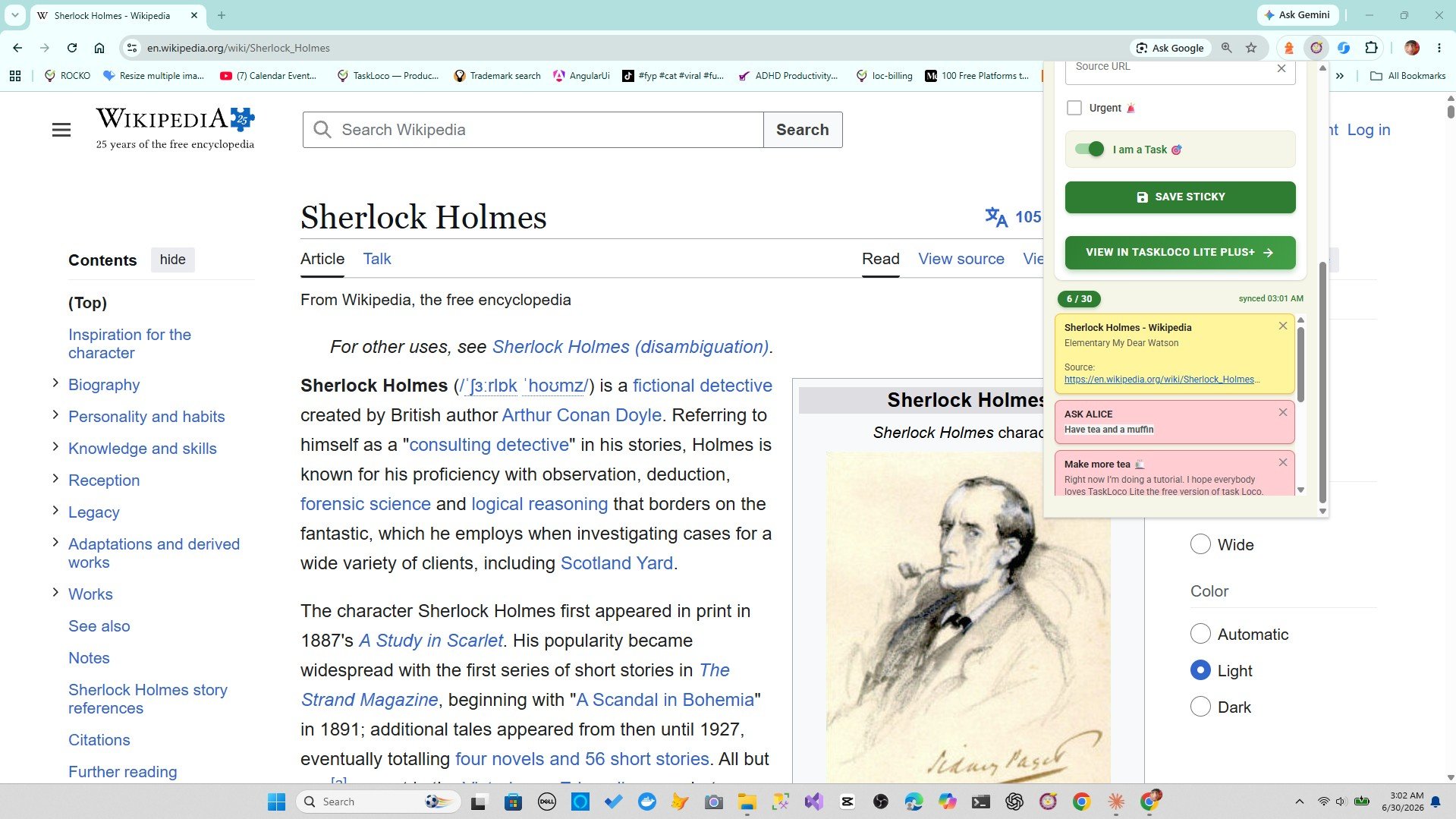
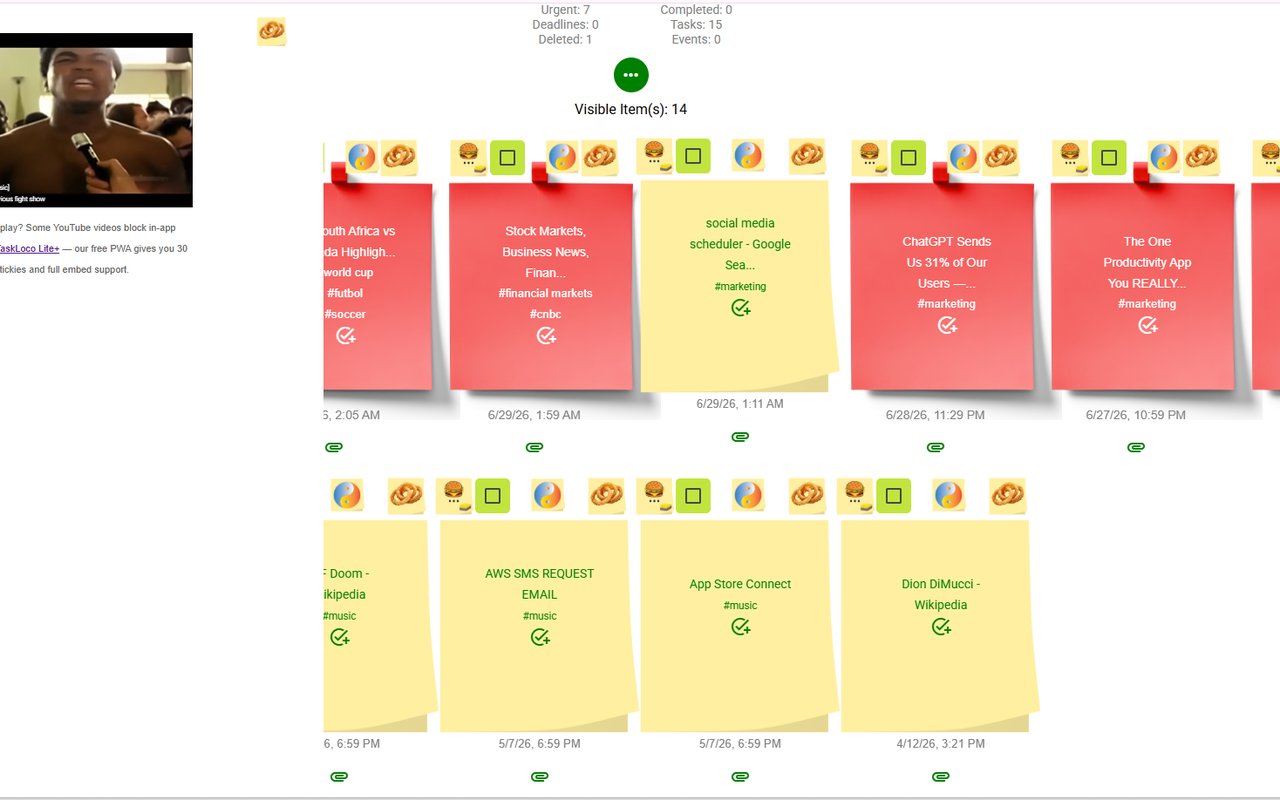
The result isn't a link in a list. It's a sticky note — a visual card that lives on your TaskLoco wall and shows you the title, your note, and the source URL at a glance. When you come back to your research a week later, you're not decoding a folder of anonymous bookmarks. You're scanning a wall of cards where each one already tells you what it is and why it's there.
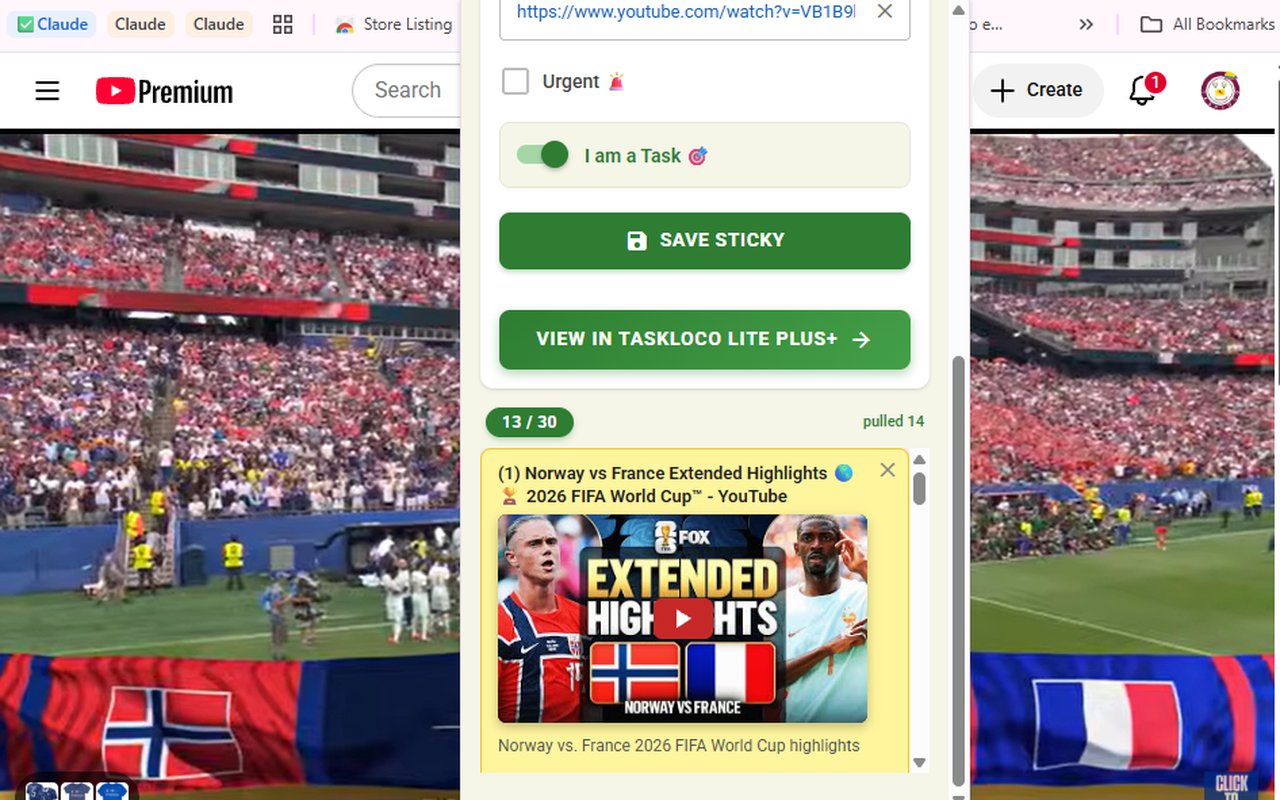
YouTube videos are a special case worth mentioning. If you clip a YouTube video — a lecture, a conference talk, a documentary clip relevant to your research — it embeds directly inside the sticky note. You can play it without leaving your research wall. That's genuinely useful when you're building a literature review that includes video sources alongside text articles.
Your notes sync to TaskLoco, which means they're available on your phone and desktop — not just in the browser session where you first saved them. If you find a source on your commute, it's waiting for you when you sit down to write.
Building a Research Archive That's Actually Usable Later
The difference between a research archive you trust and one you quietly stop using comes down to retrieval confidence. If you're not sure a source is in there, or you can't find it when you need it, you lose faith in the system and go back to tab-hoarding.
A few habits make the Sticky Note Web Clipper genuinely powerful as a research tool:
- Write the note before you close the tab. The moment you click save is the moment your context for that source is sharpest. Even one sentence — the methodology here is cleaner than the previous study — is worth more than any folder name you'll come up with later.
- Use tags for project-level organization. If you're running multiple research threads simultaneously, tags let you filter your wall to just the sources relevant to a specific paper or topic. Search works across your note text too, so the words you wrote when you saved become your search index later.
- Let the visual layout do the scanning work. Resist the urge to over-organize. The sticky note format is designed for fast visual scanning — you should be able to look at your wall and know what's there without reading every word. If a card doesn't make sense at a glance, that's a signal the note needs one more sentence.
- Clip as you go, not in batches. Research is more manageable when you capture sources immediately rather than trying to reconstruct your trail at the end of a session. The one-click save is fast enough that it doesn't interrupt your reading flow.
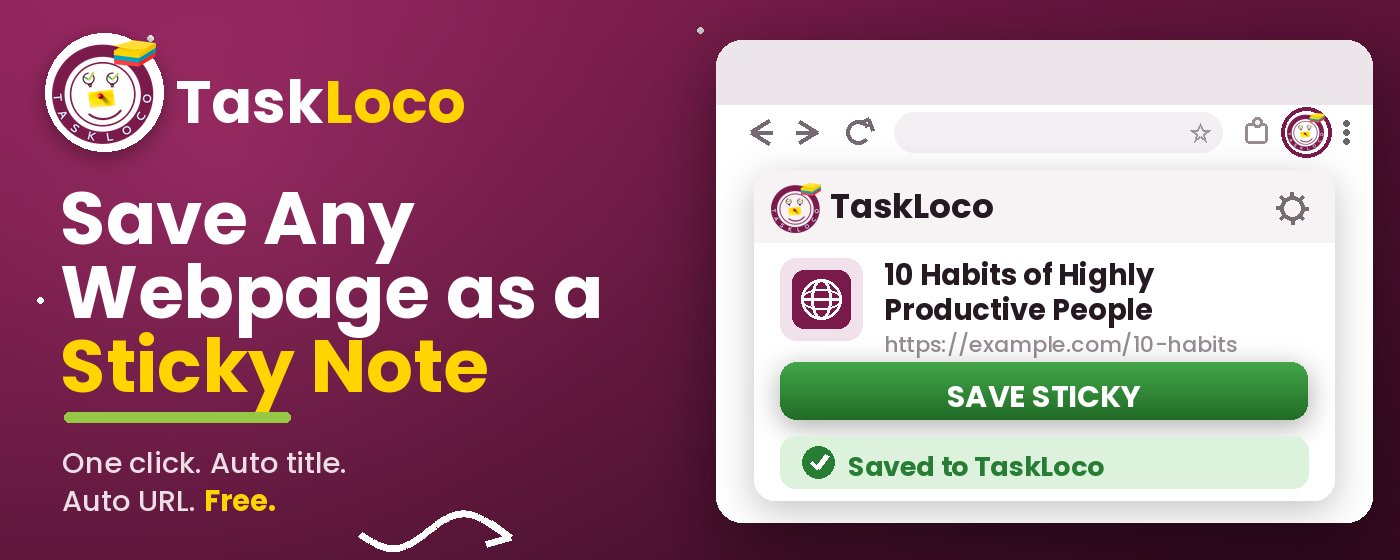
The Sticky Note Web Clipper is free. Install it from the Chrome Web Store, sign in with Google, and every page you clip becomes a sticky note you can find later.
Your clipped notes sync to TaskLoco across Chrome, desktop, iPhone, and Android — also free to start. No credit card to begin.
Get the Free Clipper
Sticky Note Web Clipper
- Free Chrome extension
- One-click save — any page, article, or video
- Title & URL auto-filled
- Tags & search
- Free forever
Synced to TaskLoco
- Sign in free with Google
- Your wall on Chrome, desktop, iPhone, Android
- YouTube videos embed & play in notes
- Visual sticky-note wall
- Free to start
Add It to Chrome — Free
One click saves any page, article, or YouTube video as a sticky note. Title and URL auto-filled.
Add to Chrome — FreeSee TaskLoco in Action
Frequently Asked Questions
Can I add my own note when I save a research article?
Yes — that's the core idea. When you click the Sticky Note Web Clipper icon in Chrome, the page title and URL are auto-filled, and you have a note field where you type your reason for saving it. Your note travels with the article every time you view it later.
Is the Sticky Note Web Clipper free?
Yes — the extension is completely free. TaskLoco also has a free tier. Install from the Chrome Web Store, sign in with Google, and start saving research articles with your notes attached.
What happens to my saved research articles if I close Chrome?
They're saved to your TaskLoco wall, not to your browser session. Close Chrome, restart your computer, switch to your phone — your notes are still there because they sync across devices via your free TaskLoco account.
Can I save YouTube videos as part of my research notes?
Yes. Clip a YouTube video the same way you'd clip any page. The video embeds inside the sticky note and plays directly from your research wall — useful for lectures, talks, or documentary footage you're referencing in your work.
How is this different from just bookmarking a research article?
Bookmarks capture the URL but nothing else — no note, no visual layout, no easy way to remember why something was saved. The Sticky Note Web Clipper saves the article as a visual card with your own note attached, so when you return to your sources later you immediately know what each one is and why it's there.
Can I search my saved research notes later?
Yes. You can search across your saved notes by title, URL, or the text of your own notes. You can also add tags to your sticky notes for project-level filtering, which is useful if you're running multiple research threads at the same time.
Does the clipper work on academic journal pages and news articles, not just regular websites?
It works on any webpage you can open in Chrome — academic journals, news sites, blog posts, PDFs opened in the browser, YouTube, and more. If Chrome can open it, you can clip it as a sticky note with one click.
Born in Brooklyn. Powered by AWS. Your data stays yours.
TaskLoco is available on iPhone, Android, Chrome, and every web browser.