Every productivity system ever invented is built around the same assumption: the list of things you haven't done yet is what matters. To-do apps, Kanban boards, GTD inboxes — they all measure your day by the gap between where you are and where you need to be. That gap is almost never zero. Which means most productivity tools, by design, end every day making you feel behind.
The Done List Method flips that. Instead of — or alongside — a to-do list, you keep a running record of what you actually finished. Tasks completed, decisions made, problems solved, conversations that moved something forward. It sounds almost embarrassingly simple, but the psychological and practical effects are real. This piece explains what the method is, why it works, and how to build the habit without overcomplicating it.
What Is the Done List Method — and Why Does It Work?
A done list is exactly what it sounds like: a record of things you completed, written down as you complete them or at the end of a day. No prioritization, no due dates, no status columns. Just a clear, honest log of output.
The reason it works comes down to how motivation actually functions. Research on the progress principle — most associated with Teresa Amabile's work at Harvard — shows that the single biggest driver of positive inner work life is making progress on meaningful work. Not finishing it. Not shipping the final version. Just moving forward. A done list makes that progress visible in real time. When your brain can see evidence of forward movement, it releases the low-grade anxiety that an unfinished to-do list constantly generates.
There's also a memory problem the done list solves. Most knowledge workers dramatically underestimate their own output at the end of a week. You handled seven issues, wrote a proposal, cleared a backlog of emails, unblocked a teammate — but what you remember is the one thing you didn't get to. A written done list is a correction for that bias. It's also genuinely useful at review time: performance reviews, client check-ins, and retrospectives all become easier when you have a real log of what happened.
Who benefits most? Anyone whose work is hard to quantify: writers, developers, managers, consultants, anyone doing creative or collaborative work where the output isn't always a concrete deliverable. If you frequently end the day feeling like you got nothing done despite being busy for eight hours, the done list is almost certainly the most useful single habit you can add.
How to Actually Run a Done List Day-to-Day
The method has almost no rules, which is both its strength and the reason people abandon it. Without a little structure, it turns into either a meaningless brain dump or something you forget to do entirely. Here's a practical framework that holds up over time.
1. Choose your capture format. The done list needs to live somewhere you'll actually look at it. Paper works for some people; a digital note works for others. The key is that it's separate from your to-do list — or at least visually distinct from it. Mixing the two defeats the psychological purpose. You want a space where everything written on it is already done.
2. Write as you go, not just at the end of the day. End-of-day recaps are better than nothing, but they rely on memory and they compress everything into a chore. The more effective habit is a quick note every time you close out something meaningful. Finished a draft? Write it down. Resolved a ticket? Write it down. Had a productive conversation? Write it down. The act of writing it in the moment is itself a small reward that reinforces the behavior.
3. Be specific enough to mean something later. "Did work" is useless. "Finished first draft of Q3 proposal" or "fixed the checkout bug that was blocking QA" is a real record. Specificity is what makes done lists valuable at review time and what makes them satisfying to read back.
4. Review weekly. At the end of the week, spend five minutes reading your done list. That's it. No analysis required. The act of reading it is the payoff — it recalibrates your sense of your own output and feeds directly into weekly planning.
5. Let it coexist with a to-do list. The done list isn't a replacement for planning. Most people who use it well run both in parallel: a to-do list for what's coming, a done list for what's behind them. Some use a physical notebook and simply draw a vertical line down the center of the page — left side for to-do, right side for done. The key is that they read and feel different.
Using TaskLoco as Your Done List Home Base
The done list is a low-friction practice by design, so the tool you use should match that energy. Anything that requires setup, configuration, or navigation overhead adds friction that erodes the habit. What you want is: open it, write it, done.
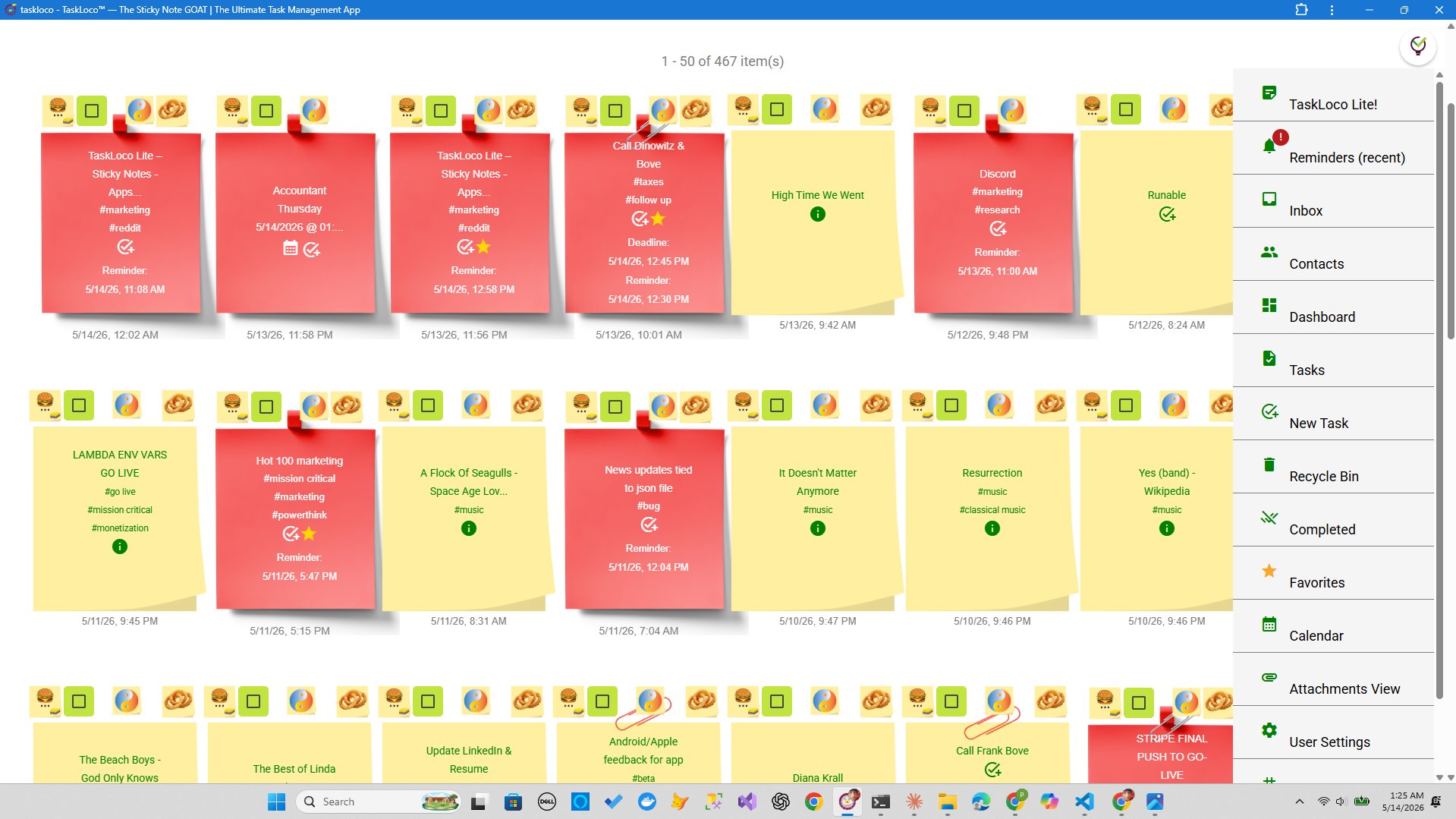
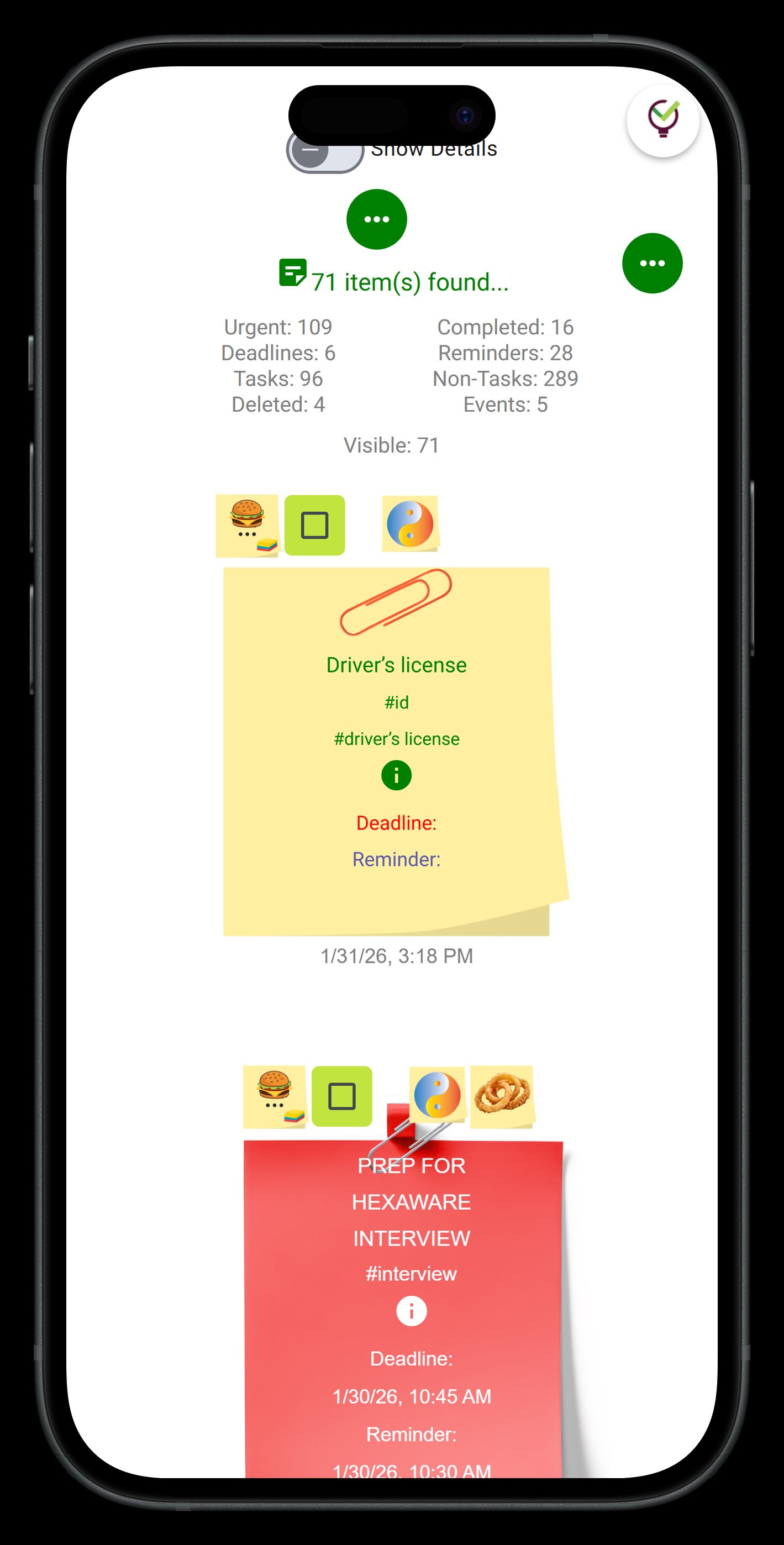
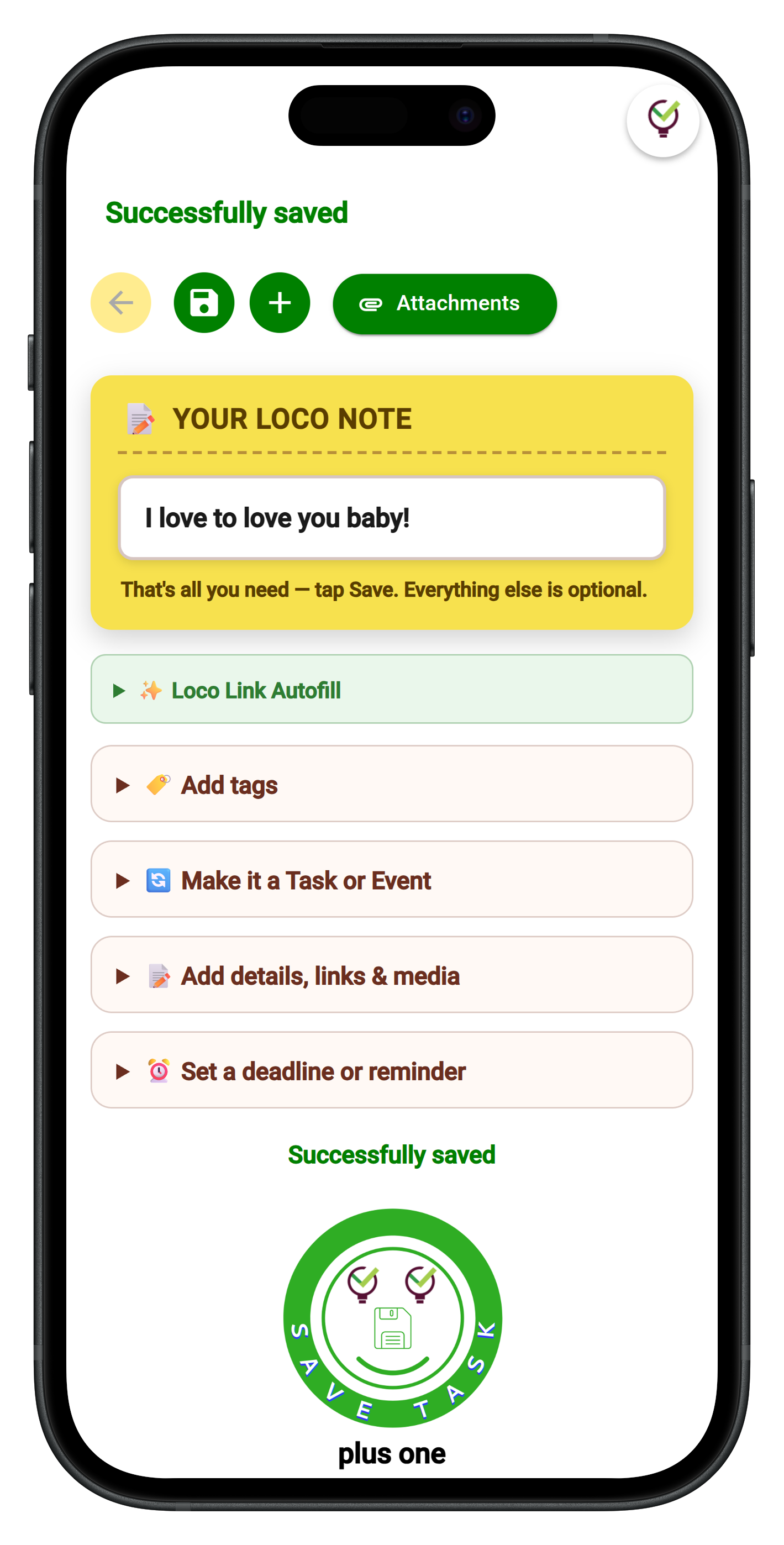
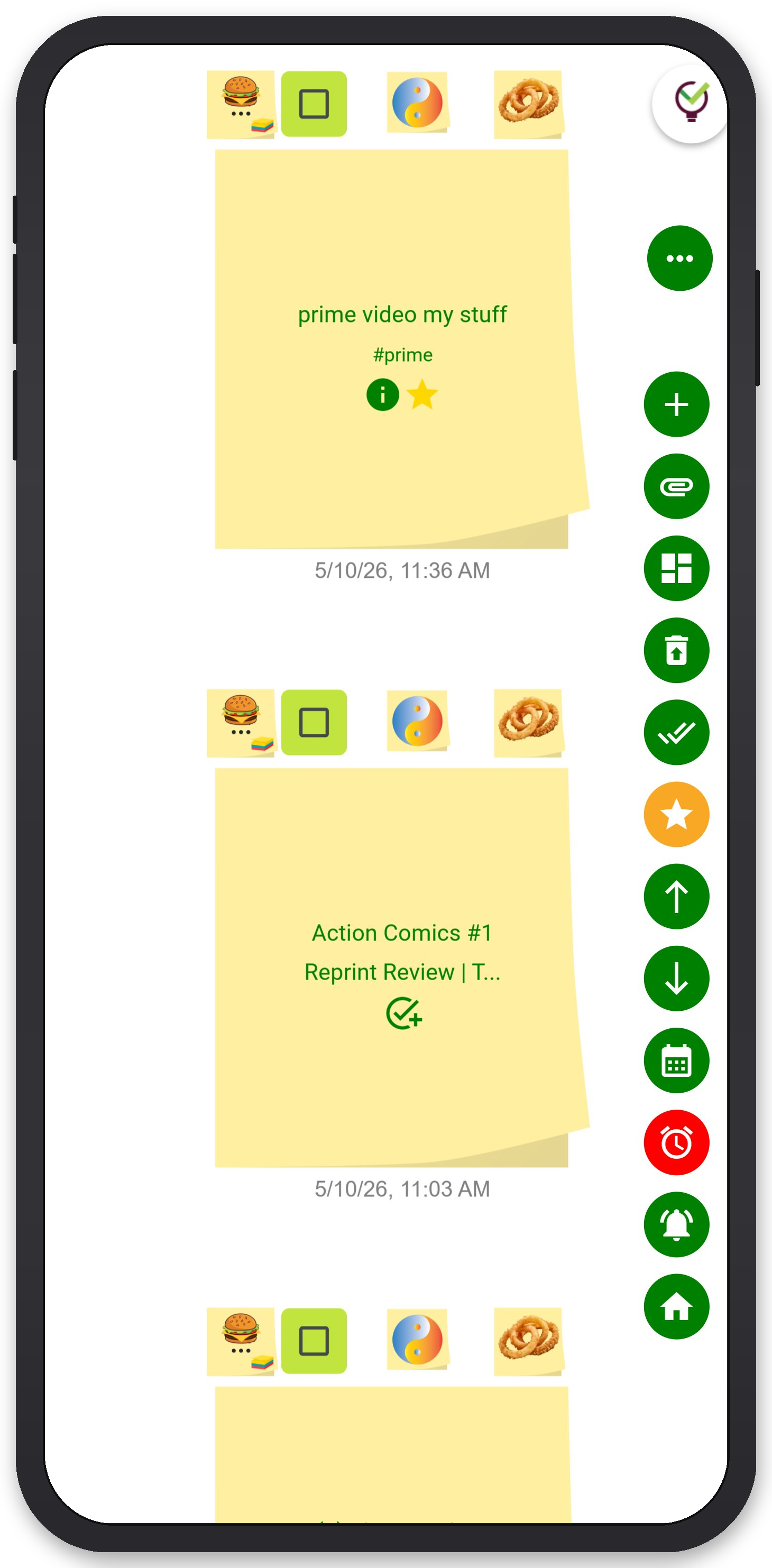
TaskLoco's sticky-note format maps almost perfectly onto how done lists actually work. Each completed item becomes its own note. You can organize notes across a visual wall — so your done list for Monday lives in one column, Tuesday in the next, and a weekly summary at the end. It's a spatial layout, not a flat text file, which makes it easier to scan and genuinely more satisfying to look at.
For people just getting started, TaskLoco Lite Plus+ (free, sign in with Google) gives you up to 30 synced notes across all your devices. That's plenty of room to run a done list for several weeks and test whether the habit sticks before committing to anything. Lite Plus+ syncs across devices via the web app, so a note you capture on your laptop shows up on your phone's browser when you check it later.
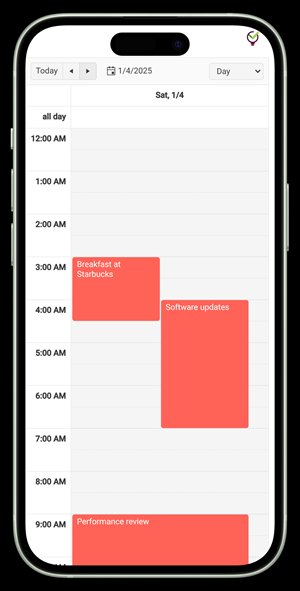
For people who want to take it further, TaskLoco Premium adds reminders delivered as push notifications that deep-link back to the original note, file attachments (10GB storage), a calendar view, unlimited notes, and full team sharing. Team sharing works the way you'd want it to: a shared note goes to a teammate who can clone it and make it their own — no permissions setup, no access levels to configure.
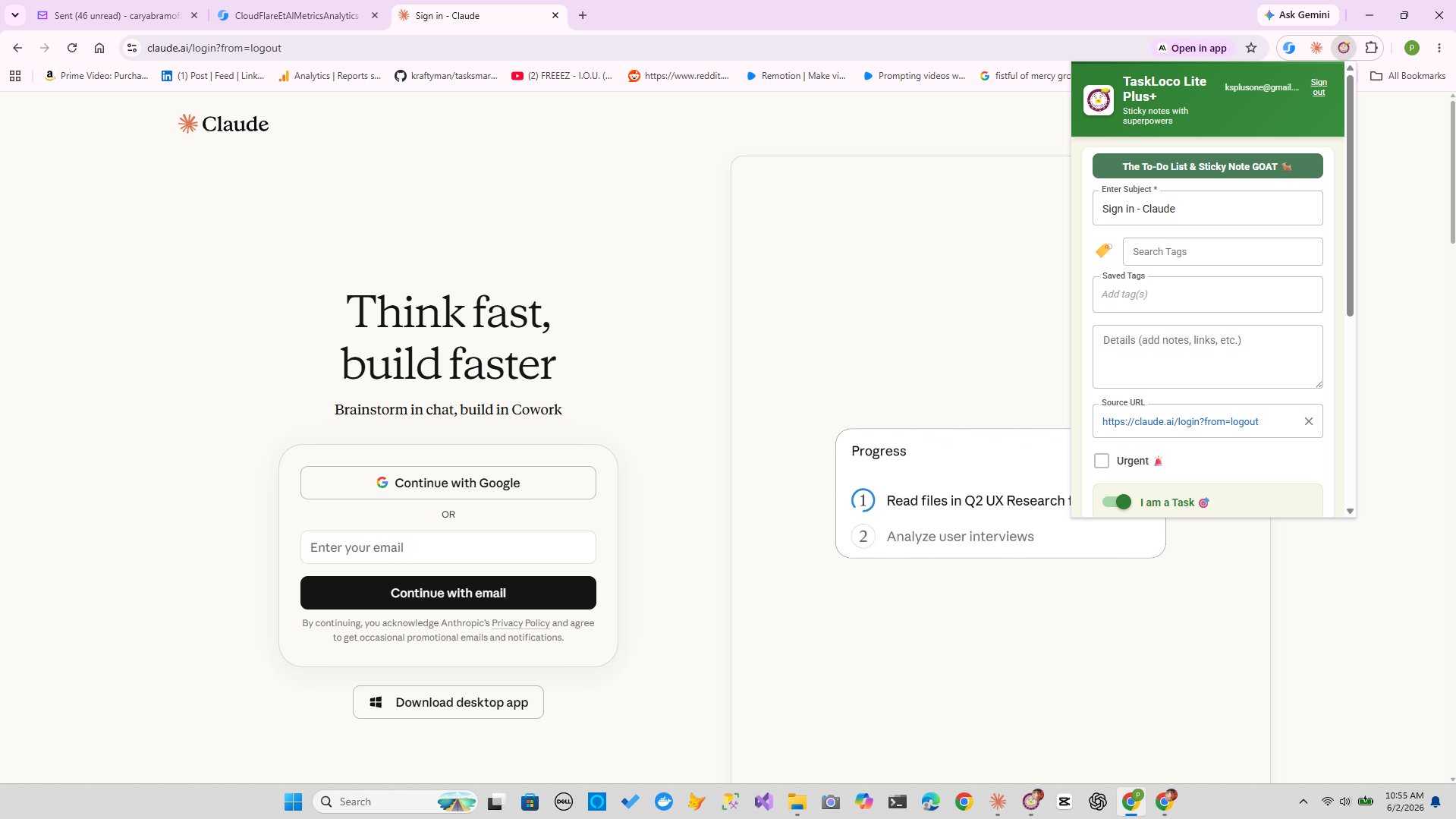
The Chrome extension is worth calling out specifically for done list users. One click captures any webpage — a finished article, a completed form, a resolved support thread — directly into a TaskLoco note. For people whose work happens largely in the browser, that single feature closes the gap between "I finished that" and "I wrote it down."
Common Done List Mistakes — and How to Avoid Them
The done list is simple enough that its failure modes are also simple. Most people who try it and quit make one of three mistakes.
Mistake 1: Making it a to-do list in disguise. If you find yourself writing things on your done list that aren't done yet — "need to follow up on X," "should finish Y" — you've drifted back into planning mode. That's not wrong, but it's a different tool. Keep the done list ruthlessly past-tense. Everything on it happened. If it hasn't happened, it doesn't belong there yet.
Mistake 2: Waiting until the end of the day to write anything. End-of-day capture requires you to remember a full day of work, which most people can't do accurately. More importantly, you lose the motivational hit of writing something down right when you finish it. That real-time capture is where a lot of the value lives. Build the micro-habit: finish something, open the app, write one line.
Mistake 3: Never reviewing it. A done list you never read is just journaling with worse prose. The weekly review — even just five minutes — is what converts the raw log into the feeling of progress. It's also what gives you material for performance conversations, retrospectives, and your own sense of whether you're spending time on things that matter.
Mistake 4: Going too granular or too broad. "Replied to an email" is usually too small to be worth logging. "Cleared inbox" might be. "Finished the entire migration project" is too broad to be useful — break it into the actual tasks that made it up. The right granularity is roughly: things that took 20 minutes or more and represent a real unit of work you'd want to remember.
TaskLoco Premium is regularly $9.99/month per person. Right now, charter members can lock in 50% off the regular price — forever. That means $4.99/month per person today. And if our price ever goes up, you still pay half. Always.
Code CHARTER50 auto-applies at checkout. First 500 spots only — once they're gone, this offer is gone permanently. Act fast while spots last.
Every Premium subscription includes unlimited notes, 10GB file storage, reminders, calendar, and team sharing. Each team member requires a separate subscription. 7-day free trial — no charge until day 8. Cancel anytime.
Free Options: TaskLoco
TaskLoco Lite
- Native iPhone & Android app
- Completely anonymous — no sign-in
- Data stays on your device
- Up to 20 notes
- Free forever
TaskLoco Lite Plus+
- Web app + Chrome extension
- Sign in with Google
- Wall syncs across all devices
- Up to 30 notes
- Free forever
Lock In 50% Off — Forever
7-day free trial. No charge until day 8. CHARTER50 auto-applies at checkout.
🔒 Lock In My Charter SpotSee TaskLoco in Action
Frequently Asked Questions
What is the Done List Method?
The Done List Method is a productivity practice where you record tasks and work as you complete them, rather than focusing solely on what's left to do. The result is a running log of your actual output — which reduces end-of-day anxiety, helps you remember your progress accurately, and gives you real material for reviews and retrospectives.
Is a done list the same as a to-do list?
No — they serve opposite functions. A to-do list is a plan: things you intend to do. A done list is a record: things you already finished. Many people run both simultaneously. The to-do list guides your day; the done list documents it. Mixing them together defeats the psychological purpose of the done list, which is to create a space where everything written is already behind you.
How is a done list different from journaling?
Journaling tends to be reflective and open-ended — processing thoughts, feelings, and experiences. A done list is strictly operational: a factual record of completed work. It's faster to write (one line per item), easier to scan back through, and directly useful for things like performance reviews or weekly retrospectives. You can absolutely combine both practices, but they're different tools.
What app should I use for a done list?
Any app that lets you capture a note quickly and review it easily works. The most important criterion is low friction — if it takes more than a few seconds to open and write, you'll stop doing it. TaskLoco's sticky-note format is a natural fit: each completed item becomes its own note on a visual wall, you can organize by day or week, and the Chrome extension lets you capture completed browser-based work in one click. TaskLoco Lite Plus+ is free and syncs across devices. TaskLoco Premium adds push notification reminders that deep-link back to your notes, file attachments, a calendar view, and unlimited notes. $9.99/month per person (currently $4.99/month per person for first 500 charter members with code CHARTER50)
How often should I review my done list?
A weekly review is the minimum that makes the habit worthwhile. Five minutes at the end of the week reading back through what you completed is usually enough to recalibrate your sense of your own output. If you do daily reviews too, keep them short — the goal is to register progress, not to analyze it. Monthly reviews are useful for spotting patterns in how you're spending your time.
Can a done list work alongside a Kanban board or project management tool?
Yes, and they complement each other well. A project management tool tracks work in progress and what's coming. A done list is personal — it captures your individual contribution and makes your output visible to you, regardless of where the task lives in the larger system. Many people keep their project work in a team tool and their personal done list in a separate simple app like TaskLoco.
Does the Done List Method work for creative work?
It works especially well for creative work, precisely because creative output is hard to quantify. A developer can count tickets closed; a writer can count words; but most creative work involves dozens of invisible decisions, drafts, and iterations that never appear on a traditional task list. A done list captures that invisible work — which is often the majority of what you actually did in a day. Writing 'revised opening section after feedback from client' is worth recording even if it never appeared on anyone's project board.
Born in Brooklyn. Powered by AWS. Your data stays yours.
TaskLoco is available on iPhone, Android, Chrome, and every web browser.