A snowball rolling downhill doesn't need more push with every rotation. Gravity does the work once the ball is moving, and mass accumulates automatically. Productivity researchers and behavioral scientists have borrowed this image to describe something they observe consistently in high performers: early, small wins don't just produce value on their own — they lower the activation energy for the next task, and the one after that.
This isn't motivational poster language. There are measurable psychological and neurological mechanisms behind it. Understanding those mechanisms explains why some people seem to get more done with less visible effort, why productivity systems succeed or collapse at predictable points, and why the hardest part of any productive day is almost always the first ten minutes of it.
Where The Idea Comes From
The snowball metaphor in productivity traces back at least to Warren Buffett, who used it to describe wealth compounding — but the underlying principle predates him by decades. In psychology, the mechanism closest to what people mean by the snowball effect is behavioral momentum, a concept developed from B.F. Skinner's operant conditioning research in the 1970s and formalized by John Nevin in 1988.
Nevin's behavioral momentum theory holds that a behavior that has been reinforced many times in a given context becomes resistant to disruption — it has, in a real sense, more mass. Applied to human productivity, this means that the more times you have successfully completed work in a particular context (a specific desk, a specific routine, a specific tool), the harder it becomes for distractions to interrupt you. The behavior has momentum.
A second mechanism is the Zeigarnik effect — the well-documented tendency for people to remember and mentally return to incomplete tasks more than completed ones. Starting a task, even partially, keeps it active in working memory and creates a mild psychological pull toward finishing it. This is why partially done work often gets finished faster than work that hasn't been started: the brain has already committed resources to it.
A third thread comes from self-determination theory. Completing tasks — especially tasks with clear, visible outcomes — satisfies the psychological need for competence. That satisfaction releases dopamine, which motivates further action. The reward isn't external; it's generated by the act of completion itself. This is the neurological engine behind the snowball.
Why It Works — And The Conditions It Needs
The snowball effect doesn't activate automatically. It requires specific conditions, and understanding those conditions explains why identical advice produces wildly different results for different people.
1. The starting task must be genuinely completable. Behavioral momentum builds on reinforcement — on the experience of finishing. A task framed as 'work on the project' is essentially incompletable; there's no moment of closure to trigger the dopamine response. A task framed as 'write the opening paragraph' has a finish line. The granularity of task definition is not a minor detail; it is the mechanism.
2. The early tasks must be easy enough to start. The snowball has to start rolling before gravity can take over. This is the logic behind the advice to begin a difficult day with two or three quick wins — not because those tasks are the most important, but because completion itself is the fuel. James Clear's popularization of habit stacking and the 'two-minute rule' in Atomic Habits is essentially an application of this principle.
3. Completed work must be visible. The feedback loop depends on seeing what you've done. Research on progress and motivation consistently shows that perceived progress — even more than actual progress — drives engagement. When completed tasks disappear from view or are filed away invisibly, the accumulating sense of momentum is lost. Systems that keep completed work visible, at least briefly, feed the loop more effectively than those that immediately archive it.
4. Interruptions reset the momentum, but not to zero. This is an important nuance that the snowball metaphor handles poorly. A real snowball hit by a tree stops. A person interrupted mid-flow doesn't forget everything — but the re-entry cost is real. Gloria Mark's research at UC Irvine found that after an interruption, it takes an average of over 20 minutes to fully return to a task. Momentum isn't destroyed by interruption, but it does require rebuilding, which is why environment design (minimizing likely interruptions) matters as much as task design.
Where The Snowball Effect Breaks Down
The snowball metaphor is useful, but it obscures some real failure modes worth understanding honestly.
Momentum toward the wrong things. Behavioral momentum is direction-agnostic. A person who builds strong momentum around answering emails or attending meetings can be extremely productive in a neurological sense — completing tasks, receiving reinforcement, building mass — while making zero progress on their most important work. The snowball rolls where it was aimed at the start. If the first task is low-stakes busy work, the momentum it generates often carries you deeper into low-stakes busy work.
The plateau problem. Compounding productivity growth is real but not infinite. Beyond a certain threshold, adding more tasks to a system doesn't accelerate output — it creates coordination overhead, decision fatigue, and context-switching costs that consume the gains. This is partly why productivity systems that work well at ten tasks a day collapse at fifty. The snowball gets too heavy to steer.
Recovery after disruption. Extended disruptions — illness, major life events, long vacations — don't just pause momentum; they can dissolve the contextual cues that were maintaining the habit loop. Returning to a productivity system after a two-week break often feels like starting from scratch, which is neurologically fairly accurate. The mass has to be rebuilt, and this is usually harder than the original build because the person now knows what momentum felt like and experiences its absence acutely.
The illusion of productivity. High momentum can feel like high output even when the output isn't high. The dopamine hit from completing small tasks is real regardless of those tasks' actual value. This is the mechanism behind 'productivity theater' — the genuinely satisfying experience of crossing things off a list that didn't need to be on the list. Awareness of this failure mode doesn't fully prevent it, but it does help explain why the composition of a task list matters as much as its length.
Applying The Principle: TaskLoco's Role In Building Momentum
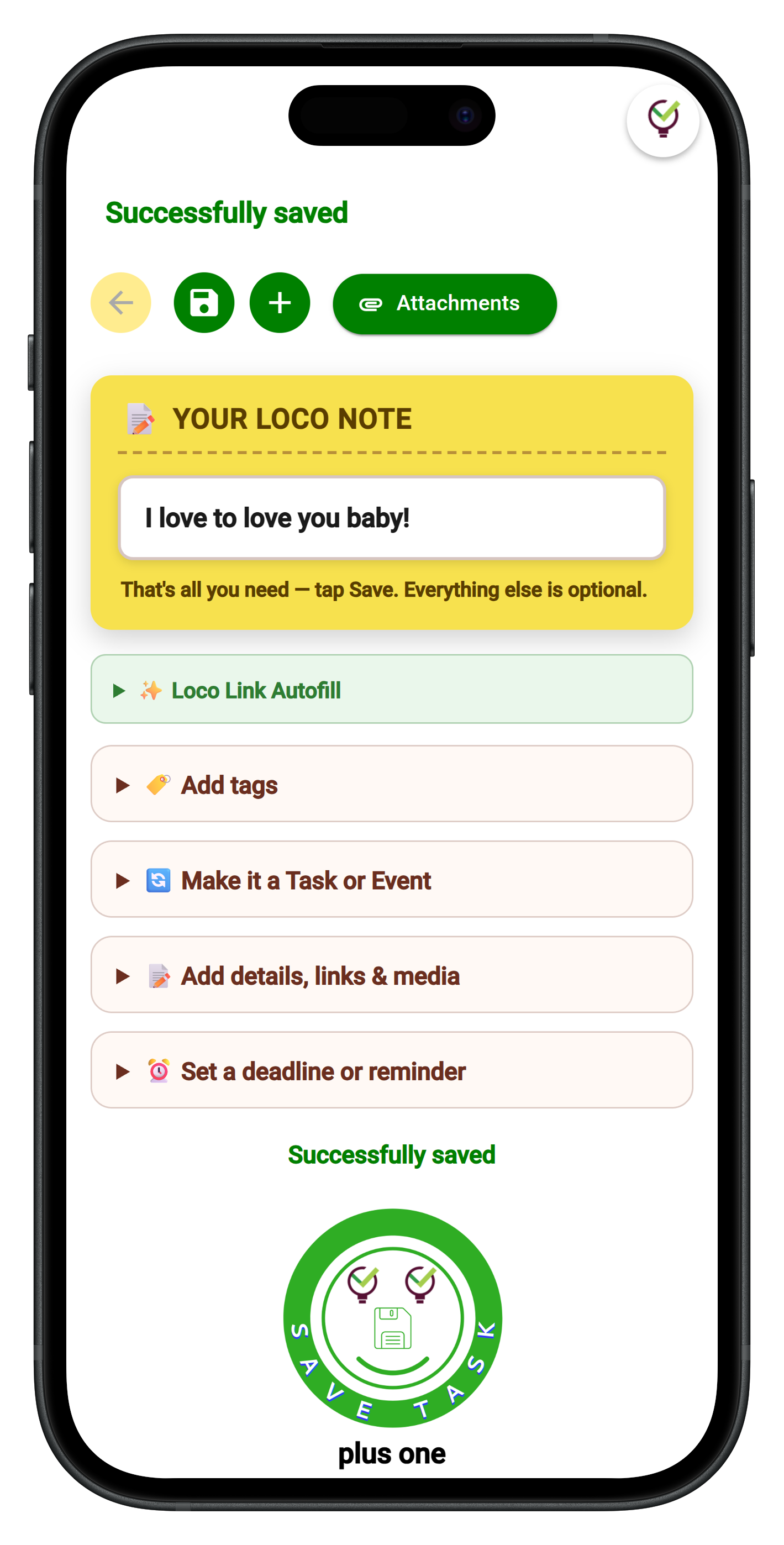
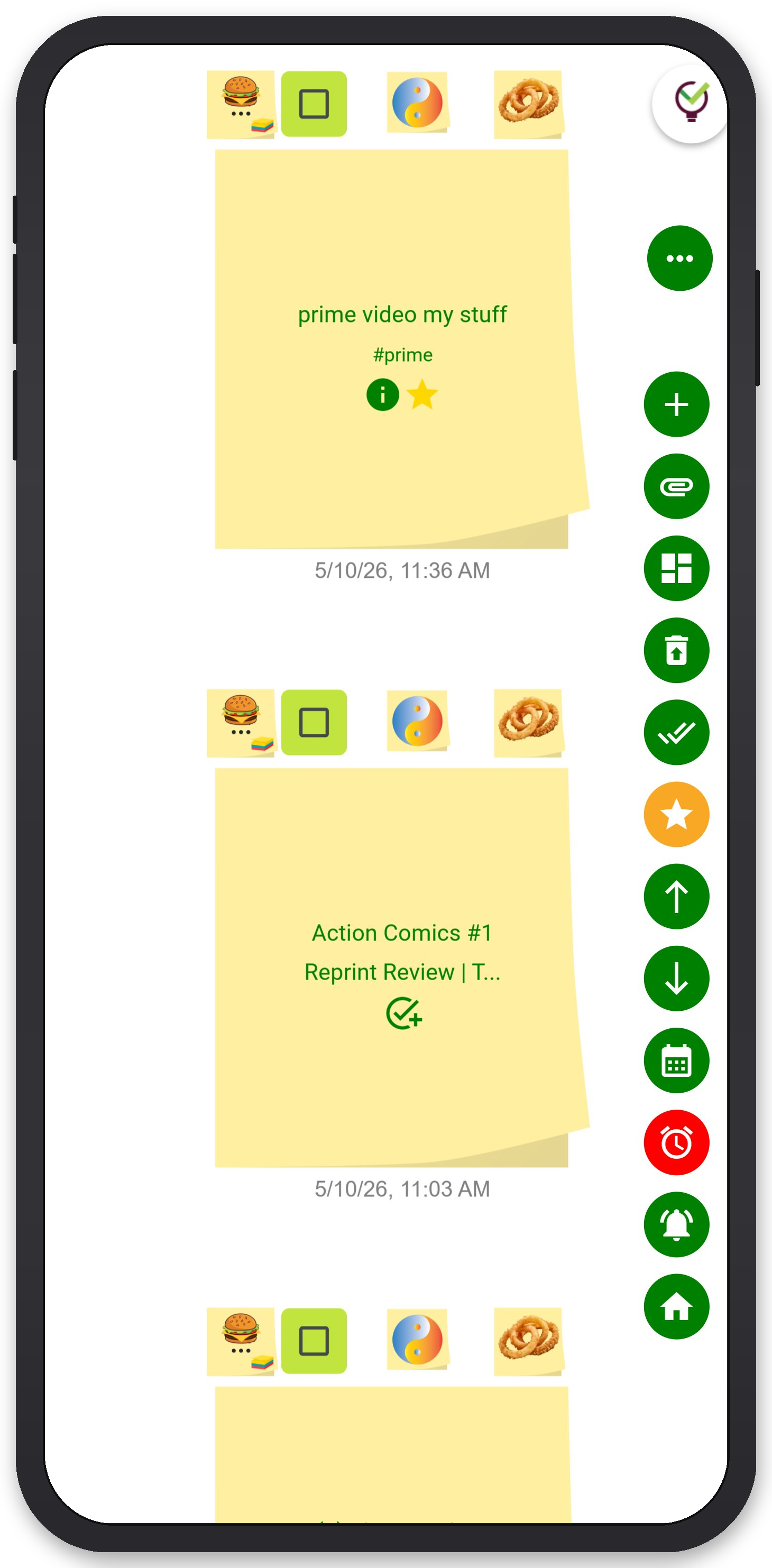
TaskLoco was built around the sticky note — the original low-friction task artifact. There's a reason people have pinned paper notes to monitors for decades: the physical act of writing a note is fast, the note stays visible, and crossing it off or removing it creates a small but real sense of completion. TaskLoco's design preserves that psychology in a digital system.
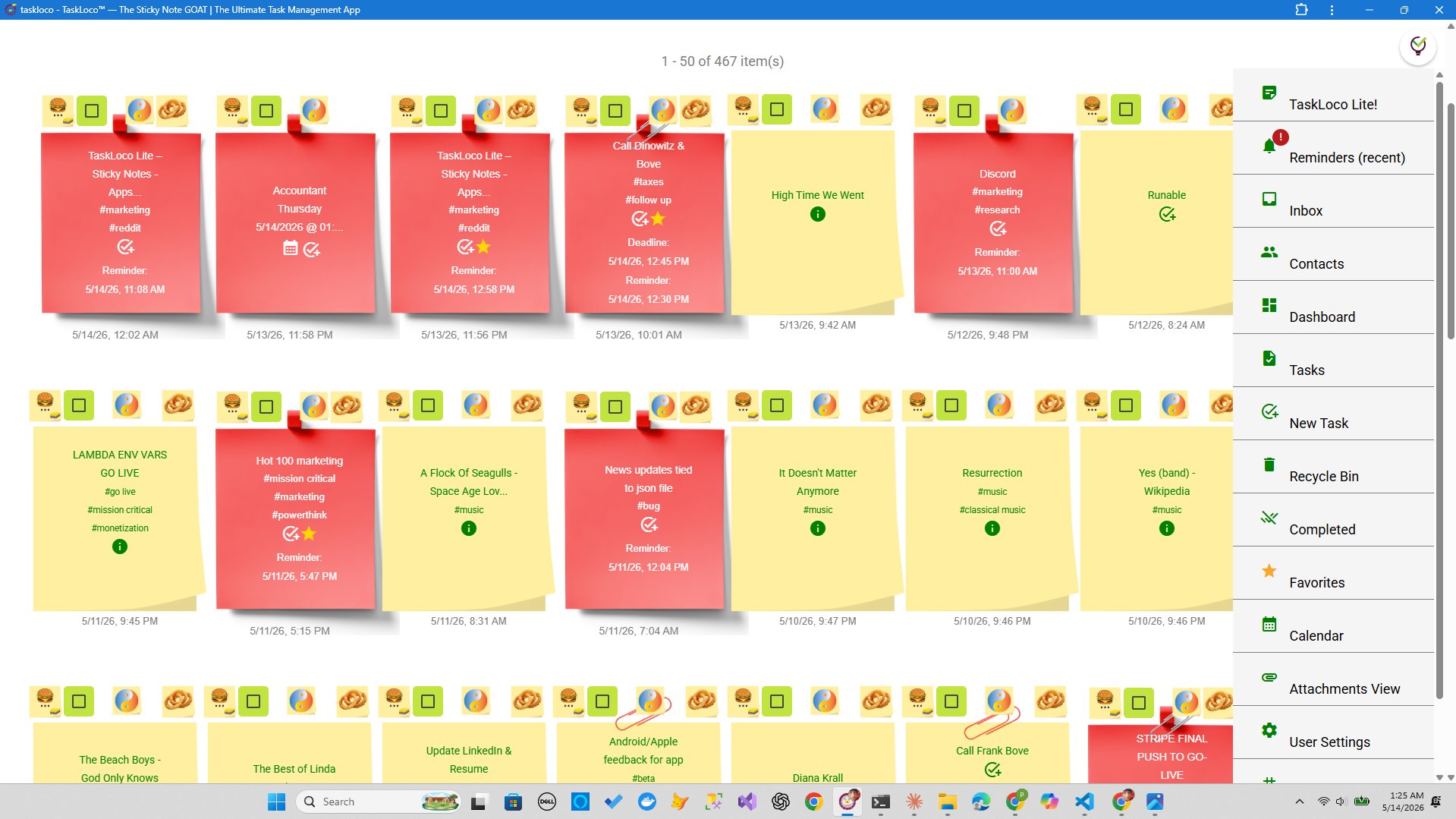
The wall view keeps your tasks visible, which matters for the progress feedback loop described above. Notes don't vanish into a folder hierarchy after you create them — they sit in front of you until you clear them. That visibility supports the same mechanism the research describes: perceived progress drives continued action.
TaskLoco Premium adds reminders that deliver as push notifications directly to your phone and computer — with an optional email channel and optional SMS add-on. Each reminder deep-links back to the original note, so you land in context instantly rather than hunting for what you were supposed to do. That re-entry speed matters: the faster you can get back to a task after an interruption, the less momentum you lose.
Team sharing in Premium works the way email does — recipients can clone a shared note and make it their own, no permissions setup required. For teams trying to build shared momentum on a project, getting everyone oriented around the same note quickly reduces the coordination overhead that kills group productivity snowballs before they start.
TaskLoco Premium is regularly $9.99/month per person. Right now, charter members can lock in 50% off the regular price — forever. That means $4.99/month per person today. And if our price ever goes up, you still pay half. Always.
Code CHARTER50 auto-applies at checkout. First 500 spots only — once they're gone, this offer is gone permanently. Act fast while spots last.
Every Premium subscription includes unlimited notes, 10GB file storage, reminders, calendar, and team sharing. Each team member requires a separate subscription. 7-day free trial — no charge until day 8. Cancel anytime.
Free Options: TaskLoco
TaskLoco Lite
- Native iPhone & Android app
- Completely anonymous — no sign-in
- Data stays on your device
- Up to 20 notes
- Free forever
TaskLoco Lite Plus+
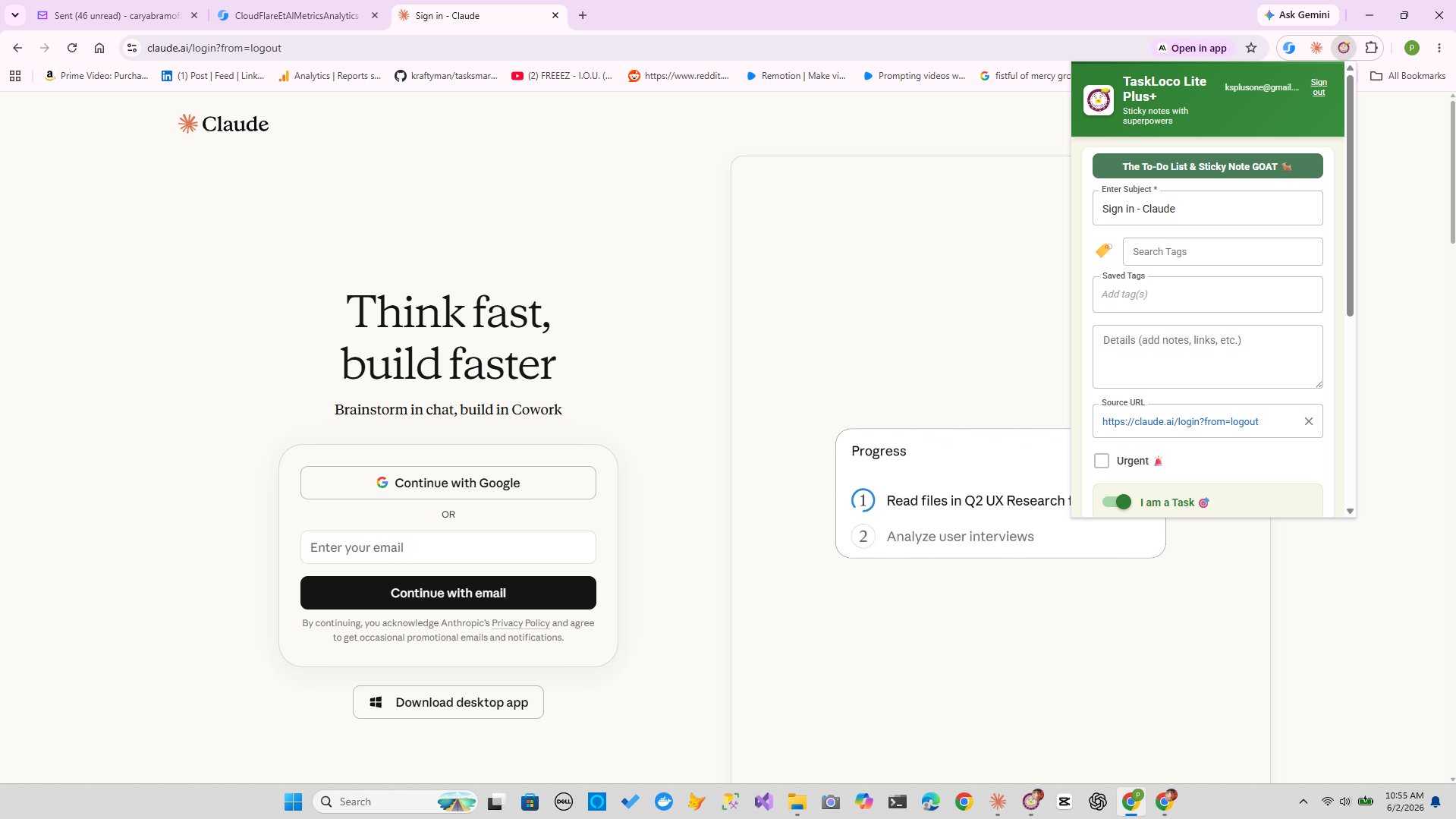
- Web app + Chrome extension
- Sign in with Google
- Wall syncs across all devices
- Up to 30 notes
- Free forever
Lock In 50% Off — Forever
7-day free trial. No charge until day 8. CHARTER50 auto-applies at checkout.
🔒 Lock In My Charter SpotSee TaskLoco in Action
Frequently Asked Questions
What is the snowball effect of productivity?
The snowball effect of productivity is the phenomenon where completing tasks builds psychological momentum that makes subsequent tasks easier to start and finish. It's grounded in behavioral momentum theory, the Zeigarnik effect, and the neurological rewards of task completion. Small early wins lower the activation energy for larger work, so effort per unit of output decreases as momentum builds.
Why does momentum make productivity easier over time?
Each completed task triggers a dopamine response that reinforces the behavior of working. Over time, the brain associates the work context with reward, making it easier to enter a productive state in that context. Behavioral momentum theory describes this as increased resistance to disruption — the more reinforced a behavior is, the harder it is to interrupt.
How do you start the snowball effect when you have no motivation?
Start with the smallest genuinely completable task you can identify — something with a clear finish line that takes under five minutes. The goal isn't to produce meaningful output immediately; it's to generate the first completion event that triggers the feedback loop. The two-minute rule and the 'just start' principle both work through this mechanism. Motion creates motivation more reliably than motivation creates motion.
Can the snowball effect work against you?
Yes. Behavioral momentum is direction-agnostic — it builds just as effectively toward low-value busy work as toward important work. If your early tasks are emails and administrative tasks, momentum will carry you deeper into emails and administrative tasks. The composition of your task list matters as much as completing it. High momentum toward the wrong work is a well-documented productivity failure mode.
How does task visibility affect productivity momentum?
Research on motivation consistently shows that perceived progress drives engagement as strongly as actual progress. When completed tasks are immediately archived or hidden, the visual accumulation of done work disappears — and with it, a significant part of the feedback loop. Systems that keep completed work visible, at least temporarily, sustain momentum more effectively than systems that instantly remove finished items from view.
Does TaskLoco support building daily momentum?
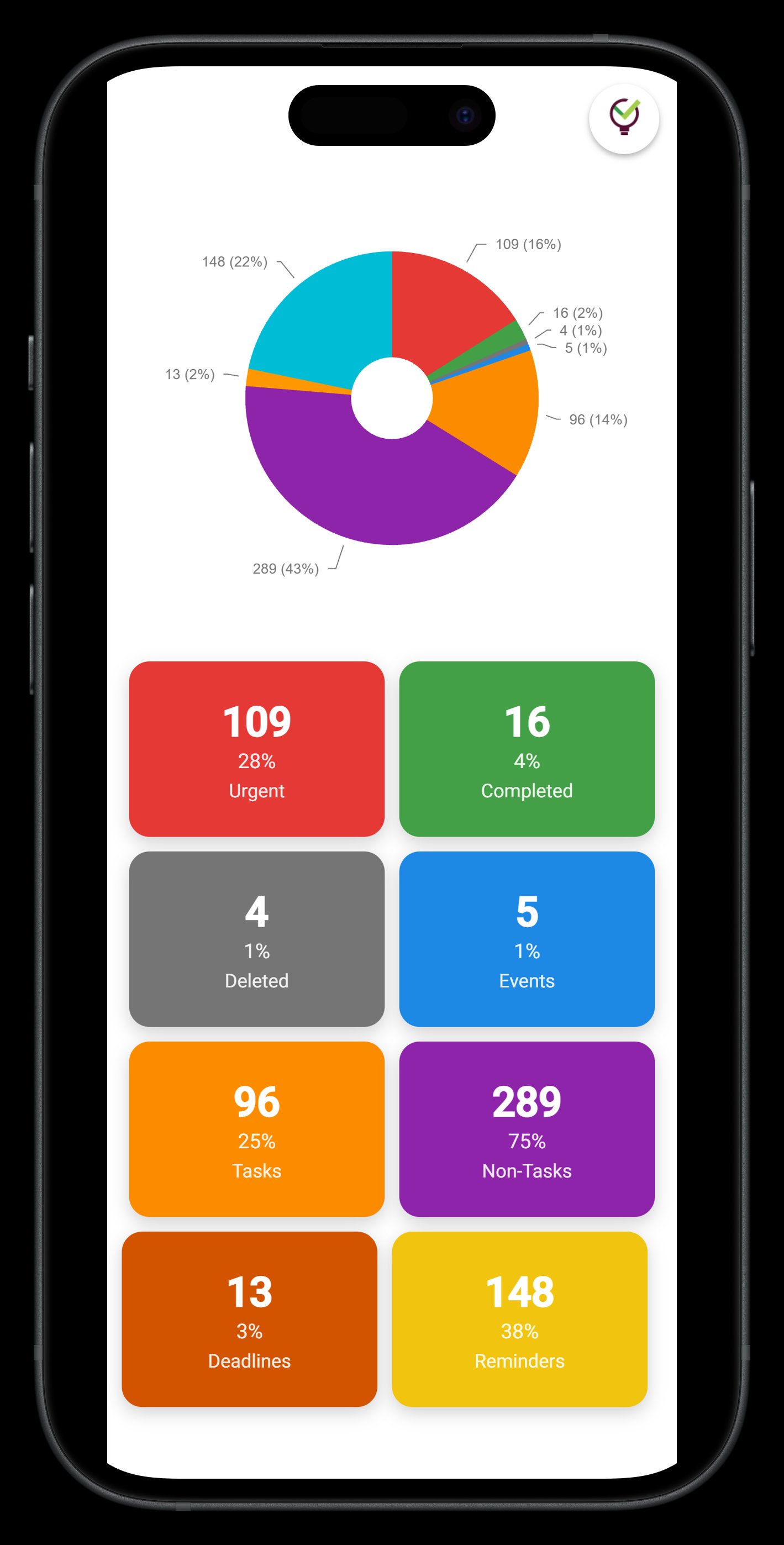
TaskLoco's wall view keeps your tasks visible rather than buried in folders, which supports the progress feedback loop central to momentum. Premium adds reminders delivered as push notifications that deep-link back to the original note — so interruptions cost less re-entry time. TaskLoco is designed for low-friction task capture and visibility, which addresses the two biggest momentum killers: high activation energy at the start and high re-entry cost after interruption. $9.99/month per person (currently $4.99/month per person for first 500 charter members with code CHARTER50)
What breaks the snowball effect and how do you recover?
The main breakers are: extended disruptions (illness, vacation, major life events) that dissolve contextual habit cues; task lists full of vague, incompletable items that can never produce a completion event; and momentum that accumulates toward low-value work. Recovery after a long break usually means restarting deliberately small — treating it like a first build rather than a resumption, because neurologically, that's what it is.
Born in Brooklyn. Powered by AWS. Your data stays yours.
TaskLoco is available on iPhone, Android, Chrome, and every web browser.